Brunei sultan calls for ‘stronger’ Islam, as Shariah laws to enter force

1 / 4
A handout photo made available by Brunei Prime Ministers Office shows Brunei's Sultan Hassanal Bolkiah (C) as he attends the Golden Jubilee ceremony in the Throne Hall, Istana Nurul Iman, marking 50 years on the throne in Bandar Seri Begawan, Brunei, 05 October 2017.
2 / 4
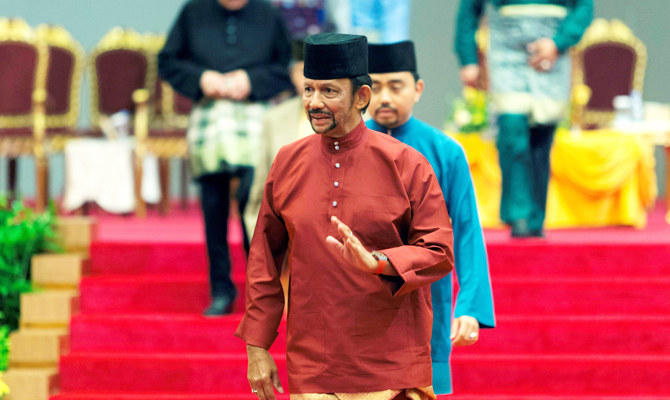
Brunei's Sultan Hassanal Bolkiah (C) leaves after speaking at an event in Bandar Seri Begawan on April 3, 2019. (AFP)
3 / 4
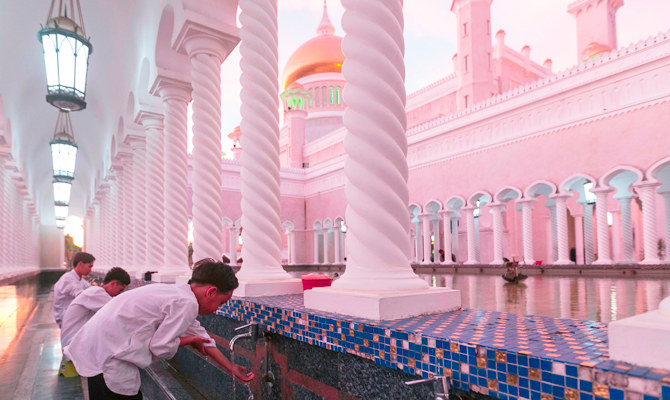
In this picture taken on April 1, 2019 children perform ablution before praying at the Sultan Omar Ali Saifuddien mosque in Bandar Seri Begawan. (AP)
4 / 4
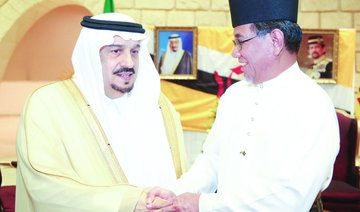
Muslim women listen to Brunei's Sultan Hassanal Bolkiah's speech during an event in Bandar Seri Begawan on April 3, 2019. (AFP)
Updated 03 April 2019
Follow

Brunei sultan calls for ‘stronger’ Islam, as Shariah laws to enter force

  • Rape and robbery are also punishable by death under the code and many of the new laws, such as capital punishment for insulting the Prophet Muhammad, apply to non-Muslims as well as Muslims
  • The government previously announced the new code would fully come into force Wednesday

BANDAR SERI BEGAWAN, Brunei: Brunei’s sultan called for Islamic teachings in the country to be strengthened as strict new Shariah punishments, including death by stoning for gay sex and adultery, were due to come into force on Wednesday.
The tough penal code in the tiny country on tropical Borneo island — ruled by the all-powerful Sultan Hassanal Bolkiah — is set to be fully implemented following years of delays.
The laws, which also include amputation of hands and feet for thieves, will make Brunei the first place in East or Southeast Asia to have a Shariah penal code at the national level, joining several mostly Middle Eastern countries such as Saudi Arabia.
Rape and robbery are also punishable by death under the code and many of the new laws, such as capital punishment for insulting the Prophet Muhammad, apply to non-Muslims as well as Muslims.
The decision to push ahead with the punishments has sparked alarm around the world, with the United Nations labelling them “cruel and inhumane” and celebrities, led by actor George Clooney and pop star Elton John, calling for Brunei-owned hotels to be boycotted.
In a public address to mark a special date in the Islamic calendar, the sultan called for stronger Islamic teachings but did not mention the new penal code.
“I want to see Islamic teachings in this country grow stronger,” he said in the nationally televised speech at a convention center near the capital Bandar Seri Begawan.
“I would like to emphasize that the country of Brunei is a... country that always devotes its worship to Allah.”
He said that he wanted the Muslim call to prayer to ring out in all public places, not just in mosques, to remind people of their Islamic duties.
The sultan, who has been on the throne for over five decades, also insisted that Brunei was a “fair and happy” country.
“Anyone who comes to visit this country will have a sweet experience, and enjoy the safe and harmonious environment,” he said.
Officials did not immediately confirm that the Shariah penal code had entered into force. At the weekend, the Brunei government said in a statement that the new punishments would be enforced from Wednesday.

The tough punishments have triggered worldwide condemnation.
Phil Robertson, deputy Asia director at Human Rights Watch, said the code was “barbaric to the core, imposing archaic punishments for acts that shouldn’t even be crimes.”
The sultan — who is one of the world’s wealthiest men and lives in a vast, golden-domed palace — announced plans for the code in 2013.
The new laws make sex between men punishable by death by stoning. For women convicted of having sexual relations with other women, the maximum punishment is 40 strokes of the cane or a maximum 10-year jail term.
The first section of the code was introduced in 2014 and included less stringent penalties, such as fines or jail terms for offenses including indecent behavior or skipping Friday prayers.
Clooney’s call to boycott nine Brunei-owned hotels in Europe and the United States last week catapulted the issue into the international headlines.
Since then, a series of well-known figures have lined up to add their names to the chorus of condemnation, including former US vice president Joe Biden and actress Jamie Lee Curtis.
Governments have weighed in, with the United States saying the punishments run counter to Brunei’s “international human rights obligations.”
“The United States strongly opposes violence, criminalization and discrimination targeting vulnerable groups,” said deputy State Department spokesman Roberto Palladino.
The sultan, who is the world’s second-longest reigning monarch, first called for the penal code in the late 1990s and it appears to enjoy broad support in the former British protectorate of about 400,000 people.
Analysts say he is seeking to burnish his Islamic credentials and shore up support among the country’s conservatives due to the waning fortunes of the oil-dependent economy, which has been ravaged by recession in recent years.
It is also unclear whether death by stoning will actually be implemented, as a high burden of proof is needed to hand down the punishment and Brunei has not executed anyone for decades.


Russia slams Western peacekeeping plan for Ukraine

Updated 4 sec ago
Follow

Russia slams Western peacekeeping plan for Ukraine

  • “The new militarist declarations of the so-called Coalition of the Willing and the Kyiv regime together form a genuine ‘axis of war’,” Zakharova
  • She called the plans drafted by Kyiv’s allies “dangerous” and “destructive“

MOSCOW: Russia on Thursday slammed a plan for European peacekeepers to be deployed to Ukraine as “dangerous” and dubbed Kyiv and its allies an “axis of war,” dousing hopes the plan could be a step toward ending the almost four-year-war.
US President Donald Trump has been pushing the warring sides to strike a deal to halt the conflict, running shuttle diplomacy between Ukraine’s Volodymyr Zelensky and Russia’s Vladimir Putin in a bid to get an agreement across the line.
An initial 28-point plan which largely adhered to Moscow’s demands was criticized by Kyiv and Europe, and now Russia has slammed the attempts to beef-up protections for Ukraine should an elusive deal be reached.
Ukraine’s allies said they had agreed key security guarantees for Kyiv at a summit in Paris earlier this week, including a peacekeeping force.
But in its first comments since the summit, Moscow said the statements were far away from anything the Kremlin could accept to end its assault.
“The new militarist declarations of the so-called Coalition of the Willing and the Kyiv regime together form a genuine ‘axis of war’,” Russia’s foreign ministry spokeswoman Maria Zakharova said in a statement.
She called the plans drafted by Kyiv’s allies “dangerous” and “destructive.”
The remarks come as Russian strikes plunged hundreds of thousands in Ukraine into darkness, leaving families without heat in below-freezing temperatures — attacks that Zelensky said showed Russia was still set on war.

- ‘Legitimate military targets’ -

European leaders and US envoys announced earlier this week that post-war guarantees for Ukraine would include a US-led monitoring mechanism and a European multinational force to be deployed when the fighting stops.
But Moscow has repeatedly warned that it would not accept any NATO members sending peacekeeping troops to Ukraine.
“All such units and facilities will be considered legitimate military targets for the Russian Armed Forces,” Zakharova said Thursday, repeating a threat previously uttered by Putin.
Zelensky also said Thursday that a bilateral agreement between Kyiv and Washington for US security guarantees was “essentially ready for finalization at the highest level with the President of the United States” following talks between envoys in Paris this week.
Kyiv says legally-binding assurances that its allies would come to its defense are essential to convince Russia not to re-attack if a ceasefire is reached.
But specific details on the guarantees, the European force, and how it would engage have not been made public.
Zelensky said earlier this week he was yet to receive an “unequivocal” answer of what they would do if Russia does attack again after a deal.
Zelensky has also said that the most difficult questions in any settlement — territorial control of the eastern Donbas region and the fate of the Russian-occupied Zaporizhzhia nuclear power plant — were still unresolved.

- Russian strikes cut heating -

Ukraine was meanwhile scrambling to restore heating and water to hundreds of thousands of households after a new barrage targeted energy facilities in its Dnipropetrovsk and Zaporizhzhia regions.
“This is truly a national level emergency,” Borys Filatov, mayor of Dnipropetrovsk’s capital Dnipro, said on Telegram.
He announced power was “gradually returning to the hospitals” after the blackouts forced them to run on generators. The city authorities also extended school holidays for children.
About 600,000 households in the region remained cut off from power in Dnipropetrovsk, Ukrainian energy company DTEK said.
In a post on social media, Zelensky said the attacks “clearly don’t indicate that Moscow is reconsidering its priorities.”
In addition to the unrelenting pummelling of Dnipropetrovsk, Russia pressed on with its ground assault on the region, claiming to have taken another village there.
It is not one of the five Ukrainian regions that Moscow claims to have annexed.