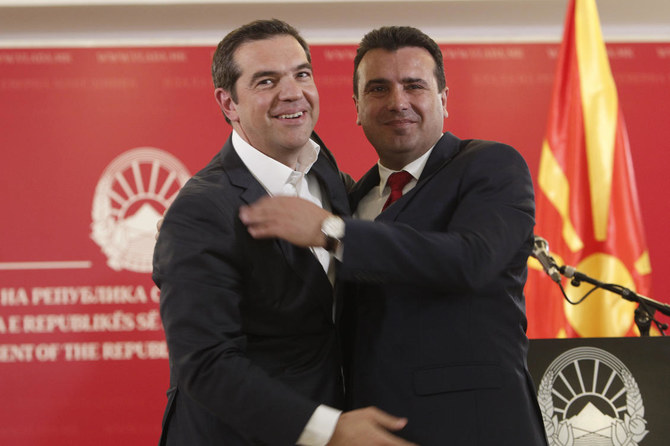
SKOPJE, Republic of North Macedonia: Greece’s prime minister was greeted with hugs and selfies on Tuesday during his landmark visit to newly renamed North Macedonia, where the neighbors celebrated a new start after resolving their decades-long identity row.
The one-day trip came a little more than a month after Alexis Tsipras and counterpart Zoran Zaev finalized a deal that added “North” to Macedonia’s name to distinguish it from a bordering province in Greece.
“We are starting to cover lost ground to build a deep friendship, not only between our governments, but especially between our people,” Tsipras said.
It was the first official visit by a Greek prime minister since the former Yugoslav republic of Macedonia declared independence in 1991, kicking off the name dispute that roiled diplomatic ties amid dogged wrestling over the name Macedonia and its cultural heritage.
In the end, Skopje agreed to the change in exchange for assurance that Athens would stop thwarting its efforts to join NATO and the European Union.
“Today our Republic for the first time in its history is a hosting an official visit of a Greek Prime Minister,” Zaev noted during a joint press conference, after he welcomed Tsipras with a warm embrace outside the government building and raised his mobile phone for a picture.
With the name issue behind them, the two countries are now exploring the potential of stronger economic ties, with both leaders to attend a business forum later in the day.
Tsipras, who brought ten ministers and dozens of business leaders with him, said he believed critics of the deal would be swayed once new financial, infrastructure and tourism links kick in.
“Gradually everyone will start to understand, both the Greek people and the citizens of North Macedonia, the damage that has been done over the past years when we were unable to sit together and try to solve our disputes,” he said.
After the initial name accord was inked in June 2018, congratulations poured in from around the globe for the two young premiers, who fought risky domestic political battles to push the deal through, enraging nationalists on both sides of the border.
Even before the deal was finalized, they were nominated for the Nobel Peace Prize by 2015 winner Wided Bouchamaoui of Tunisia.
But there is still opposition to the deal among nationalist groups in both countries.
In Greece, some are angry that the deal allows its northern neighbor to continue referring to its people and language as Macedonian.
Disgruntlement is also palpable in Skopje among those who feel the name-change is an embarrassing concession and that the end-goal — entry into the EU — may never materialize.
North Macedonia is in the process of joining NATO and hoping the EU will open accession talks in June.
Yet the timeline for the latter could slide, with appetite for enlargement shrinking considerably among several members of the bloc, particularly France.
Meanwhile, in his own protest, the Balkan state’s President Gjorge Ivanov has been refusing to sign bills from parliament ever since North Macedonia became the official name.
The two-term president is to be replaced following elections later this month.


![]()

Greek PM hails new ties during landmark N. Macedonia visit
Greek PM hails new ties during landmark N. Macedonia visit
- It was the first official visit by a Greek prime minister since the former Yugoslav republic of Macedonia declared independence in 1991
- With the name issue behind them, the two countries are now exploring the potential of stronger economic ties


Latest updates


© 2026 SAUDI RESEARCH & PUBLISHING COMPANY, All Rights Reserved And subject to Terms of Use Agreement.