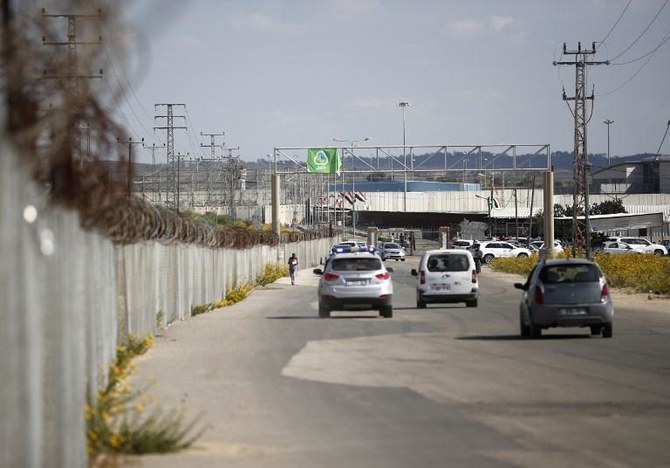
GAZA: Israel reopened its commercial crossing with the Gaza Strip on Sunday, a day after a smaller-than-expected Palestinian protest along the volatile frontier.
In another sign of the confrontation easing — as Egyptian mediators pushed on for a full cease-fire — Palestinians said Israel would on Monday almost double the breadth of Mediterrean waters where they are permitted to fish.
Gaza medical officials said four Palestinians were killed by Israeli fire during demonstrations on Saturday marking the first anniversary of the “Great March of Return” protests.
But while around 40,000 protesters, some hurling grenades and explosives, turned out on Saturday, according to the Israeli military, several signs pointed to pullback from wider violence.
An Israeli military spokesman noted that there had been “significantly less violence” during Saturday’s protest — which organizers had billed a “million person march” — than in past weekly demonstrations.
In addition, hundreds of Palestinian men, some from Gaza’s ruling Hamas group, were deployed in bright orange vests to deter people from going near Israel’s border fence, a frequent flashpoint.
A Hamas official said Egyptian mediators were expected to hold talks in Israel to try to finalize a deal.
Israel has maintained an official silence about any pending agreement, a week before a closely contested election in which rocket strikes from Gaza on Israeli border towns have become a main issue.
The crossing had been closed on Monday after a rocket that wounded seven Israelis north of Tel Aviv touched off a two-day surge in cross-border violence.
But trucks carrying food and fuel rolled into Gaza through the reopened Kerem Shalom crossing on Sunday despite the firing of several rockets at southern Israel overnight and Israeli tank fire on Hamas positions in response. No injuries were reported.
FLARE-UP
Around 200 Gazans have been killed by Israeli troops since the protests started on March 30 last year, according to Palestinian Health Ministry figures. An Israeli soldier was also killed by a Palestinian sniper in July.
The protesters are demanding a right to return to land from which their ancestors fled or were forced to flee during Israel’s founding in 1948.
A prospective deal, according to three Palestinian officials close to the talks, would include steady Qatari-funded fuel supplies for Gaza and job creation projects.
The Palestinian fishermen’s union said waters they could ply, currently limited by the Israeli navy to between 6 miles and 9 miles (9 km and 15 km) off Gaza’s coast, would on Monday be expanded to between 12 and 15 miles. The zone was last expanded that far in 2007, Palestinians said.
An Israeli official confirmed that the fishing zone would be expanded but declined to give figures.
For their part, groups in Gaza agreed before Saturday’s protest to keep demonstrators from the border fence and stop the launching of incendiary balloons that have burned farmland in southern Israel, the officials said.
“Days separate us from achieving our demands. We are patient and the enemy is under a test,” Khalil Al-Hayya, Hamas’s deputy Gaza chief, told the group’s Aqsa TV.
Israeli Prime Minister Benjamin Netanyahu, accused by far-right rivals of being too soft on Hamas, said on Sunday he ordered Israeli forces to remain at “full strength” along the Gaza frontier.
But in public remarks on Thursday, he said Israel would would only undertake a broad military campaign in Gaza after exhausting all other options. Hamas and Israel last fought a war in 2014.


![]()

Israel reopens Gaza crossing as mediators push for deal
Israel reopens Gaza crossing as mediators push for deal
- Israel closed the crossings after a rocket hit a house near Tel Aviv
- Four Palestinians died during protests the night before the crossings were reopened


Latest updates


Recommended


© 2026 SAUDI RESEARCH & PUBLISHING COMPANY, All Rights Reserved And subject to Terms of Use Agreement.