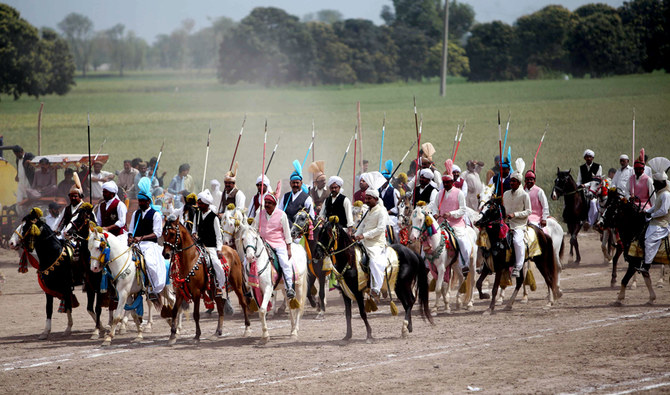
TULAMBA, Pakistan: Traditional drumbeats and melodious shahnai flutes are drowned out by thundering hooves in the small Pakistani city of Tulamba, as riders pound down a dusty track seeking world record glory in the ancient sport of tent-pegging.
Riders in bright costumes drive their lances into the targets, wooden pegs embedded in the dry ground, their aim sometimes obscured by the dust kicked up by other competitors.
The cavalry sport requires a mounted horseman to pierce and pick up a peg from the ground at a full gallop.
"This is the sport of young lions," local politician Shaukat Hayat Bosan told AFP. "For this sport not only a good horse but a good rider is also necessary."
This year's event organised by the Muhammadiya Hyderia Sultania Awan Club in Tulamba, held on Wednesday, aimed to be a little different: organisers claim they used it to set six world records.
Admittedly, organiser Shahzada Sultan Muhammad Ali said, there had been no mention of tent pegging in the Guinness Book of World Records previously.
But, he told the crowd, they established a record for 120 horses reaching the finish line in 166 seconds, and for uprooting 90 tent pegs at once, among others.
They are awaiting final confirmation from Guinness officials.
Organisers hope the bid will draw much-needed international attention to the sport.
Popular for centuries on the sub-continent, tent-pegging has become a dying pastime in Pakistan, mainly kept alive in wealthy Punjab province.
There it remains part of cultural celebrations in urban areas, where riders dress up in traditional waistcoats and turbans of vibrant colors while horses are fitted with shining saddles.
Muhammad Sohail, one of the participants in Tulamba, took the opportunity to call for more support for the sport.
"We are promoting this sport on our own," he said, calling on the Pakistani government to help.
In 2018 Pakistan qualified for the first time in a decade to participate in the tent-pegging World Cup held in the UAE. A total of 12 teams participated in the event.


Pakistanis seek world record in ancient sport of tent-pegging
Pakistanis seek world record in ancient sport of tent-pegging

- The cavalry sport requires a mounted horseman to pierce and pick up a peg from the ground at a full gallop
- Organizers say they await final confirmation from Guinness officials for a world record


Pakistan says defense pact with Saudi Arabia elevated brotherly ties to ‘new heights’
- Pakistan, Saudi Arabia signed strategic defense pact last year pledging aggression against one will be treated as attack on both
- Deputy PM Ishaq Dar says enduring bonds with Islamic and Arab nations form vital pillar of Pakistan’s foreign policy
ISLAMABAD: Deputy Prime Minister Ishaq Dar said on Wednesday that Pakistan’s defense pact with Saudi Arabia elevated its brotherly ties with the Kingdom to “new heights,” stressing that close ties with Arab and Islamic nations form a key pillar of Islamabad’s foreign policy.
Pakistan and Saudi Arabia signed a Strategic Mutual Defense Agreement on Sept. 17 last year, pledging that aggression against one country would be treated as an attack on both, enhancing joint deterrence and formalizing decades of military and security cooperation.
Both nations agreed in October 2025 to launch an economic cooperation framework to strengthen trade and investment ties.
“In the Middle East, our landmark Strategic Mutual Defense Agreement with Saudi Arabia has elevated our brotherly ties to new heights,” Dar said while speaking at the Pakistan Governance Forum 2026 event in Islamabad.
The Pakistani deputy prime minister was speaking on the topic “Navigating International Relations Amidst Changing Geo-Politics.”
Dar noted that Pakistan has reinforced partnerships with other Middle Eastern nations such as the UAE, Qatar, Jordan, Oman, Egypt and Bahrain. He said these partnerships have yielded “concrete agreements” in investment, agriculture, infrastructure, and energy sectors.
“Our enduring bonds with Islamic and Arab nations form a vital pillar of our foreign policy, and we will continue to expand our partnerships across Asia, Latin America, and Africa,” he said.
Dar pointed out that the presidents of Kazakhstan, Uzbekistan and Kyrgyzstan have undertaken visits to Pakistan in recent months, reflecting Central Asian nations’ desire to boost cooperation with Islamabad.
On South Asia, the Pakistani deputy PM said Pakistan has successfully transformed its fraternal ties with Bangladesh into “a substantive partnership.”
“Similarly, the trilateral mechanism involving China, Pakistan, and Bangladesh has been launched with a view to expanding and deepening regional cooperation and synergy,” the Pakistani minister said.
He said Islamabad has strengthened its “all-weather” partnership with China via the second phase of the multi-billion-dollar China-Pakistan Economic Corridor agreement and “unwavering support” from both sides for each other’s core interests.
Dar said Pakistan had also reinvigorated its partnership with the US, advancing cooperation in trade, technology, investment, and regional stability.
“This calibrated approach has enhanced our ability to navigate complexity with skill and confidence, ensuring that our national interests are served without compromising our core foreign policy principles,” he said.