

International Red Cross ready for Venezuela humanitarian aid operation

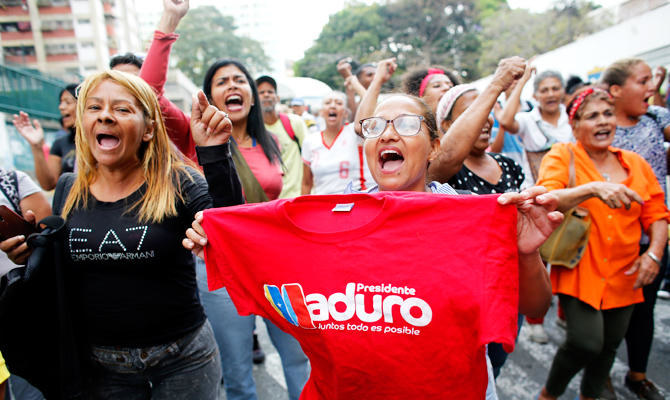
Supporters of President Nicolas Maduro screams at supporters of Venezuela's self-proclaimed interim president Juan Guaido, during a rally in Caracas, Venezuela, Friday, March 29, 2019. (AP)
Updated 30 March 2019
Follow

International Red Cross ready for Venezuela humanitarian aid operation

  • China, which has major oil investments in the country, has continued to back Maduro while criticizing the United States for meddling in the country’s affairs

CARACAS: The International Federation of the Red Cross and Red Crescent Societies said on Friday it was prepared to channel humanitarian aid to Venezuela through an operation that could be similar to one in Syria, potentially helping ease chronic hunger and disease in the South American nation.
President Nicolas Maduro in February blocked efforts by political opponents to bring US-backed aid into the country across its borders with neighboring Colombia and Brazil, and has denied the country is suffering a humanitarian crisis.
The IFRC “can count on the legal and technical conditions to work in the country, to gain access to humanitarian aid that is so needed,” the group’s President Francesco Rocca told a press conference. “This obviously will not resolve the problems in Venezuela and nobody should assume this is a complete solution.”
The group within 15 days could begin providing assistance, and expects that it will initially be able to help 650,000 of the most needy citizens in the country of around 30 million inhabitants, he said.
The first supplies would include medical equipment, surgical kits and power generators, Rocca said, following two major blackouts this month.
Power in many parts of Caracas, and in other Venezuelan cities, went out again on Friday evening, a day and a half after lights came back on in the capital. The blackouts have worsened Venezuelans’ suffering, cutting off water supplies and leaving hospitals and airports in the dark. The involvement of the IFRC could signal that Maduro’s socialist government, which has been subjected to crippling US sanctions, may allow in much-needed food and medicine.
But Venezuelan officials were not present at the press conference. Maduro’s government did receive a shipment of medicines on Friday from China, which has supported the embattled socialist leader and accused the United States of meddling in Venezuelan affairs.
The country’s hyperinflationary crisis has made food and medicine unaffordable for most citizens, fueling widespread malnutrition, especially among children, and a rise in preventable diseases.
The United Nations estimates that about a quarter of Venezuelans need humanitarian assistance, according to an internal UN report seen by Reuters.
Venezuela has also been mired in a political crisis as dozens of nations have recognized Juan Guaido, the head of Venezuela’s National Assembly, as the country’s rightful leader, arguing Maduro’s 2018 re-election was illegitimate.

CHINESE REMEDIES
Guaido, who invoked the constitution to assume an interim presidency in January, led an unsuccessful effort to transport humanitarian aid into Venezuela from neighboring Colombia and Brazil on Feb. 23.
Julio Castro, of the non-profit group Doctors for Health, described the IFRC’s aid announcement as an advance but said it did not guarantee success, offering a sports analogy of the sort that is common in the baseball-loving country.
“Today I feel as if I’ve hit a line drive with runners on second and third — we haven’t won the game, but we’ve moved forward,” Castro wrote via Twitter.
It was not immediately evident what assurances the government had provided to the IFRC. Rocca said he could not reveal what had been discussed in meetings.
Venezuela’s information ministry did not reply to a request for comment.
Guaido in February led an effort to bring aid across borders with neighboring Colombia and Brazil. Troops loyal to Maduro repelled the convoys, saying they were part of a veiled invasion by Washington.
Industries Minister Tareck El Aissami on Friday afternoon received the shipment of Chinese medicine at the country’s principal airport of Maiquetia, saying China was helping counteract US efforts to weaken Maduro’s government.
“This is an exercise in sovereignty, independence and dignity,” El Aissami said of the shipment, which included medical supplies ranging from analgesics to diabetes treatment.
“We are defeating the blockade that North American imperialism wants to impose.”
El Aissami did not describe the supplies as humanitarian aid, saying Venezuela had set up bilateral funds and “healthy commercial relations” to ensure supplies of medicine.
He did not mention the Red Cross, which earlier said it would not be involved in distributing the medication from China.
China, which has major oil investments in the country, has continued to back Maduro while criticizing the United States for meddling in the country’s affairs. It has lent Venezuela some $50 billion over the last decade through oil-for-loan arrangements. Amid recent blackouts, it has also offered to help improve the power supply.


US and Mideast countries seek Kyiv’s drone expertise as Russia-Ukraine talks put on ice

Updated 59 min 33 sec ago
Follow

US and Mideast countries seek Kyiv’s drone expertise as Russia-Ukraine talks put on ice

KYIV, Ukraine: The United States and its allies in the Middle East are seeking Ukraine's expertise in countering Iran's Shahed drones, according to Ukrainian President Volodymyr Zelenskyy.

Various countries, including the United States, have approached Ukraine for help in defending against the Iranian drones, Zelenskyy said late Wednesday. He said he has spoken in recent days with the leaders of the United Arab Emirates, Qatar, Bahrain, Jordan and Kuwait about possible cooperation.

Russia has fired tens of thousands of Shaheds at Ukraine since it invaded its neighbor just over four years ago, launching a swarm of more than 800 drones and decoys in its biggest nighttime barrage. Iran has responded to joint U.S.-Israeli strikes by launching the same type of drones at countries in the Middle East.

Ukrainian assistance in countering Iranian drones will be provided only if it does not weaken Ukraine's own defenses, and if it adds leverage to Kyiv's diplomatic efforts to stop the Russian invasion, according to the Ukrainian leader.

"We help to defend from war those who help us, Ukraine, bring a just end to the war" with Russia, Zelenskyy said. Later Thursday, Zelenskyy said he had received a U.S. request for support to defend against the drones in the Middle East and had given the order for equipment to be provided along with Ukrainian experts without providing further details.

"Ukraine helps partners who help our security and the protection of our people's lives," he added in a social media post.

Trump, in an interview Thursday with Reuters, said, "Certainly I'll take, you know, any assistance from any country."

Ukraine has battle-tested drone defenses

Ukraine has pioneered the development of cut-price drone killers that cost as little as $1,000, rewriting the air defense rule book and making other countries take notice.

European countries got a wake-up call last September on the changed nature of air defense when Poland scrambled multimillion-dollar military assets, including F-35 and F-16 fighter jets and Black Hawk helicopters, in response to airspace violations by cheap drones.

Ukrainian manufacturers have developed low-cost interceptor drones specifically designed to hunt and destroy Shaheds, and its rapidly expanding drone industry is producing excess capacity.

Zelenskyy announced earlier this year that Ukraine would begin exporting the battle-tested systems.

The European Union's top diplomat, Kaja Kallas, said before chairing a meeting of EU and Gulf foreign ministers via video link Thursday that the talks would look at how Ukraine's experience can help countries counter Iranian drones.

Middle East war delays Russia-Ukraine talks

The Iran war, now in its sixth day, has drawn international attention away from Europe's biggest conflict since World War II, and forced the postponement of a new round of U. S-brokered talks between Russia and Ukraine planned for this week, Zelenskyy said.

Western governments and analysts say the Russia-Ukraine war has killed hundreds of thousands of people, while there is no sign that yearlong U.S.-led peace efforts will stop the fighting any time soon.

"Right now, because of the situation around Iran, there are not yet the necessary signals for a trilateral meeting," Zelenskyy said. "But as soon as the security situation and the overall political context allow us to resume that trilateral diplomatic work, it will be done."

Zelenskyy thanked the United States for the return from Russia on Thursday of 200 Ukrainian prisoners of war. Russia's Defense Ministry also said it received the same number of prisoners from Ukraine and thanked the U.S. and United Arab Emirates for mediating.

Prisoner swaps have been one of the few tangible results of the talks. Vladimir Medinsky, a Russian negotiator, said on social media that a total of 500 prisoners from each side would be exchanged between Thursday and Friday.

Oleksandr Merezhko, the head of Ukraine's parliamentary foreign affairs committee, said Russian President Vladimir Putin is trying to drag out the negotiations so that he can press on with Russia's invasion while escaping further U.S. sanctions.

He urged the U.S. administration to look at the Russia-Ukraine war and the war in the Middle East as linked.

"In reality, Russia and Iran are close allies that act in concert — Iran supplies weapons and Russia helps Iran develop its defense industry. These are interconnected conflicts," Merezhko told The Associated Press.

Ukraine's army has recently pushed back Russian forces at some points along the roughly 1,250-kilometer (750-mile) front line, according to the Institute for the Study of War.

Localized Ukrainian counterattacks liberated more territory than Ukrainian forces lost in the last two weeks of February, the Washington-based think tank said this week, estimating the recovered land at about 257 square kilometers (100 square miles) since Jan. 1.