

Philippine news site chief and Duterte critic freed on bail after latest arrest

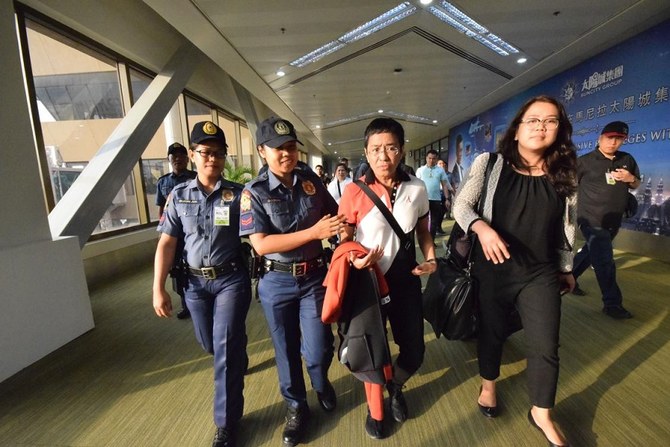
Ressa, a prominent critic of President Rodrigo Duterte, was arrested on a fraud charge, a colleague said. (AFP)
Updated 01 April 2019
Follow

Philippine news site chief and Duterte critic freed on bail after latest arrest

  • Press freedom advocates have said the arrest is a retaliation for Ressa's news site’s criticism of President Rodrigo Duterte
  • The arrest was the second for Ressa, who was nabbed in February on an Internet libel charge

MANILA: The head of a Philippine news website known for critical reports about President Rodrigo Duterte was freed on bail hours after she was re-arrested at a Manila airport on Friday on charges she had violated foreign ownership rules.
“You cannot harass and intimidate journalists to silence. We’ll stand up and fight against it,” Maria Ressa, the award-winning head of news platform Rappler, told reporters after posting bail of 90,000 pesos ($1,707).
Lawsuits against news platform Rappler have drawn global concern about a free and open media in the democratic Southeast Asian country.
Rappler and its officials are now facing 11 cases, said Ressa, who posted bail for the seventh time.
Ressa was served an arrest warrant over a libel case live on television last month and spent a night in detention before she was released. She was arrested again on Friday minutes after arriving from the United States.
“It is sad this is the kind of welcome our country gives to journalists,” said Ressa, who is due to be arraigned in a regional court on April 10.
State prosecutors filed the latest charges against her and other Rappler executives on Wednesday, while she was overseas. Philippine National Police Chief Oscar Albayalde said officers were enforcing a court order.

The Philippine constitution bans foreign ownership of media but Rappler has said foreigners who invested in its Philippine Depositary Receipts do not have any say in its operations.
Media watchdogs said the charges against Ressa were trumped up and aimed at intimidating those who challenge Duterte’s rule, in particular his deadly crackdown on illicit drugs.
“The court case is unprecedented and speaks volumes of the Duterte administration’s determination to shut the website down for its credible and consistent reporting on the government, particularly the ‘drug war’ and the extrajudicial killings of drug suspects and civilians,” Human Rights Watch said.
More than 5,000 suspected drug dealers have been killed in police sting operations. Rights group say the police summarily executed suspects, a claim which police deny.
Presidential spokesman Salvador Panelo said the courts and police were acting according to the law in issuing and executing the arrest warrant against Ressa.
“She cannot complain this is a violation of press freedom,” Panelo told a news conference. “Press freedom has nothing to do with the charges against Ms. Ressa.”
The National Union of Journalists of the Philippines said Rappler had become “the whipping boy of the Duterte administration as it seeks to silence or intimidate the independent and critical press.”
Duterte has made no secret of his annoyance at Rappler and has sparred frequently with its reporters, who are known for scrutinizing his policies and appointments and for questioning the accuracy of his sweeping, often bellicose statements.


Saudi Media Forum urges ethical coverage as crises redefine Arab journalism

Updated 04 February 2026
Follow

Saudi Media Forum urges ethical coverage as crises redefine Arab journalism

  • Raw news without context can mislead audiences and distort credibility, experts say

RIYADH: Arab media was born in crisis and shaped by conflict rather than stability, Malik Al-Rougi, general manager of Thaqafeyah Channel, said during the Saudi Media Forum in Riyadh on Wednesday.

Al-Rougi was speaking during a panel titled “Media and Crises: The Battle for Awareness and the Challenges of Responsible Coverage,” which examined how news organizations across the region navigated credibility and professional standards amid fast-moving regional developments.

“Today, when you build a media organization and invest in it for many years, a single crisis can destroy it,” he said.

Referring to recent events, Al-Rougi said that he had witnessed news channels whose credibility “collapsed overnight.”

“In journalistic and political terms, this is not a process of news production. It is a process of propaganda production,” he said. “The damage caused by such a post … is enormous for an institution in which millions, perhaps billions, have been invested.”

When a media outlet shifts from professionalism and credibility toward “propaganda,” he added, it moves away from its core role. 

Saudi media leaders, journalists, and experts gathered at the Saudi Media Forum in Riyadh to discuss credibility, ethics, and innovation. (AN photo by Huda Bashatah/Supplied)

“A crisis can work for you or against you,” Al-Rougi added. “When, in the heart of a crisis, you demonstrate high credibility and composure, you move light-years ahead. When you fail to adhere to ethical standards, you lose light-years as well.”

Abdullah Al-Assaf, professor of political media studies at Imam Muhammad bin Saud Islamic University, said that in many crises across the Arab world, agendas and directives had often prevailed over professionalism.

“Credibility was buried,” he added.

Hasan Al-Mustafa, writer and researcher at Al-Arabiya channel, said that raw information could be subject to multiple interpretations if not placed within a proper political, security, historical or geographical context.

He added that such an approach was urgently needed during periods of political and security volatility in the Middle East. 

When, in the heart of a crisis, you demonstrate high credibility and composure, you move light-years ahead. When you fail to adhere to ethical standards, you lose light-years as well.

Malik Al-Rougi Thaqafeyah, Channel general manager

“This objectivity, or this reliability, is a great responsibility,” Al-Mustafa said. “It is reflected not only in its impact on the audience, but also on the credibility of the content creator.”

Al-Mustafa warned against populism and haste in coverage, saying that they risked deepening crises rather than providing informed public perspectives.

He also said that competition with social media influencers had pushed some traditional outlets to imitate influencer-driven models instead of strengthening their own professional standards.

“Our media has been crisis-driven for decades,” he said, describing much of the region’s coverage as reactive rather than proactive.

During a separate panel titled “The Official Voice in the Digital Age: Strategies of Influence,” speakers discussed how rapid technological and social changes were reshaping the role of institutional spokespersons.

Abdulrahman Alhusain, official spokesperson of the Saudi Ministry of Commerce, said that the role was no longer limited to delivering statements or reacting to events.

“Today, the spokesperson must be the director of the scene — the director of the media narrative,” he said.

Audiences, he added, no longer accept isolated pieces of information unless they were presented within a clear narrative and structure.

“In the past, a spokesperson was expected to deliver formal presentations. Today, what is required is dialogue. The role may once required defense, but now it must involve discussion, the exchange of views, and open, candid conversation aimed at development — regardless of how harsh the criticism may be.”

He said that spokespersons must also be guided by data, digital indicators and artificial intelligence to understand public opinion before speaking.

“You must choose the right timing, the right method and the right vocabulary. You must anticipate a crisis before it happens. That is your role.”

Abdullah Aloraij, general manager of media at the Riyadh Region Municipality, said that the most important skill for a spokesperson today was the ability to analyze and monitor public discourse.

“The challenge is not in transferring words, but in transferring understanding and impact in the right way,” he said.