

Pakistan says Indian dossier does not link it to Pulwama attack

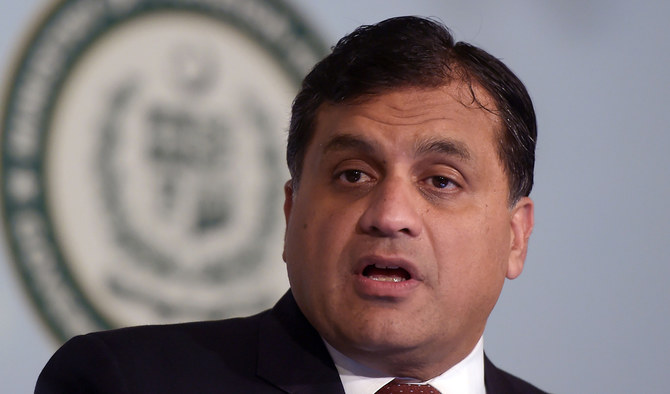
Pakistan's Foreign Ministry spokesman Mohammad Faisal on March 28 said it had found no links between militants swept up in a recent dragnet and a suicide attack in Indian-administered Kashmir last month that brought the nuclear-armed rivals to the brink of war. (AFP)
Updated 28 March 2019
Follow

Pakistan says Indian dossier does not link it to Pulwama attack

  • Last month India handed over a document on Pakistan’s alleged involvement in Feb 14 attack in Indian-held Kashmir
  • Foreign Office says dossier’s claims unsubstantiated, contained no information linking Jaish-e-Mohammad chief to Pulwama attack

ISLAMABAD: Pakistan on Thursday said it had scrutinised a dossier handed over by India in the wake of a suicide attack last month and concluded that the accusations that Pakistani groups were involved or there were militant training camps in Pakistan were unsubstantiated.

At least 40 Indian paratroopers were killed when a suicide bomber attacked a convoy on February 14 at Pulwama in Indian-controlled Kashmir. Pakistan-based militant group Jaish-e- Mohammad (JeM) claimed the attack, which pushed India and Pakistan to the brink of war as they exchanged airstrikes and fought brief dogfights.

Last month, India handed over to Pakistan a dossier of what it said was evidence that linked Pakistan to the Pulwama attack.

At a news briefing on Thursday, Dr Mohammad Faisal, the foreign office spokesman, said the Indian dossier listed 90 Pakistanis suspected of belonging to banned organisations with militant links and 22 locations of alleged militant training camps.

“While 54 detained individuals are being investigated, no details linking them to Pulwama have been found so far,” Faisal said. “Similarly, the 22 pin locations shared by India have been examined. No such camps exist.”

The spokesman said Pakistan was willing to allow visits to the locations of the alleged training camps if India requested it but “additional information and documents from India would be essential to continue the process of investigations.”

Answering journalists’ questions, the spokesman said Pakistan was “ready to cooperate [with India] and if they have any actionable intelligence that would sustain and clear the threshold of a Pakistani court, we are ready to work on that.”

He also said “the dossier does not claim any linkage of Masood Azhar,” the head of the JeM group that India blames for the Pulwama attack, to the suicide attack itself.


Pakistan PM calls for faster CPEC implementation, pledges security for Chinese workers

Updated 12 sec ago
Follow

Pakistan PM calls for faster CPEC implementation, pledges security for Chinese workers

  • Shehbaz Sharif pushes expanded cooperation in agriculture, IT and mining under CPEC phase two
  • Chinese envoy reaffirms Beijing’s support for Pakistan’s sovereignty and economic development

ISLAMABAD: Prime Minister Shehbaz Sharif on Friday called for speeding up projects under the China-Pakistan Economic Corridor (CPEC) and pledged stronger security guarantees for Chinese workers and investments, during a meeting with China’s ambassador in Islamabad.

Sharif made the remarks as the two countries strive to launch the second phase of CPEC, a multibillion-dollar infrastructure and energy initiative launched in 2015 as part of China’s Belt and Road Initiative (BRI).

CPEC’s first phase focused largely on power generation and transport infrastructure aimed at easing Pakistan’s chronic energy shortages and improving connectivity. The second phase seeks to expand cooperation into industrial development, with an emphasis on special economic zones and export-oriented growth.

“While highlighting the importance of accelerating ongoing CPEC projects, the Prime Minister stressed on the need to enhance cooperation in agriculture and IT and mining & minerals,” said a statement circulated by the PM Office after the meeting.

“He also underscored Pakistan’s resolve to provide a secure and conducive environment for Chinese personnel, investments, and institutions in Pakistan,” it added.

Chinese nationals and projects in Pakistan have faced security threats in the past, including attacks by militant groups targeting infrastructure sites and convoys. Islamabad has repeatedly vowed to tighten security and has deployed special protection units for Chinese workers.

China is Pakistan’s closest ally in the region and a key economic partner, with CPEC widely regarded by Islamabad as central to long-term economic growth.

During the meeting, the prime minister conveyed greetings to Chinese President Xi Jinping and Premier Li Qiang, particularly on the occasion of the Chinese New Year.

China’s Ambassador to Pakistan, Jiang Zaidong, reiterated Beijing’s support for Pakistan’s sovereignty and socioeconomic development, according to the statement. Both sides also exchanged views on regional and international issues and agreed to maintain close coordination.