British PM Theresa May promises to quit to save Brexit plan

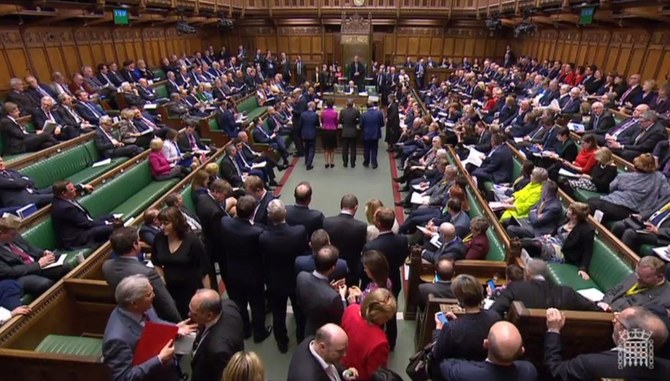
A video grab from footage broadcast by the UK Parliament's Parliamentary Recording Unit (PRU) shows MPs as they hear the outcome of a vote on a motion moved by Conservative MP Oliver Letwin. (AFP Photo/PRU)
Updated 28 March 2019
Follow

British PM Theresa May promises to quit to save Brexit plan

  • Lawmakers have twice resoundingly rejected Theresa May's deal
  • Parliament voting on eight options ranging from second referendum to recalling EU withdrawal notice

LONDON: Prime Minister Theresa May on Wednesday pledged to step down if MPs back her EU divorce deal, in a bid to break the Brexit deadlock in Britain’s fractured parliament.
Following months of pressure, May told her Conservative MPs that she would quit if they see through the withdrawal agreement she painstakingly negotiated with Brussels.
Her dramatic gambit came just two hours before MPs start a flurry of votes seeking a last-minute alternative Brexit plan to replace her deal.
May said she would not lead the country in negotiations on the UK’s future relationship with the European Union once Britain is out of the bloc.
“This has been a testing time for our country and our party. We’re nearly there,” May told the packed closed-door meeting in parliament, according to her Downing Street office.
“I know there is a desire for a new approach — and new leadership — in the second phase of the Brexit negotiations and I won’t stand in the way of that.
“But we need to get the deal through and deliver Brexit. I am prepared to leave this job earlier than I intended in order to do what is right for our country and our party.
“I ask everyone in this room to back the deal so we can complete our historic duty — to deliver on the decision of the British people and leave the European Union with a smooth and orderly exit.”
Three years of political turmoil that followed Britain’s decision to break its near half-century bond with the EU were meant to have ended on Friday with the formal completion of the divorce.
But no clear end is in sight and lawmakers have twice resoundingly rejected the agreement May concluded with Brussels over 17 months of acrimonious talks.
Parliament has decided to try to resolve the crisis by giving itself the right to choose from a variety of alternatives to May’s plan.
It will vote at 1900 GMT on eight options that range from a second referendum to recalling the EU withdrawal notice or leaving under much closer economic terms.
Time has been set aside on Monday for MPs to try and whittle down the most popular options to a final plan.
But the motions are non-binding and it will be tough for parliament to force the government to back any proposal with which it disagrees.
House of Commons Leader Andrea Leadsom, responsible for bringing forward government business, warned that a lot of parliament’s proposals “are just undeliverable.”
She said there was a “real possibility” that May will bring back her deal for a third vote on Thursday or Friday.
But Commons Speaker John Bercow reminded May that he already scuppered her plan to hold a third vote last week because she was effectively bringing back the same rejected text.
“I do expect the government to meet the test of change,” Bercow told the chamber.
EU leaders have given Britain an extended deadline of April 12 to either salvage May’s deal or find a better way.
Failure to do either could result in a no-deal divorce — a scenario that frightens markets and businesses.
If parliament does adopt May’s deal, Britain is headed for the exit door on May 22.
Britain could otherwise seek an even longer extension that puts it in the odd situation of having to take part in European Parliament elections nearly two months after it was supposed to have left.
May will hope none of the alternatives earn majority support and that her own agreement ends up looking like the best option.
She has already won the backing of Jacob Rees-Mogg, who heads the European Research Group of hard Brexiteers in her party that twice voted against the deal.
“I think we’ve got to the point where legally leaving is better than not leaving at all,” he told BBC radio.
European leaders are watching the entire process with concern.
European Council President Donald Tusk urged EU lawmakers on Wednesday to remain open to a long postponement while Britain rethinks its stance.
“We should be open to a long extension if the UK wishes to rethink its Brexit strategy,” he said.


Bangladesh’s Tarique Rahman poised to be PM as Jamaat-e-Islami concedes election

Updated 8 sec ago
Follow

Bangladesh’s Tarique Rahman poised to be PM as Jamaat-e-Islami concedes election

  • Election Commission figures showed Bangladesh Nationalist Party won a landslide victory in Thursday’s polls
  • Jamaat-e-Islami chief Shafiqur Rahman says ‘we recognize the overall outcome, and we respect the rule of law’

Dhaka: Bangladesh’s largest religious party conceded defeat in elections on Saturday, despite earlier alleging problems with the vote count, clearing the way for nationalist leader Tarique Rahman to become prime minister.

Election Commission figures showed Rahman’s Bangladesh Nationalist Party (BNP) had won a landslide victory in the elections on Thursday, the first since a deadly 2024 uprising ousted the iron-fisted rule of Sheikh Hasina.

The success of BNP chief Rahman, 60, marks a remarkable turnaround for a man who only returned to Bangladesh in December after 17 years in exile in Britain, far from Dhaka’s political storms.

Rahman, the scion of one of Bangladesh’s most powerful political dynasties, is expected to make a victory speech later on Saturday.

His father, president Ziaur Rahman, was assassinated in 1981, while his mother, Khaleda Zia, served three terms as prime minister and dominated national politics for decades.

Nobel laureate Muhammad Yunus, who has led the country of 170 million as interim leader since the uprising, said Rahman “would help guide the country toward stability, inclusiveness, and development.”

The BNP alliance won 212 seats compared with 77 for the Jamaat-e-Islami-led alliance, according to the Electoral Commission.

VERDICT OF THE PEOPLE’

Jamaat-e-Islami chief Shafiqur Rahman, 67, had said on Friday he would “seek redress” from the commission, with his party alleging “inconsistencies and fabrications.”

But a day later, he conceded defeat.

“In any genuine democratic journey, the true test of leadership is not only how we campaign, but how we respond to the verdict of the people,” the Jamaat leader said in a statement.

“We recognize the overall outcome, and we respect the rule of law.”

Hasina’s Awami League party was barred from taking part. Hasina, 78, who was sentenced to death in absentia for crimes against humanity, issued a statement from hiding in India decrying an “illegal and unconstitutional election.”

The US embassy congratulated Rahman and the BNP for a “historic victory,” while neighboring India praised Rahman’s “decisive win,” a notable shift after deeply strained ties.

China and Pakistan, which both grew closer to Bangladesh since the 2024 uprising and the souring of ties with India, where Hasina has sheltered since her ouster, also congratulated the BNP.

International election observers said the polls had been a success, with the European Union saying Saturday they had been “credible.”

The International Republican Institute noted that while “election administration was technically sound, the broader political environment remains fragile.”

SUCCESSFUL’

Jamaat’s Rahman said his party “will serve as a vigilant, principled, and peaceful opposition, holding the government to account.”

Election Commissioner Md Anwarul Islam Sarker told AFP that the vote had been a success.

“It was by far the best election,” he said, noting that voting was canceled at only one of the more than 42,000 polling centers.

“People had doubts about whether a successful election could be held under these circumstances, but we have done it,” he said Saturday. “If anyone still has any issues, they can go to court.”

The Election Commission said turnout was 59 percent across 299 constituencies out of 300 in which voting took place.

Only seven women were elected, although a further 50 seats in parliament reserved for women will be named from party lists.

Shafiqur Rahman stressed the significant gains his Islamist party had made compared with past elections, after years of being crushed under Hasina.

“With 77 seats, we have nearly quadrupled our parliamentary presence and become one of the strongest opposition blocs in modern Bangladeshi politics,” he said. “That is not a setback. That is a foundation.”

Voters on Thursday also endorsed proposals in a referendum for a sweeping democratic reform charter backed by Yunus, to overhaul what he called a “completely broken” system of government and to prevent a return to one-party rule.

Those include prime ministerial term limits, a new upper house of parliament, stronger presidential powers and greater judicial independence.

Crisis Group analyst Thomas Kean warned that the incoming government now faced “daunting challenges,” including “boosting the economy, ensuring security and continuing the reform process.”