JAKARTA: A senior Indonesian minister warned on Wednesday Southeast Asia’s biggest economy could consider exiting the Paris climate deal if the European Union goes ahead with a plan to phase out palm oil in renewable transportation fuel.
Indonesia, the world’s biggest palm oil producer, has lashed out at the EU after the bloc classified palm oil as a risky crop that caused significant deforestation and ruled that its use in renewable fuel should stop by 2030.
Speaking at a palm oil forum, Luhut Pandjaitan, the coordinating minister overseeing maritime and natural resources, said the EU “should not underestimate Indonesia” and pledged the government would firmly defend its national interest.
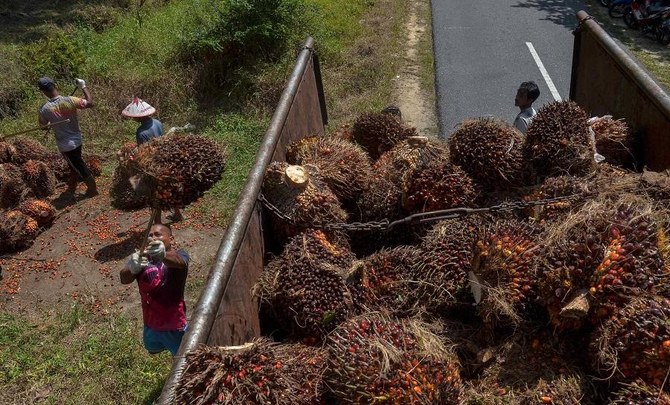
Palm cultivation is often blamed for deforestation and destroying the habitat of endangered animals such as orangutans and Sumatran tigers.
Indonesia’s government, however, says palm requires far less land to produce oil compared to crops such as soy and rapeseed.
“If the US and Brazil can leave the climate deal, we should consider that. Why not?” Pandjaitan said.
Under the Paris climate accord, Indonesia has committed to reducing its greenhouse gas emissions unconditionally by 29 percent and conditionally by 41 percent by 2030.
On Tuesday, the government said it plans to adopt sustainable economic policies which could help cut greenhouse gas emissions while boosting economic growth.
“The US was not sanctioned at all by the EU (after leaving the Paris accord),” said Peter Gontha, special staff at Indonesia’s foreign ministry.
He also said Indonesia faced EU pressure over palm oil despite the government declaring a moratorium on permits for new estates.
Indonesia claims palm is being discriminated against by the EU to protect the market of European oils such as sunflower and rapeseed oils.
Indonesia has said it is preparing to challenge the EU and its Renewable Energy Directive (RED II) at the World Trade Organization as soon as it is implemented. The government is also examining its relations with EU members which support the act.
EU delegates for Indonesia and Brunei have said the bloc is complying with WTO rules and continues to be open for discussion with Indonesian government over the issue.
Earlier this week, and Indonesian Trade Ministry official urged palm companies to log legal action of their own over the issue at courts.


Indonesia threatens to quit Paris climate deal over palm oil
Indonesia threatens to quit Paris climate deal over palm oil

- An Indonesian official said said the EU “should not underestimate Indonesia” and pledged the government would firmly defend its national interest
- Indonesia claims palm is being discriminated against by the EU to protect the market of European oils


PIF-backed AviLease achieves revenue of $664m and 19% growth in 2025
RIYADH: Saudi Arabia’s Public Investment Fund-backed AviLease achieved exceptional performance and sustainable business growth during 2025, supported by the strategic expansion of its global platform.
According to its financial results for 2025, AviLease recorded total revenues of $664 million, an annual increase of 19 percent, driven by disciplined growth in its asset portfolio and strong performance in aircraft remarketing amid sustained global demand for modern, fuel-efficient aircraft, the Saudi Press Agency reported.
Profit before tax doubled compared to the previous year, reaching $122 million. The year witnessed an expansion in AviLease’s portfolio, reaching 202 owned and managed aircraft, leased to over 50 airline companies in more than 30 countries.
The total value of the company’s assets stabilized at $9.3 billion. AviLease maintained a 100 percent fleet utilization rate, reflecting the resilience of its business model, the efficiency of its asset management, and the strength of its strategic relationships with airlines around the world.
AviLease concluded purchase agreements for aircraft from Airbus, including the A320neo family and A350F, and Boeing 737 aircraft, aiming to enhance its future asset portfolio with modern, fuel-efficient aircraft. This step will contribute to supporting future growth and meeting increasing customer demand for the latest aircraft, aligning with the Kingdom’s ambitions to become a leading global aviation hub.
AviLease strengthened its prestigious credit standing by obtaining a strong Baa2 credit ratings from Moody’s and BBB from Fitch, reflecting its financial solidity, managerial discipline, and efficiency in managing leverage. The company also successfully issued senior unsecured bonds worth $850 million last November under Regulation 144A/RegS. This issuance contributed to diversifying its funding sources and enhancing its financial flexibility.
Commenting on the results, AviLease CEO Edward O’Byrne said: “This exceptional performance reflects the quality of the company’s investment portfolio, the strength of its partnerships with airlines, and its strategic focus on responsibly deploying capital into highly sought-after, efficient, modern aircraft assets.”
He added: “As aviation markets continue to grow, AviLease is strategically positioned to continue its expansion plans and deliver sustainable long-term value for shareholders, contributing to the Kingdom’s ambitions.”
Throughout 2025, AviLease continued to play a pivotal role in the Kingdom’s growing aviation sector and contributed directly to the launch and scaling of the new national carrier, Riyadh Air, by completing a sale and leaseback transaction for a Boeing 787-9 aircraft, which thereby became the first aircraft to join the airline’s fleet.
AviLease also established a strategic partnership with Hassana Investment Co. This partnership aims to provide an opportunity for local and international investors to enter the aircraft financing asset class and benefit from AviLease’s technical expertise and operational capabilities to support partnership growth and enhance performance.
Hassana Investment Co. has agreed to acquire an initial portfolio of 10 modern aircraft from AviLease.


