CARACAS, Venezuela: Venezuelans reacted with despair and resourcefulness on Tuesday as nationwide power cuts closed schools and businesses, paralyzing a nation that was only starting to recover from its worst blackouts earlier this month.
The new outages, which began Monday, forced people to follow now-familiar routines: scour neighborhoods for food in the few shops that were open or seek out the few spots where they could find a signal on their mobile phones and get in touch with family and friends. The collapse of the power grid was yet another setback for a country whose oil reserves made it one of Latin America’s wealthiest decades ago.
“Venezuela doesn’t stand a chance anymore, there is no life here,” said Johnny Vargas, a frustrated restaurant worker who said he wishes he could leave the country. “People can’t work anymore; we can’t do anything.”
In Caracas, lights flickered on and off in various districts, raising hopes and then dashing them as people once again reflected on divergent explanations from the government of President Nicolas Maduro, which alleged sabotage, and the US-backed opposition, which said state corruption and incompetence is to blame.
Communications Minister Jorge Rodriguez posted a video of a fireman training a hose on smoking equipment at a power facility, seeking to reinforce his claims that Venezuela is under attack by “terrorists” executing a US-led scheme to sow chaos. Authorities said they had detained six people in connection with the outage, but provided no details outlining the accusations against them.
The US and Venezuelan opposition leader Juan Guaido say allegations of sabotage are an attempt to deflect attention from government failures.
The government’s allegations aren’t credible in part because it said the military had deployed to protect the entire power grid after the last blackouts, Guaido said.
Jose Aguilar, an expert on the Venezuelan electrical grid, said images of a blaze shared by the government as well as information from engineers on the ground indicate the fire began inside one of three critical transformers near the Guri dam, which provides most of the country’s electricity. He attributed the blaze to neglect, saying equipment that facilitates an electrical current’s passage was not regularly maintained.
Sitting on a bench in a plaza, 72-year-old Armando Taioli gestured at people walking in the streets or traveling in buses and said they were adapting as best they could to the power outages, but that he fears social unrest if the situation deteriorates.
“That calm, you have to be worried about it,” Taioli said.
Vice President Delcy Rodriguez said schools and industries would be suspended for a second day on Wednesday as officials work to restore electricity.
After the last blackouts started on March 7, the situation became increasingly desperate for many Venezuelans who lost access to water because pumps failed without electricity. Looters ransacked hundreds of businesses in the city of Maracaibo. The blackouts eased nearly a week later, but many areas only had intermittent power even after the government said the problem was solved.
The new outage appeared to have affected the majority of the 23 states in Venezuela, whose steep economic decline contributed to the flight of more than 3 million people, or one-tenth of the population, to other countries as the crisis escalated. Guaido says Maduro’s re-election last year was rigged, and the US has imposed sanctions on Venezuela in an attempt to force the Russia-backed president from power.
Simmering political tension was apparent Tuesday, as a video circulating on social media showed a man appearing to kick a car and other men throwing objects at it. Guaido’s spokesman Edward Rodriguez said the incident was an attack on vehicles carrying lawmakers from the opposition-controlled National Assembly after a session. Opposition activists say they are sometimes targeted by “colectivos,” a term for pro-government enforcers in civilian clothing who are seen on Caracas streets from time to time.
US Secretary of State Mike Pompeo condemned the attack and called on state security forces to protect civilians against violent armed groups.
“These acts of intimidation will not succeed in delaying the inevitable — the peaceful restoration of democracy, stability, and prosperity to the people of Venezuela,” he said.
Netblocks, a non-government group based in Europe that monitors Internet censorship, tweeted Tuesday that network data shows 85 percent of Venezuela was offline “with little evidence of recovery.”
Dr. Julio Castro, one of the leaders of the non-profit Doctors for Health, said on Twitter that one person had died as a result of the latest outage — an 81-year-old woman who perished after doctors were unable to connect her to a respirator on a different floor of the Central Hospital of Maracay because they could not use the elevators. A survey of hospitals conducted by Castro’s group found most had power or access to a generator but lacked water.
The country’s main airport at Maiquetia said its emergency generator was operating and that international flights were on schedule. Many international airlines have stopped flying to Venezuela in recent years.
Debit cards are a common form of payment in Venezuela, where cash is scarce and hyperinflation hit several years ago. Without power, the cards weren’t working on Tuesday. So some shops that were open gave meat and dairy products to customers in hopes of getting paid later, since the goods won’t last without refrigeration.
Shopkeeper Jose Ferreira, 59, said he’d rather give to a stranger and hope for payment later than lose everything. “There are still honest people in this country,” he said.
Rocio Perez, 31, bought a kilogram of meat on credit.
“I’d like to buy more, but I have to cook and eat it immediately to avoid problems,” Perez said. “I don’t even want to think about getting sick.”


Weary Venezuelans adapt to more nationwide power cuts
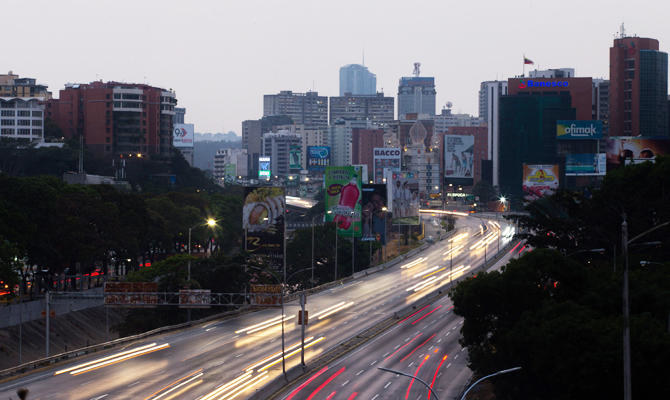

Weary Venezuelans adapt to more nationwide power cuts

- The new outage appeared to have affected the majority of the 23 states in Venezuela, whose steep economic decline contributed to the flight of more than 3 million people


Trump takes unconventional approach to communicating to the public about war in Iran
- The communications strategy opened Trump to criticism that he hadn’t done enough to explain the rationale and objectives of the war
Typical of an unconventional presidency, the Trump administration waited more than 48 hours to make any live, public communication to the American people about why it had decided to go to war with Iran.
President Donald Trump discussed why he launched the attack prior to a White House ceremony honoring military heroes on Monday but took no questions from reporters. Earlier in the day, Defense Secretary Pete Hegseth and Joint Chiefs of Staff Chairman Dan Caine briefed journalists at the Pentagon.
The two days previous, Trump delivered two pretaped statements that were released on Truth Social, the social media site owned by the president’s media company, and granted telephone interviews to more than a dozen journalists — several of which produced fragmented responses that, to some, clouded as much as they cleared up.
The communications strategy opened Trump to criticism that he hadn’t done enough to explain the rationale and objectives of the war, even as the American military suffered its first casualties. By contrast, Israeli Prime Minister Benjamin Netanyahu, who has teamed with the US against Iran, delivered two statements the day the war began and addressed reporters Monday at the site of a missile attack that killed nine people. The Israeli military has held multiple press briefings each day.
“The American people need a commander in chief, and he has been absent in that role,” Rahm Emanuel, White House chief of staff under President Barack Obama, said on CNN Monday. Emanuel, a Democrat, is contemplating a run for the presidency in 2028.
An unconventional strategy leads to criticism
Peter Baker, chief White House correspondent for The New York Times, wrote on social media that “after Trump launched a new war on Iran, he did not rush back to the White House to make an Oval Office address to rally the nation as other presidents have done. He stayed at Mar-a-Lago to attend a glitzy political fundraiser.”
That post provoked a response from Steven Cheung, White House communications director. “Imagine being a reporter so consumed with Trump Derangement Syndrome that he wants President Trump to mimic the failed policies of the past. The truth is that President Trump spent the majority of his time monitoring the situation in a secure facility, in constant contact with world leaders, and made multiple addresses to the nation that garnered hundreds of millions of views. He also took dozens of calls with reporters.”
The calls included one with Baker’s colleague at The Times, Zolan Kanno-Youngs. Trump’s mobile phone number is known to many of the reporters who cover him, and the president often takes their calls for on-the-spot interviews. Besides The Times, he spoke in the aftermath of the attack to journalists for ABC, CBS, NBC, CNN, CNBC, Fox News Channel, The Atlantic, The Washington Post, Axios, Politico and an Israeli television station.
Most of the calls were brief and marginally illuminating; Politico’s Dasha Burns said Trump answered but said he was too busy to talk. The public couldn’t hear what Trump said in the interviews and was dependent upon what the journalists chose to report on the conversations.
“I spoke to President Trump today and he told me that the operation in Iran is going to go very fast,” Libby Alon, a reporter for Channel 14 News in Israel, wrote about her interview on X. “It’s doing very well, and (will) make the people of Israel very happy, and the people of the world very happy.”
The Times reported that in its six-minute chat, Trump “offered several seemingly contradictory visions of how power might be transferred to a new government — or even whether the existing Iranian power structure would run that government or be overthrown.”
In one of his two conversations with Trump, ABC News’ Jonathan Karl said when he asked about the death of Iranian Ayatollah Ali Khamenei, the president said: “I got him before he got me. They tried twice. Well I got him first.” CNN’s Jake Tapper went on the air minutes after his conversation Monday, saying Trump told him “the big one is coming soon,” an apparent reference to a future attack.
Asked for comment, White House spokeswoman Anna Kelly said: “President Trump is the most transparent and accessible president in American history. The American people have never had a more direct and authentic relationship with a president of the United States than they have with President Trump.”
Hegseth briefing concentrates on friendly reporters
Pentagon reporters learned late Sunday about Hegseth’s briefing. Reporters from The Associated Press, Reuters, ABC, CBS, NBC, CNN, Fox News Channel and Stars & Stripes were permitted into the briefing room, but Hegseth did not call on them. Instead, he took questions from NewsNation and Trump-friendly outlets like the Daily Caller, Daily Wire, One America News and the Christian Broadcasting Network. Most mainstream news outlets left their regular stations at the Pentagon last fall rather than agree to Hegseth’s rules restricting their work.
Hegseth denounced the “foolishness” of people wanting to know details of the operation in advance, such as whether Americans would commit to more than air power, and said the operation would continue as long as it took to achieve objections. He initially ignored NBC News’ Courtney Kube when she called out a question: “President Trump put a four-week time limit on it. Are you saying he’s wrong?”
Later, Hegseth denounced Kube for asking “the typical NBC sort of gotcha-type question. President Trump has all the latitude in the world to talk about how long it might take — four weeks, two weeks, six weeks, it could move up, it could move back. We’re going to execute at his command the objectives he set out to achieve.”
Unlike Pentagon briefings in past administrations, reporters were given assigned seats, with the Trump-friendly outlets seated in front. Jennifer Griffin, Hegseth’s former colleague at Fox News Channel who left the Pentagon with other reporters after not accepting his new rules, was seated in the last row.


