India’s Congress party vows basic income for millions of India’s poorest

1 / 2
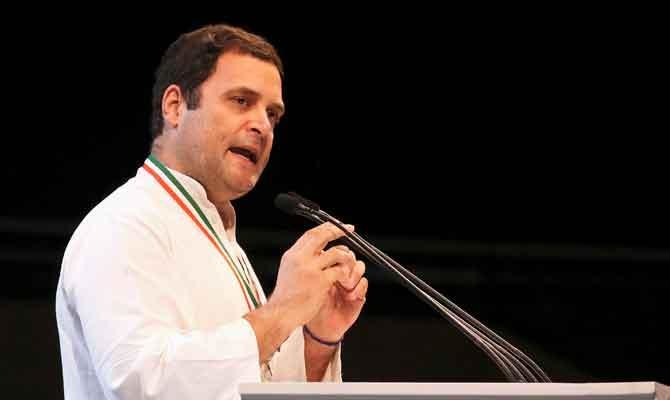
Indian Congress party president Rahul Gandhi addresses the 48th Congress plenary session in New Delhi, India, Saturday, March 17, 2018. (AP)
2 / 2
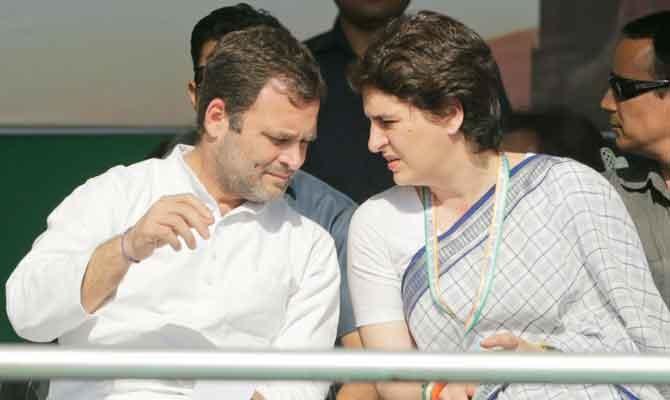
India's main opposition Congress party President Rahul Gandhi, left, speaks with his sister and party General Secretary Priyanka Gandhi Vadra during a public meeting at Adalaj in Gandhinagar, India, Tuesday, March 12, 2019. (AP)
Updated 26 March 2019
Follow

India’s Congress party vows basic income for millions of India’s poorest

  • Gandhi, whose father, grandmother and great-grandfather were all prime ministers, has attacked Modi’s economic record, accusing him of failing to create jobs for the nation’s youth

NEW DELHI: Opposition leader Rahul Gandhi on Monday vowed a “final assault on poverty” in India if elected prime minister in May, promising a minimum income for tens of millions of the country’s poorest.
The Congress Party leader, broadly seen as trailing the incumbent Narendra Modi in the race for top office, described the scheme to pay a guaranteed basic income of $1,000 a year to 50 million poor families as the largest of its kind on Earth.
The sop to voters comes less than three weeks before Indians start casting their ballots in mammoth elections that stretch nearly six weeks until May 19.
Modi’s Bharatiya Janata Party routed Congress at the last general election in 2014 and his supporters hope the Hindu nationalist leader can deliver another crushing victory.
But Gandhi is trying to close the gap, promising among other things a safety net for Indians living beneath the poverty line in the world’s second-most populous nation.
“People have suffered in the last five years. We will give justice to them,” the scion of the Gandhi-Nehru dynasty told reporters in Delhi.
“It is on this day that the Congress Party launched its final assault on poverty. It will be the world’s largest minimum income scheme.”
Gandhi, whose father, grandmother and great-grandfather were all prime ministers, has attacked Modi’s economic record, accusing him of failing to create jobs for the nation’s youth or aid desperate farmers.
His proposed cash handouts for the poor are seen as modelled loosely on universal basic income, a concept attracting growing interest around the world.
UBI — supported by Facebook founder Mark Zuckerberg among others as a way to reduce inequality — involves people being given a flat lump sum by the state instead of subsidies and social security payments.
It has been tried out in several countries including Finland and Kenya, and has been promised by the ruling party of the small northern Indian state of Sikkim as well as Italy’s new populist government.
Finance Minister Arun Jaitley said that Gandhi was using the poor for political gains with his new scheme.
“The announcement is a bluff. Congress has a history of doing politics over removing poverty and swindling people in name of poverty alleviation,” he told reporters.
Modi has already unveiled a raft of sweeteners for farmers and the middle class in Asia’s third-largest economy, hoping to deflect opposition salvos over his 2014 campaign promise to create “good days” for all.


Chinese visitors to Japan slump as spat rumbles on

Updated 5 sec ago
Follow

Chinese visitors to Japan slump as spat rumbles on

TOKYO: Mainland Chinese visitors to Japan tumbled 60.7 percent in January year-on-year, figures showed Wednesday, in the continued fallout from the countries’ diplomatic spat.
“Last year, the lunar new year began in late January, but this year it fell in mid-February,” the Japan National Tourism Organization said as it published the data.
“Additionally, the Chinese government issued a warning advising against travel to Japan. Factors such as reduced flight frequencies also contributed to the number of foreign visitors to Japan falling below the level of the same month last year,” a statement said.
Previously Chinese visitors were the biggest contingent, contributing to a tourism boom in the land of cherry blossom and Mount Fuji that was fueled by a weak yen making shopping cheap.
But in January this year, South Korea was the biggest source with 1.2 million visitors, up 21.6 percent, compared with 385,300 from mainland China, down from 980,520 in January 2025.
Visitors from Hong Kong also tumbled 17.9 percent.
Overall the number of visitors to Japan fell 4.9 percent to 3.597 million in January compared to the same period last year.
Prime Minister Sanae Takaichi suggested in November that Japan could intervene militarily if Beijing sought to take Taiwan by force.
China, which regards the democratic island as part of its territory and has not ruled out force to annex it, was furious.
Beijing summoned Tokyo’s ambassador and on November 14 warned Chinese citizens against visiting Japan, citing “significant risks to the personal safety and lives of Chinese citizens.”
The number of Chinese visitors to Japan already tumbled 45 percent in December to 330,000.
In December, J-15 jets from China’s Liaoning aircraft carrier twice locked radar on Japanese aircraft in international waters near Okinawa, according to Japan.
China also tightened controls on exports to Japan for items with potential military uses, fueling worries that Beijing may choke supplies of vital rare-earth minerals.
Japan’s last two pandas were even returned to China last month.
Takaichi, 64, was seen as a China hawk before becoming Japan’s first woman prime minister in October.
She won a landslide victory in snap elections on February 8, putting her in a strong position for the next four years to stamp her mark on Japanese domestic and foreign policy.
Takaichi said after her election win that Tokyo would bolster its defenses and “steadfastly protect” its territory.
She also said she was “open to various dialogues with China.”
But China’s foreign ministry said “genuine dialogue should be built on respect for one another.”
“Proclaiming dialogue with one’s mouth while engaging in confrontation — no one will accept this kind of dialogue,” foreign ministry spokesman Lin Jian said Tuesday.
Beijing’s top diplomat Wang Yi told the Munich Security Conference on Saturday that forces in Japan were seeking to “revive militarism.”