

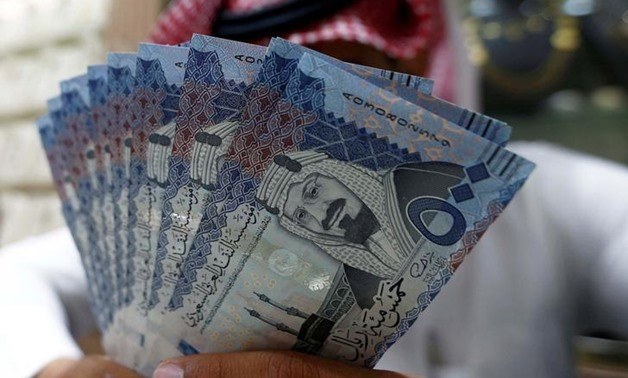
Pakistani rupee at all-time low against dollar due to excessive buying of Saudi Riyal

Many people in Pakistan are buying Saudi Riyals while preparing for the Hajj season since they fear further devaluation of Pakistani rupee, says President of the Pakistan Forex Association Malik Bostan. (Reuters)
Updated 12 April 2019
Follow

Pakistani rupee at all-time low against dollar due to excessive buying of Saudi Riyal

  • Exchange rate fluctuations not linked to ongoing dialogue with IMF, says finance ministry
  • Forex traders urge the government to maintain exchange rate in interbank market to stabilize the situation

ISLAMABAD: Pakistan’s Ministry of Finance said on Saturday that it was focused on strengthening the exchange rate regime after the rupee hit an all-time low of 140.36 against the US dollar on Friday in interbank trade, mainly pushed by the excessive buying of the Saudi Riyal for the upcoming Hajj season.

Malik Bostan, President Pakistan Forex Association, told Arab News that individuals who intended to go to Saudi Arabia for Umrah and Hajj in the coming months were excessively buying the Saudi Riyal due to “rumors of further depreciation of the Pakistani rupee.”

“We used to have five to seven million Riyals in surplus per day in market that were exported to the international market to import dollars,” he said. “However, now the Saudi Riyal is not in surplus due to its increasing demand in local market, and this gap has led to a shortage of US dollars.”

Bostan urged the government to maintain the exchange rate in the interbank market to “quell rumors of further devaluation of the Pakistani rupee in the coming days.”

The country’s currency exchange rate market remains highly volatile due to speculations of further depreciation of the local currency before Islamabad signs a bailout deal with the International Monetary Fund (IMF) next month.

The rupee on Friday plunged to 140.50 against the US dollar at one point, but it closed at 140.36.  The dollar gained one rupee in the interbank and 1.30 rupees in the open market during the week.

The Finance Ministry’s spokesman, Dr. Khaqan Hassan Najeeb, has denied any link between the exchange rate fluctuations and Pakistan’s ongoing negotiations with the IMF.

“The discussions with international partners do not entail any specific target of the exchange rate,” he said in a statement on Saturday.

“The government’s focus is on further strengthening the exchange rate regime, aligning it and keeping it consistent with the evolving macroeconomic fundamentals of the economy,” he added.

On March 15 this year, Pakistan received inflow of $1 bn from UAE as placement of funds. After taking into account outflows relating to external debt and other official payments, the total foreign exchange reserves held by central bank of the country increased by $716 million during the week to  $8.8 billion while reserves held by the commercial banks stood at $6.9 billion, increasing the total reserves held by the country to $15.709 billion by the end of the last week. 

China is also expected to release $2.1 billion in commercial loan by Monday, an injection that will further push up foreign currency reserves and help stabilize the exchange rate.


Islamic military coalition, Pakistan to deepen cooperation to combat ‘terrorism’ — Pakistani military

Updated 02 February 2026
Follow

Islamic military coalition, Pakistan to deepen cooperation to combat ‘terrorism’ — Pakistani military

  • Islamic Military Counter Terrorism Coalition is a 43-member alliance that includes Pakistan, Saudi Arabia, Egypt, Jordan, UAE and other nations
  • The Pakistani military statement comes after a meeting between IMCTC secretary-general and the chief of Pakistani defense forces in Rawalpindi

ISLAMABAD: Pakistan and the Islamic Military Counter Terrorism Coalition (IMCTC) have reaffirmed their commitment to deepening cooperation, including intelligence sharing and capacity building, to jointly combat “terrorism” and “extremism,” the Pakistani military said on Monday.

The IMCTC is a 43-member military alliance that was formed on Saudi Arabia’s initiative in Dec. 2015 to consolidate Muslim countries’ efforts in countering “terrorism.”

A 17-member IMCTC delegation is visiting Pakistan from Feb. 2-6 to conduct a training at National University of Sciences and Technology on “Re-integration and Rehabilitation of Extremist Elements,” according to the Pakistani military.

On Monday, IMCTC Secretary-General Maj. Gen. Mohammed bin Saeed Al-Moghedi held a meeting with Chief of Pakistani Defense Forces Field Marshal Asim Munir to discuss cooperation among IMCTC member states.

“During the meeting, matters of mutual interest were discussed, with particular emphasis on regional security dynamics and enhanced cooperation in counter-terrorism efforts,” the Inter-Services Public Relations (ISPR), the Pakistani military’s media wing, said in a statement.

“Both sides reaffirmed their shared commitment to combating terrorism and extremism through collaborative strategies, intelligence sharing, and capacity building among member states.”

The IMCTC features Pakistan, Saudi Arabia, Türkiye, Afghanistan, Egypt, Jordan, Qatar, Palestine, UAE, Bangladesh and other nations. In 2017, Pakistan’s former army chief Gen. (retd) Raheel Sharif was appointed as the IMCTC commander-in-chief.

During discussions with Major General Al-Moghedi, Field Marshal Munir appreciated the role of IMCTC in fostering stability and promoting coordinated counterterrorism initiatives across the Islamic world, according to the ISPR.

The IMCTC secretary-general acknowledged Pakistan’s significant contributions and sacrifices in the fight against militancy and lauded the professionalism of Pakistan’s armed forces.

“The meeting underscored the resolve of both sides to further strengthen institutional collaboration for peace, stability, and security in the region,” the ISPR added.

Pakistan enjoys cordial ties with most Muslim countries around the world, particularly Gulf Cooperation Council countries. In Sept. 2025, Pakistan signed a landmark defense pact with Saudi Arabia according to which an act of aggression against one country will be treated as an act of aggression against both.