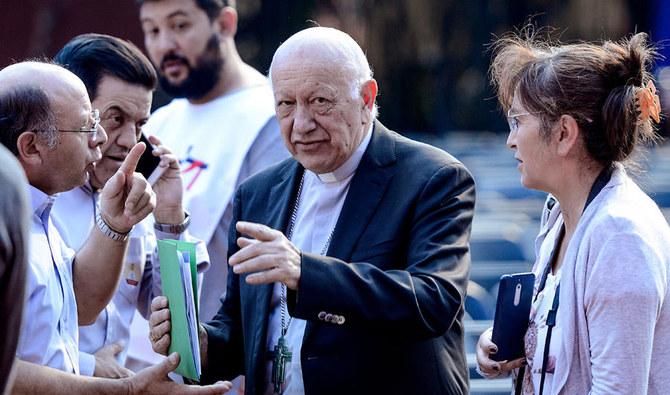
VATICAN CITY: Pope Francis on Saturday replaced Cardinal Ricardo Ezzati as archbishop of Santiago, Chile, after he was placed under criminal investigation in the country’s spiraling church sex abuse and cover-up scandal.
Francis accepted Ezzati’s resignation and named a temporary replacement to govern Chile’s most important archdiocese: the Spanish-born Capuchin friar and current bishop of Copiapo, Chile, Monsignor Celestino Aos Braco.
In a statement asking for prayers for his new job, Aos acknowledged the difficulties ahead, noting the “light and darkness, success and shortcomings, wounds and sins” of the Santiago church. But Aos too faced accusations of cover-up after a former seminarian accused him of helping stall his case years ago.
The 77-year-old Ezzati had submitted his resignation to Francis two years ago when he reached the mandatory retirement age of 75. But Francis kept him on, and Ezzati became the flashpoint of abuse survivors’ ire for mishandling several cases of abuse.
Just Friday, an appeals court in Chile allowed prosecutors to continue investigating Ezzati for an alleged cover-up, rejecting his motion to dismiss the case and remove himself from the probe, Chilean media reported.
Ezzati has denied covering up any cases but has acknowledged the pain of abuse victims and vowed to promote transparency.
At a press conference Saturday, he said he was leaving “with my head held high.” He insisted that all complaints that were lodged with the archdiocesan office he created in 2011 “have been investigated or are being investigated.”
Francis himself became embroiled in the Chilean scandal after initially discrediting victims during his 2018 trip to the country, sparking a crisis in confidence in the Chilean hierarchy and his own leadership.
After realizing his error and apologizing to the victims, Francis summoned all of Chile’s 30-plus active bishops to the Vatican last May and strong-armed them into offering their resignations. With Ezzati’s resignation Saturday, Francis has accepted eight of them.
Chilean abuse survivors have long accused Ezzati and his predecessor in Santiago, Cardinal Javier Errazuriz, of protecting predator priests and discrediting victims. In recent weeks, Ezzati has been embroiled in a new scandal after a man sued him for allegedly covering up his rape inside the cathedral.
The Chile abuse scandal first erupted in 2009, when victims publicly accused one of the country’s most prominent preachers, the Rev. Fernando Karadima, of molesting them for years. Errazuriz initially shelved an investigation, only to have the Vatican eventually convict Karadima in a church tribunal.
After the scandal exploded again last year, Francis stiffened the penalty against Karadima and defrocked him.
Pollsters have cited the Karadima scandal as the tipping point in the Chilean church’s progressive loss of credibility among ordinary Chileans.
Francis had sparked the recent crisis by strongly defending one of Karadima’s proteges, Bishop Juan Barros, against accusations that he had witnessed Karadima’s abuse and ignored it. But after realizing that something was amiss, Francis ordered a Vatican investigation that uncovered decades of abuse and cover-ups by the Chilean church leadership, Barros and Ezzati included.
One of Karadima’s victims and Ezzati’s harshest critic, Juan Carlos Cruz, welcomed Aos’ appointment, tweeting that “anything is better than Ezzati and his band.”
In a joint statement, he and Karadima’s other whistleblowers said they hoped Aos “would bring about a culture centered on victims and vulnerable people and no longer one of culture and cover-up.”
But a former seminarian, Mauricio Pulgar, said Aos didn’t allow him to present proof or witnesses to back up his claims of abuse by a priest, the Rev. Jaime Da Fonseca, when he first presented them in 2012.
In an interview with The Associated Press, Pulgar said Aos — who as a priest had been tasked with investigating the case in Valparaiso — “covered up abusers and one of them was Jaime Da Fonseca and that allowed him to keep abusing for six more years.”
Da Fonseca was finally defrocked last year. Aos left Valparaiso in 2014 to become bishop of Copiapo; the bishop running Valparaiso at the time was removed last year as part of Francis’ cover-up house-cleaning.
The Chilean Church did not immediately respond to a request for comment Saturday on Aos’ role in the Da Fonseca case.


![]()

Pope replaces Chile bishop accused of sex abuse cover-up
Pope replaces Chile bishop accused of sex abuse cover-up
- Chilean abuse survivors have long accused Ezzati and his predecessor in Santiago of protecting predator priests and discrediting victims
- The Chile abuse scandal first erupted in 2009 when victims accused a prominent preacher of molesting them for years


Latest updates


© 2026 SAUDI RESEARCH & PUBLISHING COMPANY, All Rights Reserved And subject to Terms of Use Agreement.