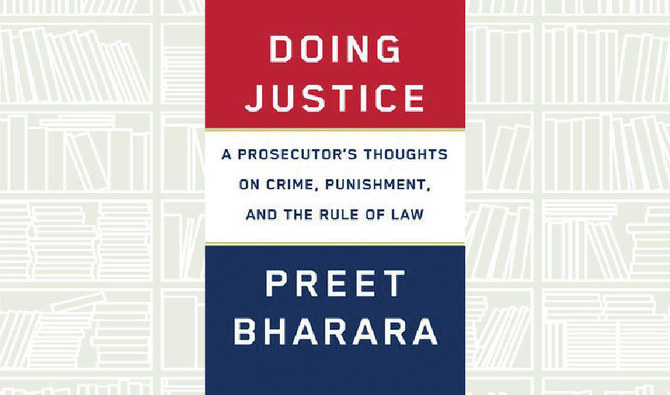
What We Are Reading Today: Doing Justice

Updated 24 March 2019
Follow

What We Are Reading Today: Doing Justice

Author: Preet Bharara

Preet Bharara’s book is divided into four sections: Inquiry, Accusation, Judgment, and Punishment.
Bharara, the one-time US federal prosecutor for the Southern District of New York, shows why each step of this process is crucial to the legal system.
Bharara uses anecdotes and case histories from his legal career — the successes as well as the failures — to illustrate the realities of the legal system, and the consequences of taking action. 
The book — an overview of crime, punishment and the rule of law — examines first how successful prosecutors select their cases and prepare the evidence they will use in court. 
It also shows “how we all need to think about each stage of the process to achieve truth and justice in our daily lives,” said a review published in goodreads.com.
“His case stories of how justice is done, and how it sometimes fails, are riveting,” it added.
“It is a thought-provoking, entertaining book about the need to find the humanity in our legal system — and in our society,” the review added.


What We Are Reading Today: ‘Lead with Influence’

Photo/Supplied
Updated 1 min 14 sec ago
Follow

What We Are Reading Today: ‘Lead with Influence’

  • The strength of “Lead with Influence” lies in its clarity and practicality

Author: Matt Norman

In “Lead with Influence: A Proven Process to Lead Without Authority” (2024), Matt Norman explores how genuine leadership begins not with control, but with understanding.

As president of Norman & Associates, a Dale Carnegie Training affiliate, Norman distills decades of coaching experience into a model that treats influence as a daily discipline rather than an abstract concept. 

To illustrate his ideas, Norman weaves in the story of Clara, a professional whose experiences reflect the challenges of leading without formal power.

Her journey, alongside the quiet guidance of her colleague, John, acts less as a traditional narrative and more like a mirror for the reader. Through her circumstances, Norman brings abstract concepts — trust, self-awareness and thoughtful communication — into focus.

At the book’s core is an exploration of how people think and respond. Norman highlights four intertwined dimensions of human cognition: reason, emotion, identity and instinct. 

Understanding these elements, he suggests, allows leaders to influence not by arguing or asserting themselves, but by creating space for others to see and decide more clearly. Leadership, in this framing, becomes an act of facilitation rather than persuasion. 

The strength of “Lead with Influence” lies in its clarity and practicality. Blending storytelling with tested leadership principles, Norman transforms ideas into tools that can reshape everyday interactions. 

His reflections invite readers to think differently about meetings, coaching moments and difficult conversations, connecting theory with lived experience.

I found Norman’s approach both useful and immediately applicable. His writing is grounded in human behavior rather than idealized leadership tropes.

The book ultimately argues that connection matters more than authority, and that true leadership begins with listening. It is a timely and encouraging reminder that influence is earned through humility, empathy and sustained intention.