Energy giants spent $1bn on climate lobbying, PR since Paris: watchdog

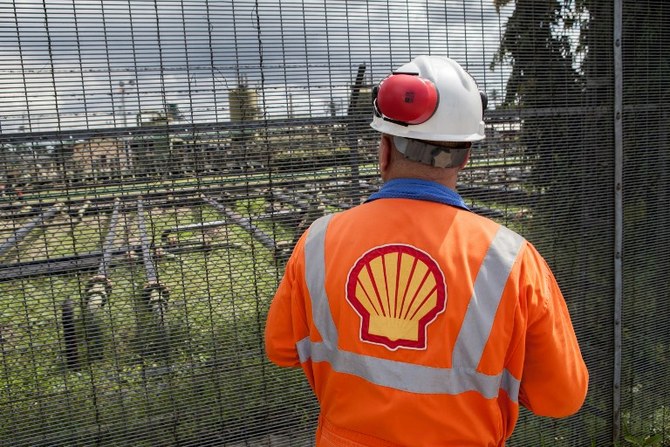
BP and other oil and gas giants are being challenged over their spending on lobbying and climate branding. (File photo/AFP)
Updated 23 March 2019
Follow

Energy giants spent $1bn on climate lobbying, PR since Paris: watchdog

  • Firms under pressure to explain how greener laws will hit business models

PARIS: The five largest publicly listed oil and gas majors have spent $1 billion since the 2015 Paris climate deal on public relations or lobbying that is “overwhelmingly in conflict” with the landmark accord’s goals, a watchdog said Friday.
Despite outwardly committing to support the Paris agreement and its aim to limit global temperature rises, ExxonMobil, Shell, Chevron, BP and Total spend a total of $200 million a year on efforts “to operate and expand fossil fuel operations,” according to InfluenceMap, a pro-transparency monitor.
Two of the companies — Shell and Chevron — said they rejected the watchdog’s findings.
“The fossil fuel sector has ramped up a quite strategic program of influencing the climate agenda,” InfluenceMap Executive Director Dylan Tanner told AFP.
“It’s a continuum of activity from their lobby trade groups attacking the details of regulations, controlling them all the way up, to controlling the way the media thinks about the oil majors and climate.”
The report comes as oil and gas giants are under increasing pressure from shareholders to come clean over how greener lawmaking will impact their business models.
As planet-warming greenhouse gas emissions hit their highest levels in human history in 2018, the five companies wracked up total profits of $55 billion.
At the same time, the International Panel on Climate Change — composed of the world’s leading climate scientists — issued a call for a radical drawdown in fossil fuel use in order to hit the 1.5C (2.7 Fahrenheit) cap laid out in the Paris accord.
InfluenceMap looked at accounts, lobbying registers and communications releases since 2015, and alleged a large gap between the climate commitments companies make and the action they take.


It said all five engaged in lobbying and “narrative capture” through direct contact with lawmakers and officials, spending millions on climate branding, and by employing trade associations to represent the sector’s interests in policy discussions.
“The research reveals a trend of carefully devised campaigns of positive messaging combined with negative policy lobbying on climate change,” it said.
It added that of the more than $110 billion the five had earmarked for capital investment in 2019, just $3.6bn was given over to low-carbon schemes.
The report came one day after the European Parliament was urged to strip ExxonMobil lobbyists of their access, after the US giant failed to attend a hearing where expert witnesses said the oil giant has knowingly misled the public over climate change.
“How can we accept that companies spending hundreds of millions on lobbying against the EU’s goal of reaching the Paris agreement are still granted privileged access to decision makers?” said Pascoe Sabido, Corporate Europe Observatory’s climate policy researcher, who was not involved in the InfluenceMap report.
The report said Exxon alone spent $56 million a year on “climate branding” and $41 million annually on lobbying efforts.
In 2017 the company’s shareholders voted to push it to disclose what tougher emissions policies in the wake of Paris would mean for its portfolio.
With the exception of France’s Total, each oil major had largely focused climate lobbying expenditure in the US, the report said.
Chevron alone has spent more than $28 million in US political donations since 1990, according to the report.
AFP contacted all five oil and gas companies mentioned in the report for comment.
“We disagree with the assertion that Chevron has engaged in ‘climate-related branding and lobbying’ that is ‘overwhelmingly in conflict’ with the Paris Agreement,” said a Chevron spokesman.
“We are taking action to address potential climate change risks to our business and investing in technology and low carbon business opportunities that could reduce greenhouse gas emissions.”
A spokeswoman for Shell — which the report said spends $49 million annually on climate lobbying — said it “firmly rejected” the findings.
“We are very clear about our support for the Paris Agreement, and the steps that we are taking to help meet society’s needs for more and cleaner energy,” they told AFP.
BP, ExxonMobil and Total did not provide comment to AFP.
FASTFACTS

$ 28m

Chevron alone has spent more than $28 million in US political donations since 1990, according to the report.


Supply chains reel as carriers halt Gulf routes and impose war risk surcharges in response to Iran-US conflict

Updated 6 sec ago
Follow

Supply chains reel as carriers halt Gulf routes and impose war risk surcharges in response to Iran-US conflict

RIYADH: Global supply chains were disrupted on March 2 as the US-Iran conflict forced shipping lines and airlines to suspend routes, reroute traffic, and impose emergency surcharges across the Middle East.

As traffic slowed through the Strait of Hormuz and airspace restrictions spread across Gulf hubs, logistics providers halted new container bookings and adjusted operations, driving longer transit times, higher freight costs, and greater uncertainty for cargo owners worldwide.

Ship-tracking data cited by Reuters showed a maritime standstill taking shape near the Hormuz chokepoint, with roughly 150 crude and liquefied natural gas tankers anchored in open waters beyond the strait and additional vessels stationary on both sides, clustered near the coasts of Iraq, Saudi Arabia, and Kuwait, as well as the UAE and Qatar.

Industry guidance warned of heightened naval activity, anchorage congestion and potential insurance volatility, even as no formal international suspension of commercial shipping had been declared.

Rising tensions in the Gulf forced operational pullbacks, with Reuters reporting at least three tankers damaged and one seafarer killed, prompting shipowners to reassess their exposure in regional waters.

Container carriers acted to limit risk, with MSC Mediterranean Shipping Co. suspending new bookings for Middle East cargo amid security concerns and network uncertainty.

A.P. Moller–Maersk paused sailings through the Suez Canal and Bab el-Mandeb and suspended vessel crossings through the Strait of Hormuz, attributing the move to the worsening security situation following the start of the US-Israeli attack on Iran.

Rival operators began diverting vessels around the Cape of Good Hope, extending voyage times between Asia and Europe and tightening effective capacity. The longer routings are increasing fuel consumption and disrupting equipment repositioning cycles, adding strain to already stretched container availability in key export markets.

Freight costs rose further after Hapag-Lloyd introduced a formal War Risk Surcharge for cargo moving to and from the Upper Gulf, Arabian Gulf and Persian Gulf, citing what it described as the “dynamic situation around the Strait of Hormuz” and associated operational adjustments across its network.

The surcharge, effective March 2 until further notice, is set at $1,500 per twenty-foot equivalent unit for standard containers and $3,500 per unit for reefer containers and special equipment.  

The surcharge will apply to any booking made on or after March 2 that has not yet shipped, as well as cargo already in transit to or from affected Gulf regions. It will be paid by the booking party and excludes shipments regulated by the Federal Maritime Commission or SSE.

France-based shipping group CMA CGM said March 2 it will introduce an “Emergency Conflict Surcharge,” effective immediately, citing escalating security risks in the region. The surcharge will be set at $2,000 per 20-foot dry container, $3,000 per 40-foot dry container, and $4,000 per reefer or special equipment container.  

The measure applies to cargo moving to and from Iraq, Bahrain, and Kuwait, as well as Yemen, Qatar, Oman, the UAE, and Saudi Arabia. It also covers shipments to Jordan, Egypt via the Port of Ain Sokhna, Djibouti, Sudan, and Eritrea, encompassing trade linked to Gulf and Red Sea countries.

On the port side, DP World said operations had resumed at Jebel Ali Port in the UAE following precautionary disruption. The reopening restored activity at the Gulf’s largest transshipment hub, though the broader impact of rerouted vessels, suspended bookings and insurance constraints continues to limit throughput predictability.

Marine insurers added to the strain by issuing notices canceling war-risk cover for vessels operating in Iranian waters and surrounding areas, with changes taking effect on March 5.

The withdrawal of coverage complicates voyage approvals and introduces further pricing volatility for shipowners and charterers considering calls within the region.

Air freight networks have also been affected. Widespread flight cancellations and airspace restrictions across the Middle East disrupted passenger and cargo flows through key hubs, including Dubai.  

FedEx said it had temporarily suspended services in specific Middle East markets, including Bahrain, Israel, and Qatar, as well as Saudi Arabia, Kuwait, and the UAE, and halted pickup and delivery services in several Gulf countries due to escalating tensions and airspace closures, affecting time-sensitive shipments across several nations.

Air cargo disruption appears to be significant. Ryan Petersen, CEO of Flexport, a US multinational corporation that focuses on supply chain management and logistics, wrote on X on March 2 that “18 percent of global air freight capacity has been taken out of the market by conflict in the Middle East this weekend,” highlighting the scale of network dislocation as airspace closures and flight cancellations ripple across Gulf hubs.

While the figure has not been independently verified, it underscores the degree to which capacity constraints are tightening for time-sensitive shipments, including pharmaceuticals, electronics and industrial components.

Data from Lloyd’s List Intelligence underscores the scale of disruption to maritime throughput. Daily deadweight tonnage of tankers and gas carriers transiting the Strait of Hormuz fell sharply by March 1, reflecting what industry sources describe as a de facto halt in normal vessel movements.

The combined effect of halted transits, booking suspensions, war-risk pricing measures and air service interruptions is beginning to ripple through global supply chains. Energy exports remain the most immediately exposed given the strategic importance of the Strait of Hormuz, but sectors dependent on just-in-time inventory, from manufacturing to retail, are also facing longer lead times and rising logistics costs.

As of March 2, carriers and freight operators were prioritizing crew safety and asset protection while monitoring military developments. The duration of the conflict will determine whether the current disruption remains a short-term operational shock or develops into a prolonged restructuring of trade routes serving the Middle East.