

Pakistani prime minister says time for dialogue to resolve all issues with India

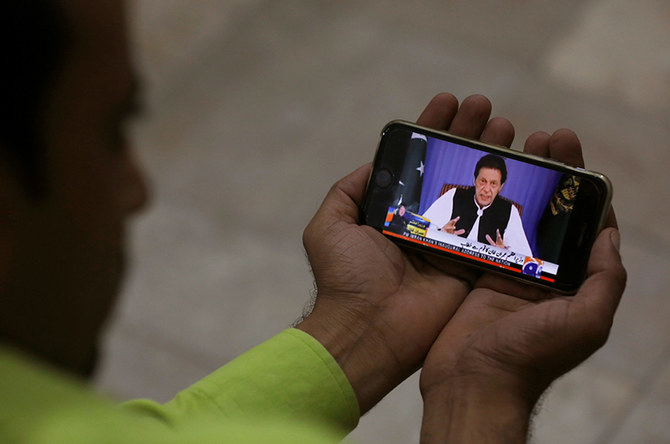
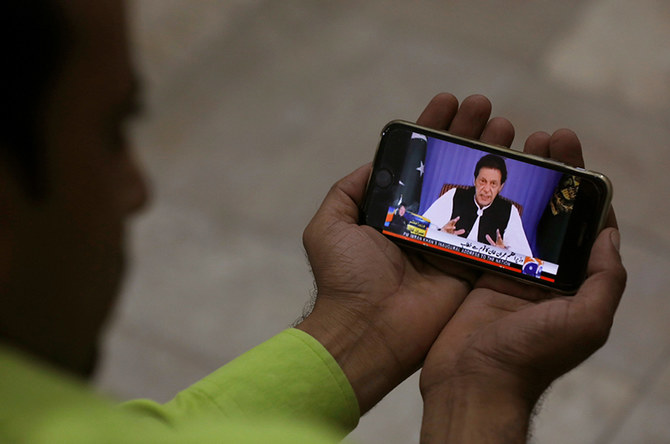
A Pakistani citizen watching Pakistani Prime Minister Imran Khan address to the nation on August 19, 2018. (File/Reuters)
Updated 23 March 2019
Follow

Pakistani prime minister says time for dialogue to resolve all issues with India

  • Khan welcomes Indian prime minister Modi’s message to the people of Pakistan on Pakistan Day
  • Says time to forge a new relationship based on peace and prosperity

ISLAMABAD: Pakistani Prime Minister Imran Khan on Friday welcomed a message from Indian Prime Minister Narendra Modi on the occasion of Pakistan Day and said it was time to begin a dialogue to resolve all issues.

Nuclear-armed neighbors Pakistan and India have fought three wars since gaining independence from British rule in 1947, two of them over Kashmir, a Muslim-majority region that both claim in full but govern in part.

Tensions between the arch-rivals rose sharply last month over a suicide attack in the Indian-controlled part of Kashmir in which at least 40 paramilitary troopers were killed. As India launched airstrikes in Pakistan and Pakistan retaliated with strikes of its own, the possibility of all-out war seemed all too real.

“I welcome PM Modi's message to our people,” Khan said in a Twitter post. “As we celebrate Pakistan Day I believe it is time to begin a comprehensive dialogue with India to address & resolve all issues, esp the central issue of Kashmir, & forge a new relationship based on peace & prosperity for all our people.”

In a separate post, Khan said he had received the following message from Modi on the occasion of Pakistan Day, celebrated across the country to mark the anniversary of a 1940 resolution calling for a separate homeland for Muslims in India:

"I extend my greetings & best wishes to the people of Pakistan on the National Day of Pakistan. It is time that ppl of Sub-continent work together for a democratic, peaceful, progressive & prosperous region, in an atmosphere free of terror and violence.”

Last year, soon after being elected as prime minister, Khan proposed talks to resolve the long-standing dispute over Kashmir and said Pakistan was ready to respond positively to any effort at dialogue.

“If India comes and takes one step toward us, we will take two,” Khan said after the July general election.

But in September, New Delhi called off a meeting between the Pakistani and Indian foreign ministers on the sidelines of the United Nations General Assembly, just a day after confirming it, citing “unclean intentions” on Pakistan’s side.

India has long accused Pakistan of backing militants fighting Indian rule in the Indian administered Kashmir. Pakistan denies this, saying it only provides diplomatic and moral support to people in Indian-held Kashmir fighting for self-determination.


Pakistan’s president defends ongoing strikes in Afghanistan, urges Kabul to dismantle militants

Updated 02 March 2026
Follow

Pakistan’s president defends ongoing strikes in Afghanistan, urges Kabul to dismantle militants

  • Afghanistan on Thursday launched attacks in retaliation for Pakistani airstrikes the previous Sunday
  • Pakistan’s military says it is only targeting Afghan military installations to avoid civilian casualties

ISLAMABAD: Pakistan’s president on Monday defended his country’s ongoing military strikes in neighboring Afghanistan, saying Islamabad tried all forms of diplomacy before targeting militants operating from Afghan territory, and called on the Taliban government in Kabul to disarm groups responsible for attacks in Pakistan.

Pakistan earlier said it is in “open war” with Afghanistan, alarming the international community. The border area remains a stronghold for militant organizations including Al-Qaeda and the Daesh (Islamic State) group.

“(The Afghan Taliban) must choose to dismantle the terror groups that survive on conflict and its war economy,” Asif Ali Zardari said during a speech to lawmakers, adding that “no state accepts serial attacks on its soil.”

Afghanistan on Thursday launched attacks in retaliation for Pakistani airstrikes the previous Sunday. Since then, Pakistan has carried out operations along the border, with Information Minister Attaullah Tarar claiming the killing of 435 Afghan forces and the capture of 31 Afghan positions.

Kabul has denied such claims.

In Afghanistan, the deputy government spokesman Hamdullah Fitrat said Pakistan’s military fired mortar shells at a refugee camp in eastern Kunar province, killing three children and injuring three others.

Afghanistan’s defense ministry said Afghan forces carried out strikes targeting a Pakistani military facility near Paktia province, causing “substantial losses and heavy casualties.”

Pakistan’s military did not respond to questions. It has said Pakistan is only targeting Afghan military installations to avoid civilian casualties.

Pakistan has witnessed a surge of violence in recent months and blames it on the outlawed Pakistani Taliban, known as Tehreek-e-Taliban Pakistan or TTP. It operates both inside Pakistan and from Afghan territory.
Islamabad accuses Afghanistan’s Taliban government of providing safe havens for the TTP, which Kabul denies.

The latest cross-border fighting ended a ceasefire brokered by Qatar and Turkiye in October. The two sides failed to reach a permanent agreement during talks in Istanbul.

Zardari reiterated Pakistan’s call for talks, saying, “We have never walked away from dialogue.”

The Pakistani leader again accused Afghanistan of acting as a proxy for India by sheltering militant groups.

“Stop being used by another country as a battlefield for their ambitions,” he said.

Zardari cited a recent report from the United Nations Security Council’s monitoring team that described the presence of militant groups in Afghanistan as an extra-regional threat.