Pakistan to receive $2.1 billion loan from China by March 25

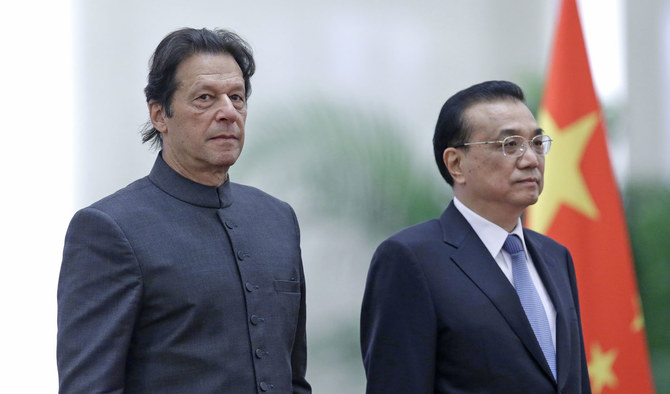
In this file photo, Pakistani Prime Minister Imran Khan, left, and China’s Premier Li Keqiang attend a welcome ceremony at the Great Hall of the People in Beijing on Nov. 3, 2018. (AFP)
Updated 22 March 2019
Follow

Pakistan to receive $2.1 billion loan from China by March 25

  • Pakistani finance ministry says loan will “help improve foreign exchange reserves and ensure balance of payment stability”
  • Pakistan also “closely engaged” in bailout discussions with the IMF

ISLAMABAD: Pakistan will receive a loan worth $2.1 billion from staunch ally China by Monday, the Pakistani finance ministry said, an injection that will help stabilize a wobbly economy hurt by a shortage of dollars plus ballooning current account and fiscal deficits.
Pakistan has been searching for investment from friendly countries since the government of Prime Minister Imran Khan took office in August.
Both Saudi Arabia and the United Arab Emirates have each offered Islamabad loan packages of $3 billion. Islamabad is also in talks with the International Monetary Fund (IMF) for a bailout deal expected to be signed next month. 
Unlike China and countries in the Middle East, the IMF is likely to demand painful structural reforms that might clash with the political agenda of Khan, who on the campaign trail vowed to build an Islamic welfare state.
“All procedural formalities for the loan worth $2.1 billion from China have been completed,” Dr. Khaqan Hassan Najeeb, the spokesperson for the Ministry of Finance, told Arab News, adding that the amount would be deposited in the central bank of Pakistan by March 25 to “help improve foreign exchange reserves and ensure the balance of payment stability.”
In November last year, China promised to support Pakistan’s economy following a meeting in Beijing between Chinese Premier Li Keqiang and Prime Minister Khan. The two countries also share the $60 billion China-Pakistan Economic Corridor (CPEC), which Beijing touts as the flagship infrastructure program in its vast Belt and Road Initiative.
On Friday, Gerry Rice, Director of Communications at the IMF, said at a press conference that the Fund was “closely engaged” in discussions with Pakistan for a loan deal and would take a mission to Pakistan “shortly.”
“I can’t put a date on when they [discussions] would conclude or when we would be in a position to announce agreement,” Rice added.
Fitch Solutions, a statistical rating organization headquartered in New York, said in a statement last month that Pakistan and the IMF could reach an agreement for a potential bailout package of about $12 billion.


Pakistan regulator amends law to facilitate capital raising by listed companies

Updated 19 January 2026
Follow

Pakistan regulator amends law to facilitate capital raising by listed companies

  • The amendments address challenges faced by listed companies when raising further capital from existing shareholders through a rights issue
  • Previously, listed companies were prohibited from announcing a rights issue if the company, officials or shareholders had any overdue amounts

KARACHI: The Securities and Exchange Commission of Pakistan (SECP) has notified amendments to the Companies (Further Issue of Shares) Regulations 2020 to facilitate capital raising by listed companies while maintaining adequate disclosure requirements for investors, it announced on Monday,

The amendments address challenges faced by listed companies when raising further capital from existing shareholders through a rights issue. Previously, listed companies were prohibited from announcing a rights issue if the company, its sponsors, promoters, substantial shareholders, or directors had any overdue amounts or defaults appearing in their Credit Information Bureau (CIB) report.

This restriction constrained financially stressed yet viable companies from raising capital, even in circumstances where existing shareholders were willing to support revival, restructuring, or continuation of operations, according to the SECP.

“Under the amended framework, the requirement for a clean CIB report will not apply if the relevant persons provide a No Objection Certificate (NOC) regarding the proposed rights issue from the concerned financial institution(s),” the regulator said.

The notification of the amendments follows a consultative process in which the SECP sought feedback from market stakeholders, including listed companies, issue consultants, professional bodies, industry associations, law firms, and capital market institutions.

The amendments are expected to enhance market confidence, improve access to capital for listed companies, and strengthen transparency within the rights issue framework, according to the SECP.

“To ensure transparency and protect investors’ interests, companies in such cases must make comprehensive disclosures in the rights offer document,” the regulator said.

“These disclosures must include details of any defaults or overdue amounts, ongoing recovery proceedings, and the status of any debt restructuring.”

The revised regulations strike an “appropriate balance” between facilitating corporate rehabilitation and enabling investors to make informed investment decisions, the SECP added.