

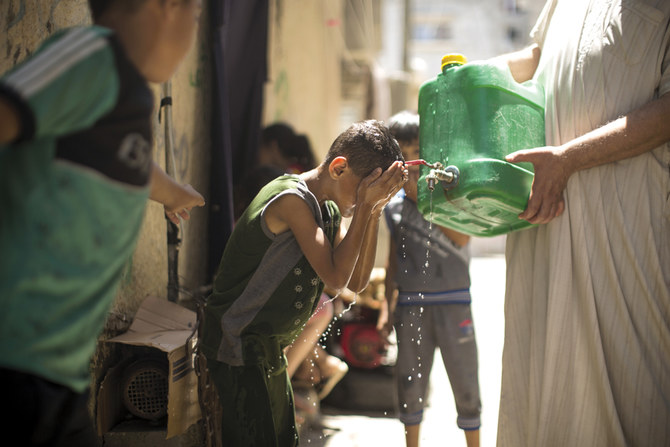

DUBAI: World Water Day had somewhat of an abysmal feel to it across the Middle East this year, as the region witnesses a growing number of people with no access to supplies of the vital resource.
Although the issue of supply has always been critical for the Arab region, known to be one of the most water-scarce in the world, matters are only getting worse with a rise in refugees and the displaced.
“The freshwater scarcity situation is aggravated by several factors, such as dependency on shared water resources, climate change, pollution, non-revenue water losses from aging systems, intermittency, inefficient use, and high population growth,” said Ziad Khayat, first economic affairs officer in water resources in the Sustainable Development Policies Division at the United Nations’ Economic and Social Commission for Western Asia (ESCWA). “Occupation and conflict also affect people’s ability to access water and sanitation services. The Arab region is perhaps the only one in the world still experiencing direct military occupation.”
He spoke of the Israeli occupation of Arab territories, which affects access to water resources and the ability of countries to properly manage and provide required water and sanitation services, with a ripple effect on food security, health and development. “Armed conflict in the region has resulted in the destruction of the water and sanitation infrastructure, hampering the provision of safe drinking water and sanitation,” he said. “In response to shortages, households resort to unregulated water vendors relying on compromised resources, such as unprotected wells. In addition, damaged wastewater systems have resulted in river waters and shallow wells becoming contaminated.”
Water shortages and electricity outages have rendered many health care facilities non-functional, while vulnerability to the outbreak of waterborne diseases, particularly for people living in conflict-affected countries, has greatly increased. “The systemic conditions affecting the Arab region’s water security are not expected to improve in the near future,” he said. “In fact, climate variability and change are projected to impose additional pressures, with adverse impacts on the quantity and quality of freshwater resources in an already water-scarce region, affecting its ability to ensure food security, sustain rural livelihoods and preserve ecosystems.”
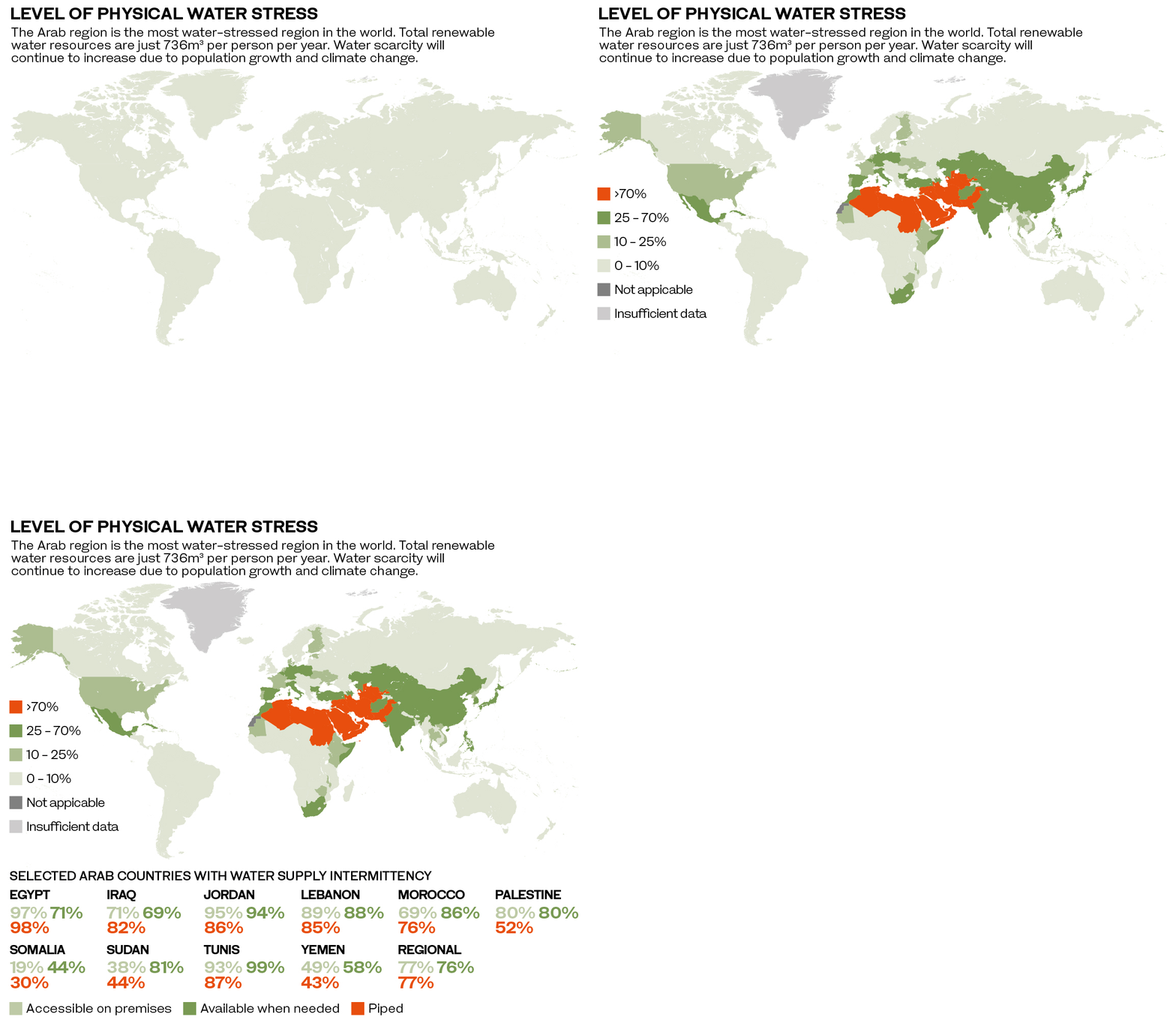
A higher frequency and intensity of floods, droughts and extreme weather is being experienced in many countries, which aggravates the situation of vulnerable communities and has led to economic losses and environmental degradation in several parts of the region. “The region has a high population growth rate and is one of the most urbanized in the world, with more than 58 percent of the population now living in cities,” Khayat said. “It has witnessed significant and uneven urban transformations, with some countries undergoing rapid wealth generation, others confronting economic challenges, and several afflicted by conflicts that have led to major displacement and migration of large sections of the population.”
Such trends are expected to place more stress on the urban infrastructure, particularly in water, given the scarcity conditions in the region. And with 86 percent of the region’s population — or nearly 362 million people — living in countries under water scarcity or absolute water scarcity, action is needed. “The predictions are that water scarcity is only going to get worse unless we change the way we manage the resource,” said Monika Weber-Fahr, executive secretary at the Global Water Partnership. “I remain an optimist. We were able to meet some of the water-related Millennium Development Goals (MDGs) and now, with the Sustainable Development Goals (SDGs), there is a new and broader resolve to, not just improve water supply and sanitation, but take a more holistic approach to managing water, including its transboundary aspects.”
 “Leaving no one behind” is the theme of this year’s World Water Day at the UN. The central challenge, Weber-Fahr believes, is that to achieve efficient, equitable, and sustainable water management, all parties must have genuine opportunities to actively participate in water management decisions. “Only then can decisions be taken that reflect how we all value water — reflecting its social, economic and environmental value,” she said. “We need to create a safe space for people to come together to build common ground for water management decisions, working with everyone, everywhere.”
In 2015, there were more than 51 million people in the Arab region lacking access to basic drinking water services, and more than 74 million without access to basic sanitation services. Access to water and sanitation is also lacking in rural areas compared with urban areas. “The record shows that in the past 10 to 12 years in the Arab region, the overall proportion of population with access to safe drinking water has improved from 85 percent to 90, almost reaching the global average of 91, but deteriorated in Palestine, Syria, Iraq, Jordan, Lebanon and Yemen, where it dropped from 94 percent to 88 due to military occupation, civil conflicts and insufficient investments,” said Dr. Waleed Zubari, professor in water resources management at the Arabian Gulf University in Bahrain. “Disparity between urban and rural population in both services continues to be considerably large, especially in the lower-income countries. This is expected to continue with the civil conflicts in Syria and Yemen and in Iraq, and under the military occupation of the West Bank and the blockade of the Gaza Strip.”
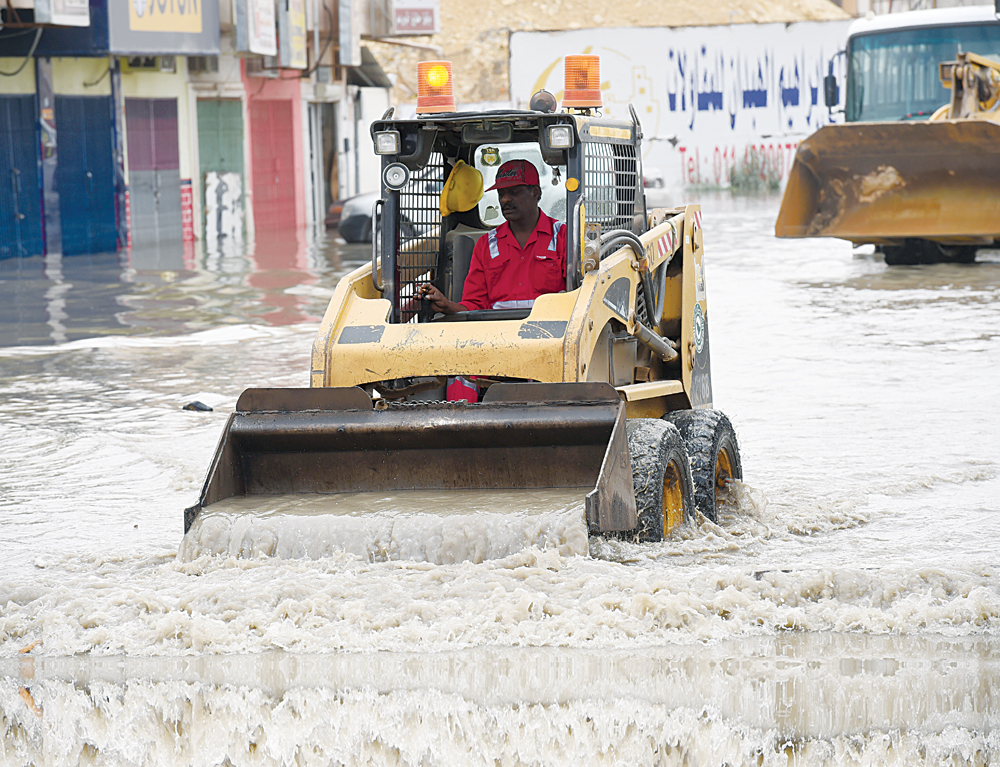
If only excess water during rainy days can be stored for use during the dry months, water shortage wouldnot be much of a problem. (AN file photo)
Climate change and drought are also expected to worsen river flows, which is the main source of water for many Arab countries such as Egypt, Iraq and Syria. “Whether we have achieved a universal access to water for all the population or not, there are some challenges that will stay with us in the Arab region,” he said. “Scarcity of water resources and limited endowments facing increasing water demands due to increased population will continue to be a major challenge in the region. Another issue that needs immediate attention is the water supply and use efficiency, recycling and reusing water, considered very low in the region, and if worked on, will reduce water stress tremendously.”
Peace and stability will also help improve the situation, as well as rebuilding the water sector in countries shattered by civil war and occupation. Similarly, water management, efficiency and conservation in policies will need to progress.
For Dr. Ahmed Murad, dean of the college of science at United Arab Emirates University, said that providing clean water for the population is essential for all communities. “Historically, the absence of water could increase conflicts between nations,” he said. “Latest statistics show that about 844 million people in the world live without access to safe water, and one in nine lack the access to safe water.”
He spoke of more pronounced circumstances in the Middle East, with high temperatures and a low amount of rainfall. “Such conditions with population growth may reduce the availability of clean water due to a high demand on water resources,” he said. “The limited and diverse water resources will pressurize natural resources, and this will continue to deteriorate if no action is taken.”


