

Turkey’s economic woes lift opposition hopes

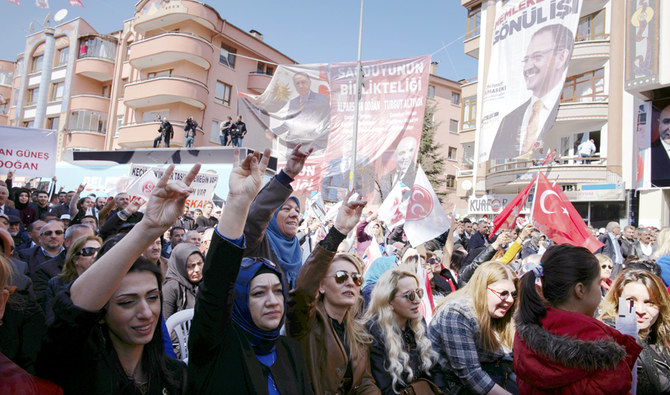
People listen to Mehmet Ozhaseki, the candidate of Turkey's ruling Justice and Development Party, AKP, and opposition Nationalist Movement Party, MHP, for Ankara Metropole, during a rally by MHP in Kecioren district, in Ankara, Turkey, on March 10, 2019. The countrywide local elections scheduled for March 31, 2019 with 57 million registered voters. (AP)
Updated 20 March 2019
Follow

Turkey’s economic woes lift opposition hopes

  • A recent poll by the opposition CHP in 29 provinces found that about 60 percent of voters are frustrated over the country’s economic decline
  • Voter frustration may translate into the loss of some big cities, including the capital Ankara and Istanbul

ANKARA: As Turkey’s March 31 local elections draw closer, economic issues are becoming a major priority for the country’s voters. 

While the ruling Justice and Development Party (AKP) has based its electoral success on the country’s prosperity for almost two decades, declining living standards and an economic downturn may signal a shift to rival parties in the election. 

Turkey was once an attractive option for investors trying to reach out to emerging markets, but the country’s economic outlook has changed significantly in recent years with double-digit inflation and a currency growing weaker by the day. 

Analysts say the economic concerns of middle-class voters, whose purchasing power has been primarily hit, will determine the electoral outcome if they turn against the AKP. 

In the previous local elections, the AKP won 43 percent of the vote, while its nearest rival, the Republican People’s Party (CHP), polled below 25 percent. 

Growing tensions between Turkey and the US are expected to further erode the value of the Turkish lira in the coming months. 

To reduce the impact of economic hardships on impoverished voters, Turkey’s government recently opened market stalls selling cheap produce. Long queues are a common sight at the stalls. 

Voter frustration may translate into the loss of some big cities, including the capital Ankara and Istanbul, where the AKP has ruled for decades.  Istanbul has added significance for President Recep Tayyip Erdogan, who began his political carrier as mayor of the city. Former Prime Minister Binali Yildirim is running for election in the city against his secular rival Ekrem Imamoglu. 

A recent poll by the opposition CHP in 29 provinces found that about 60 percent of voters are frustrated over the country’s economic decline. 

Burhanettin Bulut, a CHP parliamentarian, said Turkish voters’ top priority will be “their empty cooking pot in the kitchen.” 

“Parents cannot give pocket money to their children when sending them to the school. From early morning until night, their main concern is how to feed themselves. Nobody is happy about this trend,” he told Arab News. 

Berk Esen, an international relations professor at Ankara’s Bilkent University, believes the poor economic outlook will make the election results in some cities, such as Ankara and the northwestern industrial hub Bursa, much tighter than in previous polls. 

“Although AKP voters will not split with their parties in a single stroke, some may opt not to vote to show their frustration. Voter turnout will be important in these elections when even 1 percent of votes can determine a candidate’s success,” he said. 

Some analysts said the alliance between the AKP and the nationalistic MHP party could offset the votes lost due to the economic outlook. 

But Esen said that in some cities where MHP candidates were not nominated, nationalistic constituencies may choose not to vote or to vote for opposition parties. 

The use of “religion” card by the government following the New Zealand terror attack is also seen as a strategy to divert attention from its economic failures. 

According to this view, voters in Turkey will not change loyalties because of ideological commitment. 

“If we focus on 30 metropolitan provinces where the majority of voters live, the number of battlefront elections is about 12,” Dr. Emre Erdogan, founder and director of the independent Infakto Research Workshop in Istanbul, told Arab News. 

“The CHP is guaranteed two provinces in the west, including Izmir, and the pro-Kurdish HDP can already list three provinces in the southeast. It seems that the AKP will gain 13 provinces hosting 10 million voters. The remaining provinces where 25 million voters live are accepted as competitive,” he said. 

Erdogan said that declining economic conditions might lead to eight of these provinces, including the southern provinces of Antalya and Mersin, as well as the northwestern province of Balikesir, voting for opposition parties. 

“In Ankara and Istanbul, the two biggest cities, the victory of the opposition will depend on third parties — Kurdish and nationalists votes,” he said. 

The HDP, with electoral support of about 10 percent, did not nominate candidates for Istanbul and Ankara, and is supporting opposition candidates.


Palestinian shot dead in Hebron

Updated 4 sec ago
Follow

Palestinian shot dead in Hebron

  • Bedouin families continue flee West Bank village due to harassment by settlers living in illegal outposts

RAMALLAH: Palestinian health officials said on Sunday that Israeli forces shot dead a Palestinian man in the occupied West Bank city of Hebron, an incident the Israeli military said it was reviewing.
The Health Ministry in Ramallah said the Palestinian body that coordinates with Israeli authorities had informed it that Israeli fire had killed Shaker Falah Ahmad Al-Jaabari, 58, on Saturday evening.
The ministry said Israeli forces were still holding Al-Jaabari’s body.
Late on Saturday, the Israeli military said its troops had responded to a “threat and opened fire at the terrorist who attempted to run them over.
Hours later, however, the military said in a separate statement that investigators had found “no conclusive findings (to) indicate that the incident constituted an intentional terror attack,” adding the case remained under investigation.
Violence has surged across the West Bank since the war in Gaza broke out in October 2023 after an unprecedented attack by Hamas on Israel.
At least 1,029 Palestinians have been killed in the West Bank by Israeli forces or settlers since the war started, according to the Palestinian Health Ministry.
Some 500,000 Israelis have settled in the West Bank since Israel captured the territory, along with East Jerusalem and the Gaza Strip, in the 1967 Mideast war. 
Their presence is viewed by most of the international community as illegal and a major obstacle to peace. 
The Palestinians seek all three areas for a future state.
Over two dozen families from one of the few remaining Palestinian Bedouin villages in the central West Bank have packed up and fled their homes in recent days, saying harassment by Jewish settlers living in unauthorized outposts nearby has grown unbearable.
The village, Ras Ein El-Auja, was originally home to some 700 people from more than 100 families that have lived there for decades.
Twenty-six families already left on Thursday, scattering across the territory in search of safer ground, rights groups say. Several other families were packing up and leaving on Sunday.
“We have been suffering greatly from the settlers. Every day, they come on foot, or on tractors, or on horseback with their sheep into our homes. They enter people’s homes daily,” said Nayef Zayed, a resident, as neighbors took down sheep pens and tin structures.
Other residents pledged to stay put for the time being. That makes them some of the last Palestinians left in the area, said Sarit Michaeli, international director at B’Tselem, an Israeli rights group helping the residents.
She said that mounting settler violence has already emptied neighboring Palestinian hamlets in the dusty corridor of land stretching from Ramallah in the West to Jericho, along the Jordanian border, in the east.
The area is part of the 60 percent of the West Bank that has remained under full Israeli control under the interim peace accords signed in the 1990s. 
Since October 2023, over 2,000 Palestinians — at least 44 entire communities — have been expelled by settler violence in the area, B’Tselem says.
The turning point for the village came in December, when settlers put up an outpost about 50 meters (yards) from Palestinian homes on the northwestern flank of the village, said Michaeli and Sam Stein, an activist who has been living in the village for a month.
Settlers strolled easily through the village at night. Sheep and laundry went missing. International activists had to begin escorting children to school to keep them safe.
“The settlers attack us day and night, they have displaced us, they harass us in every way,” said Eyad Isaac, another resident. 
“They intimidate the children and women.”
Michaeli said she has witnessed settlers walk around the village at night, going into homes to film women and children and tampering with the village’s electricity.
The residents said they call the police frequently to ask for help — but it seldom arrives. 
Settlement expansion has been promoted by successive Israeli governments over nearly six decades. 
But Benjamin Netanyahu’s far-right government, which has placed settler leaders in senior positions, has made it a top priority.
That growth has been accompanied by a spike in settler violence, much of it carried out by residents of unauthorized outposts. 
These outposts often begin with small farms or shepherding that are used to seize land, say Palestinians and anti-settlement activists. 
UN officials warn the trend is changing the map of the West Bank, entrenching Israeli presence in the area.
For now, displaced families from the village have dispersed to other villages near the city of Jericho and Hebron, further south, residents said. 
Some sold their sheep and are trying to move into the cities.
Others are just dismantling their structures without knowing where to go.
“Where will we go? There’s nowhere. We’re scattered,” said Zayed, the resident, “People’s situation is bad. Very bad.”