UAE and Saudi Arabia emerging as regional ‘tech powerhouses’

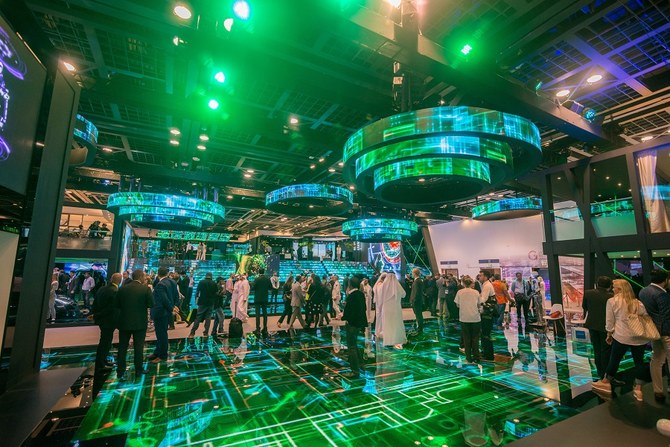
36th Gitex Technology Week in Dubai World Trade Center: New Technology exhibition in Gulf and MENA Region at DWTC, Dubai. (Shutterstock)
Updated 19 March 2019
Follow

UAE and Saudi Arabia emerging as regional ‘tech powerhouses’

  • UAE and Saudi Arabia still have work to be done in order to catch up with countries with cutting-edge skill sets in technology, business and data science
  • Ahead of private sector expansion, business will be a key area for improvement in the UAE and Saudi Arabia

DUBAI: The UAE and Saudi Arabia show the most promise in terms of skills in technology, according to the Coursera’s Global Skills Index, an in-depth report on skill trends and performance across 60 countries in the Middle East and around the world.

“The UAE shows the most promise in Technology (#40) compared to Business (#52) and Data Science (#38). This may be a reflection of the UAE government betting big on AI and fostering a testing ground for robotics,” the report stated.

“Saudi Arabia ranks higher in Technology (#50) compared to Business (#58) and Data Science (#58). Its strong performance in Human-Computer Interaction (92%) is likely a reflection of the government’s investment in digitization,” it added.

“Although there’s been a significant increase in education investment in recent decades, MEA students still aren’t graduating with the right skills, as the 31% youth unemployment rate indicates.”

While they are on the right track, and are regional powerhouses, results show that the UAE and Saudi Arabia still have work to be done in order to catch up with countries with cutting-edge skill sets in technology, business and data science such as Spain, Austria and Switzerland.

Ahead of private sector expansion, business will be a key area for improvement in the UAE and Saudi Arabia. The UAE’s lowest performing domain is business and it ranks #52 globally and #4 in the region. Saudi Arabia also ranks lower in business at #58 globally and second to last in the region. It lags the most in accounting and marketing (2%). Upskilling in business will be key areas to the region’s goals for private sector expansion.

“As the countries shift their industrial base away from natural resources, they must focus on building a knowledge-based economy that’s driven by a highly skilled workforce. The development of technology and data science skills, in particular, will continue to emerge with the adoption of new-age technologies such as Internet of Things, Artificial Intelligence and blockchain, underpinned by the UAE Vision 2021 and Saudi Arabia Vision 2030, respectively,” the findings stated.

Finland, Switzerland and Austria round up the top three worldwide respectively in terms of business skill sets, which include accounting, marketing, finance, sales, management and communication. Saudi Arabia, Bangladesh and Egypt, however, sit as the bottom three respectively.

Argentina, Czech Republic and Austria sit as the top three worldwide respectively in terms of technology, while Kenya, Pakistan and Nigeria round up the bottom three. Technology skill sets studied include computer networking, operating systems, human computer interaction, databases, security engineering and software engineering.

In terms of data science worldwide, Israel, Switzerland and Belgium are rated as the top three worldwide respectively, with Saudi Arabia, Pakistan and Nigeria sitting at the bottom three. Data science skills include math, statistics, machine learning, data management, statistical programming, and data visualization.

Coursera’s full Global Skills Index can be found below:


PIF’s Humain invests $3bn in Elon Musk’s xAI prior to SpaceX acquisition

Updated 18 February 2026
Follow

PIF’s Humain invests $3bn in Elon Musk’s xAI prior to SpaceX acquisition

JEDDAH: Humain, an artificial intelligence company owned by Saudi Arabia’s Public Investment Fund, invested $3 billion in Elon Musk’s xAI shortly before the startup was acquired by SpaceX.

As part of xAI’s Series E round, Humain acquired a significant minority stake in the company, which was subsequently converted into shares of SpaceX, according to a press release.

The transaction reflects PIF’s broader push to position Saudi Arabia as a central hub in the global AI ecosystem, as part of its Vision 2030 diversification strategy.

Through Humain, the fund is seeking to combine capital deployment with infrastructure buildout, partnerships with leading technology firms, and domestic capacity development to reduce reliance on oil revenues and expand into advanced industries.

The $3 billion commitment offers potential for long-term capital gains while reinforcing the company’s role as a strategic, scaled investor in transformative technologies.

CEO Tareq Amin said: “This investment reflects Humain’s conviction in transformational AI and our ability to deploy meaningful capital behind exceptional opportunities where long-term vision, technical excellence, and execution converge, xAI’s trajectory, further strengthened by its acquisition by SpaceX, one of the largest technology mergers on record, represents the kind of high-impact platform we seek to support with significant capital.” 

The deal builds on a large-scale collaboration announced in November at the US-Saudi Investment Forum, where Humain and xAI committed to developing over 500 megawatts of next-generation AI data center and computing infrastructure, alongside deploying xAI’s “Grok” models in the Kingdom.

In a post on his X handle, Amin said: “I’m proud to share that Humain has invested $3 billion into xAI’s Series E round, just prior to its historic acquisition by SpaceX. Through this transaction, Humain became a significant minority shareholder in xAI.”

He added: “The investment builds on our previously announced 500MW AI infrastructure partnership with xAI in Saudi Arabia, reinforcing Humain’s role as both a strategic development partner and a scaled global investor in frontier AI.”

He noted that xAI’s trajectory, further strengthened by SpaceX’s acquisition, exemplifies the high-impact platforms Humain aims to support through strategic investments.

Earlier in February, SpaceX completed the acquisition of xAI, reflecting Elon Musk’s strategy to integrate AI with space exploration.

The combined entity, valued at $1.25 trillion, aims to build a vertically integrated innovation ecosystem spanning AI, space launch technology, and satellite internet, as well as direct-to-device communications and real-time information platforms, according to Bloomberg.

Humain, founded in August, consolidates Saudi Arabia’s AI initiatives under a single entity. From the outset, its vision has extended beyond domestic markets, participating across the global AI value chain from infrastructure to applications.

The company represents a strategic initiative by PIF to diversify the Kingdom’s economy and reduce oil dependence by investing in knowledge-based and advanced technologies.