NAIROBI: Pakistan has lodged an official complaint with the United Nations over damage caused to a protected forest reserve during an air strike by India last month, Pakistan’s climate change minister Malik Amin Aslam Khan said on Monday.
The air strike in the Massar Jabba Forest Reserve had damaged a forest ecosystem which “could take up to a century to recover,” said Khan, Prime Minister Imran Khan’s adviser for climate change.
Khan said he handed over a dossier detailing the damage at the UN Environment Assembly (UNEA) in Nairobi, calling on the global body to condemn India and seek compensation.
“We think what happened was a strike on nature — it was a strike on the Massar Jabba Forest Reserve which is a protected ecosystem and a globally important carbon sink,” Khan told the Thomson Reuters Foundation in an interview.
“We are speaking for the voiceless trees of the Massar Jabba forest reserve which became a target of this operation.”
India and Pakistan are amidst their biggest stand-off in years, with the United States and other global powers mediating to de-escalate tensions between arch-foes who have fought three wars since independence from British colonial rule in 1947.
Indian warplanes on Feb. 26 bombed the hilly forest area near the northern Pakistani town of Balakot, about 40 km (25 miles) from India’s border in the Himalayan region of Kashmir.
India said it destroyed a militant training camp, adding Pakistan’s accusation of environmental damage was “misguided.”
“It is unfortunate that the Pakistan delegation has misused this forum and wasted the time on matters not relevant,” Rahul Chhabra, Permanent Representative to UN Environment told the world’s environment ministers at the UNEA last week.
“The air strike by India in Balakot in Pakistan was a precision and accurate strike directed at terrorists located in a terrorist training camp and the strike was not aimed at any environmental damage.”
Pakistan denies there were any such camps in the area.
The Jabba Massar Reserve Forest is located in Pakistan’s northwestern Khyber Pakhtunkhwa province and was established as a protected area in 2015 as part of the “Billion Trees Afforestation Project” which promotes forest regeneration.
A report by Pakistan after the air strike found damage to an area of 1.2 acres which included 19 pine trees valued at 2.7 million Pakistani rupees ($20,000) and soil erosion.
“The recovery of biomass lost due to this destructive action will take about a century to recover,” said the report, produced by a team of experts, including staff from the International Union for Conservation of Nature and World Wide Fund for Nature.
Khan said India had violated international rules such as a UN resolution which states “destruction of the environment, not justified by military necessity and carried out wantonly, is clearly contrary to existing international law.”
The damage contravened International Humanitarian Law, with additional protocols to the Geneva Convention prohibiting warfare which is intended to cause “long-term” and “severe” environmental damage, he added.
“In terms of the extent of damage, I mean, the whole forest did not go up in flames — but the fact is that the only victim of this atrocity was the environment,” said Khan.
“Nature paid a price for somebody’s madness. We want compensation, retribution and condemnation of this act.”


![]()
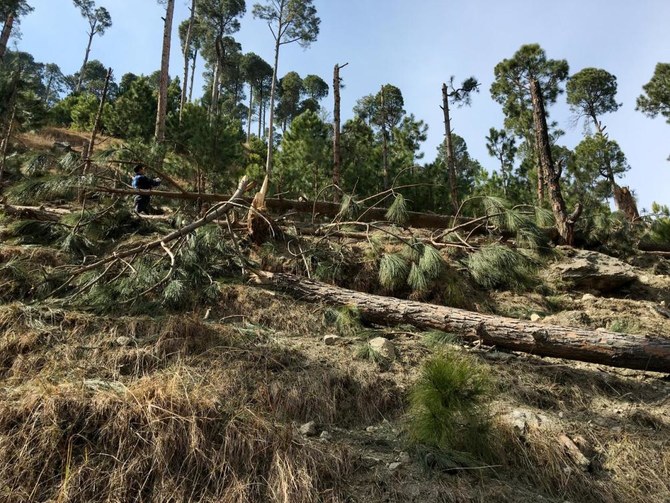

Pakistan lodges formal complaint to UN over forest damage by Indian air strike
Pakistan lodges formal complaint to UN over forest damage by Indian air strike
- The air strike in the Massar Jabba Forest Reserve had damaged a forest ecosystem which “could take up to a century to recover”

Mexico’s violence-hit Guadalajara to host World Cup games
GUADALAJARA: The city of Guadalajara erupted with cartel violence this past weekend, alongside other parts of Mexico, after an army raid left a notorious drug lord dead.
Now, Guadalajara is looking ahead nervously to the World Cup this summer, in which it will host four games.
Authorities are turning to technology to keep its slice of the planet’s premier sporting event safe, as Mexico is co-hosting the tournament with the United States and Canada.
Drones, anti-drone equipment and AI-driven video surveillance systems are some of the tools the state government of Jalisco — of which Guadalajara is the capital — will deploy to provide security.
The preparations come as Jalisco endures an epidemic of disappearances and the discoveries of clandestine graves, with Guadalajara having more of its residents go missing due to brutal drug-related violence than any other city in Mexico.
On Sunday, Nemesio “El Mencho” Oseguera, leader of the Jalisco New Generation Cartel and one of the most wanted men in Mexico and the United States, was killed in a military operation some 130 kilometers (80 miles) from Guadalajara.
The cartel reacted with fury, triggering gunfire with security forces that left at least 57 people dead across Mexico — both soldiers and cartel members — as well as highway blockades in 20 states.
Following the burning of buses and businesses, authorities suspended football games in Guadalajara and the central state of Queretaro.
Football’s world governing body FIFA declined to comment on the violence in one of the cup’s host cities.
On Monday, the streets of Guadalajara remained semi-empty, as businesses stayed shut as classes were suspended in Jalisco. Schools also shut down in a dozen other states.
Days before, state security officials had reported that Guadalajara was “peaceful.”
- ‘Grotesque situation’ -
Jalisco is one of the states with the most disappeared people in all of Mexico, with 12,575 reported missing, according to official statistics. More than half of the cases come from Guadalajara’s metropolitan area.
Disappearances are driven by forced recruitment for criminal groups, said Carmen Chinas, an academic at the University of Guadalajara.
Family members of disappeared people have unearthed hundreds of clandestine graves as they look for their loved ones.
Some activists have expressed dismay over Guadalajara’s hosting of the World Cup.
“I don’t think there is anything to celebrate. It seems like a pretty grotesque situation to me,” said 26-year-old Carmen Ponce, whose brother Victor Hugo was disappeared in 2020.
“The country celebrates goals while we are here searching,” she said at a field where last September she and her mother found buried plastic bags containing the remains of five people.
People are also jittery about hosting World Cup games in a city that has been through so much.
Juan Carlos Contreras, who oversees the city’s security camera network, told AFP there could be protests by residents furious with the government as they search for their missing loved ones.
- ‘Economic blow’ -
Missael Robles, a 31-year-old tour guide from Guadalajara, told AFP that he’s canceled as many as 25 tours since the Oseguera violence exploded on Sunday.
“The economic blow is a big deal,” he added.
Authorities have discovered properties used by criminal groups just a few kilometers from the Akron stadium which is due to host World Cup games.
Less than two kilometers (one mile) from the sporting complex, the state prosecutor’s office raided a house and arrested two people accused of kidnapping.
AFP saw chains wrapped around metal bars in the abandoned building, with the Akron stadium visible in the distance.
Jose Raul Servin, who has been looking for his son Raul since he disappeared in April of 2018, fears that tourists coming for the World Cup could be preyed on by crime gangs.
“We don’t want anything to happen,” he said, “like what’s happened to us.”
Servin remembers with nostalgia that his son was a football fan. “If he were here, he would be happy about the World Cup,” he said.
Now, Guadalajara is looking ahead nervously to the World Cup this summer, in which it will host four games.
Authorities are turning to technology to keep its slice of the planet’s premier sporting event safe, as Mexico is co-hosting the tournament with the United States and Canada.
Drones, anti-drone equipment and AI-driven video surveillance systems are some of the tools the state government of Jalisco — of which Guadalajara is the capital — will deploy to provide security.
The preparations come as Jalisco endures an epidemic of disappearances and the discoveries of clandestine graves, with Guadalajara having more of its residents go missing due to brutal drug-related violence than any other city in Mexico.
On Sunday, Nemesio “El Mencho” Oseguera, leader of the Jalisco New Generation Cartel and one of the most wanted men in Mexico and the United States, was killed in a military operation some 130 kilometers (80 miles) from Guadalajara.
The cartel reacted with fury, triggering gunfire with security forces that left at least 57 people dead across Mexico — both soldiers and cartel members — as well as highway blockades in 20 states.
Following the burning of buses and businesses, authorities suspended football games in Guadalajara and the central state of Queretaro.
Football’s world governing body FIFA declined to comment on the violence in one of the cup’s host cities.
On Monday, the streets of Guadalajara remained semi-empty, as businesses stayed shut as classes were suspended in Jalisco. Schools also shut down in a dozen other states.
Days before, state security officials had reported that Guadalajara was “peaceful.”
- ‘Grotesque situation’ -
Jalisco is one of the states with the most disappeared people in all of Mexico, with 12,575 reported missing, according to official statistics. More than half of the cases come from Guadalajara’s metropolitan area.
Disappearances are driven by forced recruitment for criminal groups, said Carmen Chinas, an academic at the University of Guadalajara.
Family members of disappeared people have unearthed hundreds of clandestine graves as they look for their loved ones.
Some activists have expressed dismay over Guadalajara’s hosting of the World Cup.
“I don’t think there is anything to celebrate. It seems like a pretty grotesque situation to me,” said 26-year-old Carmen Ponce, whose brother Victor Hugo was disappeared in 2020.
“The country celebrates goals while we are here searching,” she said at a field where last September she and her mother found buried plastic bags containing the remains of five people.
People are also jittery about hosting World Cup games in a city that has been through so much.
Juan Carlos Contreras, who oversees the city’s security camera network, told AFP there could be protests by residents furious with the government as they search for their missing loved ones.
- ‘Economic blow’ -
Missael Robles, a 31-year-old tour guide from Guadalajara, told AFP that he’s canceled as many as 25 tours since the Oseguera violence exploded on Sunday.
“The economic blow is a big deal,” he added.
Authorities have discovered properties used by criminal groups just a few kilometers from the Akron stadium which is due to host World Cup games.
Less than two kilometers (one mile) from the sporting complex, the state prosecutor’s office raided a house and arrested two people accused of kidnapping.
AFP saw chains wrapped around metal bars in the abandoned building, with the Akron stadium visible in the distance.
Jose Raul Servin, who has been looking for his son Raul since he disappeared in April of 2018, fears that tourists coming for the World Cup could be preyed on by crime gangs.
“We don’t want anything to happen,” he said, “like what’s happened to us.”
Servin remembers with nostalgia that his son was a football fan. “If he were here, he would be happy about the World Cup,” he said.
Latest updates


© 2026 SAUDI RESEARCH & PUBLISHING COMPANY, All Rights Reserved And subject to Terms of Use Agreement.