BEIRUT: Eight years of war in Syria have left more than 370,000 people dead including 112,000 civilians, a monitor said Friday.
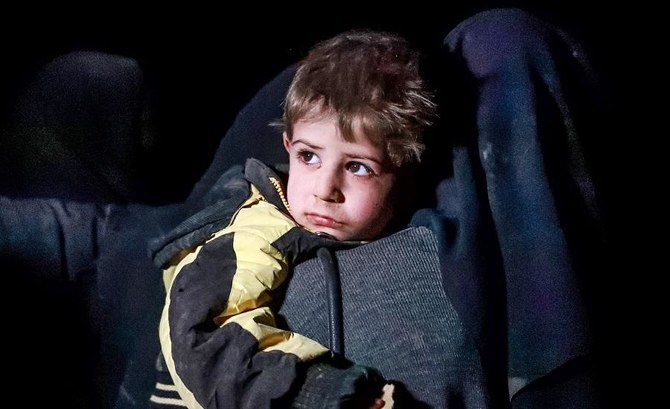
The Syrian Observatory for Human Rights, which has a network of sources across the country, said more than 21,000 children and 13,000 women were among the dead.
The conflict flared after unprecedented anti-government protests in the southern city of Daraa on March 15, 2011.
Demonstrations spread across Syria and were brutally suppressed by the regime, triggering a multi-front armed conflict that has drawn in foreign powers and militant groups.
The Britain-based Observatory's last casualty toll on the Syrian conflict, issued in September, stood at more than 360,000 dead.
Over 125,000 Syrian government soldiers and pro-regime fighters figured in the latest toll, the monitoring group said.
It said other fighters, including rebels and Kurds, accounted for 67,000 of those killed.
Almost 66,000 were militants, mainly from the Daesh group and Hayat Tahrir al-Sham (HTS), dominated by Al-Qaeda's former affiliate in Syria.
The devastating conflict has displaced or sent into exile around 13 million Syrians, causing billions of dollars-worth of destruction.
With the support of powerful allies Russia and Iran, President Bashar al-Assad has won his war for political survival but his country is fractured and cash-strapped.
Having reversed rebel gains with a massive Russian intervention, Assad now controls almost two-thirds of Syria's territory.
But key areas remain beyond regime control, including a swathe of the oil-rich northeast held by Kurdish-led fighters.
Washington backs the Syrian Democratic Forces, which are spearheading an anti-Daesh campaign, which is drawing to a close near the Iraqi border.
Idlib in northwestern Syria, held by HTS, is protected by a ceasefire deal between Ankara and Moscow which has seen Turkish troops deployed to the area.
Syria's conflict is estimated to have set its economy back three decades, destroying infrastructure and paralysing the production of electricity and oil.
Assad, however, has regained control of key commercial arteries and started a tentative comeback on the Arab diplomatic scene.
Several countries have called for Syria to be reintegrated into the Arab League, from which it was suspended as the death toll from the uprising mounted in 2011.


Syria death toll more than 370,000 in 8 years of war: monitor
Syria death toll more than 370,000 in 8 years of war: monitor
- More than 21,000 children and 13,000 women were among the dead
- 112,000 were civilians


German prosecutors seize assets in Lebanon bank fraud probe
- They allege that Salameh, acting with his brother Raja, “embezzled funds totalling more than $330 million”
- The money was laundered through a shell company in the British Virgin Islands
BERLIN: German prosecutors said Thursday they had seized assets worth around 35 million euros ($42 million) as part of a money-laundering probe targeting Lebanon’s former central bank governor Riad Salameh and four other people.
Salameh headed Lebanon’s central bank between 1993 and 2023 and has faced numerous accusations including embezzlement, money laundering and tax evasion in separate probes in Lebanon and abroad.
He has denied any wrongdoing.
Prosecutors in Munich said in a statement that “high-value commercial properties in Munich and Hamburg, as well as shares in a real estate company in Duesseldorf” had been seized as part of their investigation.
They allege that Salameh, acting with his brother Raja, “embezzled funds totalling more than $330 million to the detriment of the Lebanese central bank and thereby at the expense of the Lebanese state, in order to illegally enrich himself” between 2004 and 2015.
The funds originated from financial transactions between the Lebanese central bank and commercial banks in Lebanon.
The money was laundered through a shell company in the British Virgin Islands and used by Raja Salameh and three other co-accused for investments in Germany and elsewhere in Europe, prosecutors say.
A court in Munich will now decide whether the seized property can be permanently confiscated.
German prosecutors opened their investigation in 2021 and have been working with investigators from France and Luxembourg.
Salameh has been accused of being a key culprit in Lebanon’s economic crash, which the World Bank has called one of the worst in recent history, but he has defended his legacy and insisted he is a “scapegoat.”
He was arrested in Lebanon in 2024 and indicted in April 2025 for allegedly embezzling $44 million from the central bank.
In September he was freed after posting more than $14 million in bail and on condition of a one-year travel ban.


