


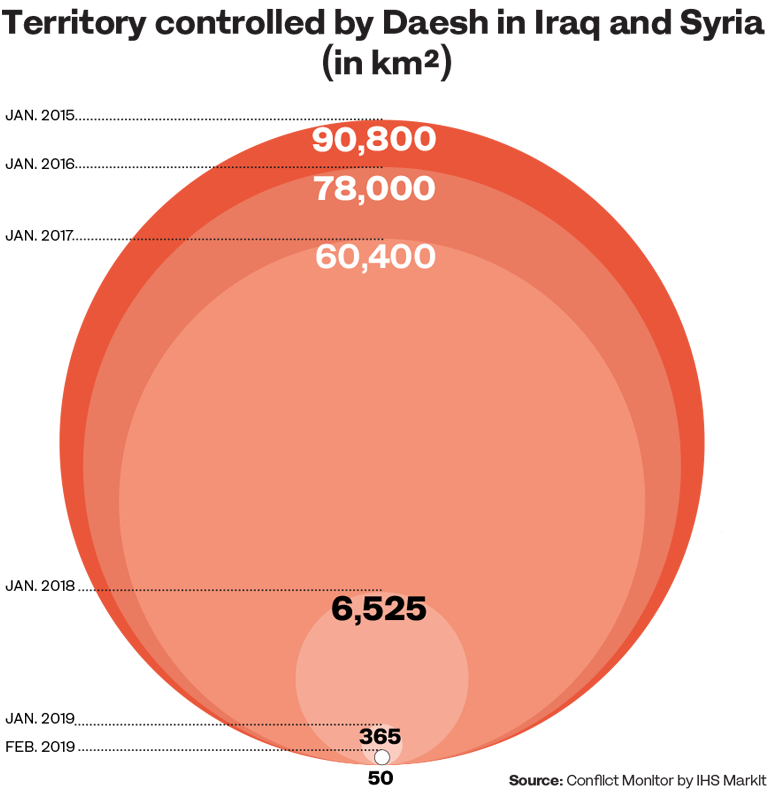
DUBAI: It is more than four years since Daesh terrorists overran large swathes of Syria and Iraq to declare a “caliphate” the size of Britain.
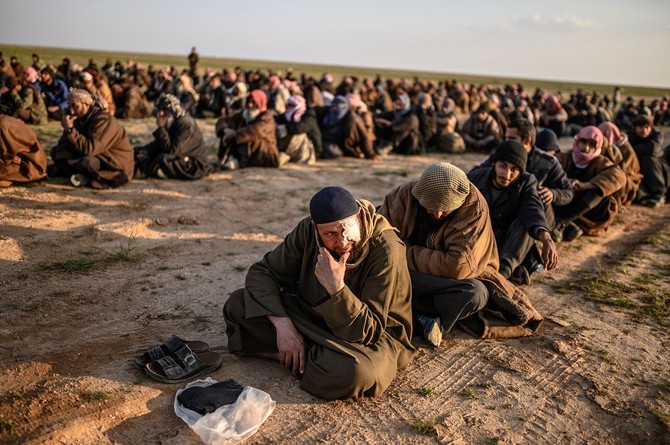
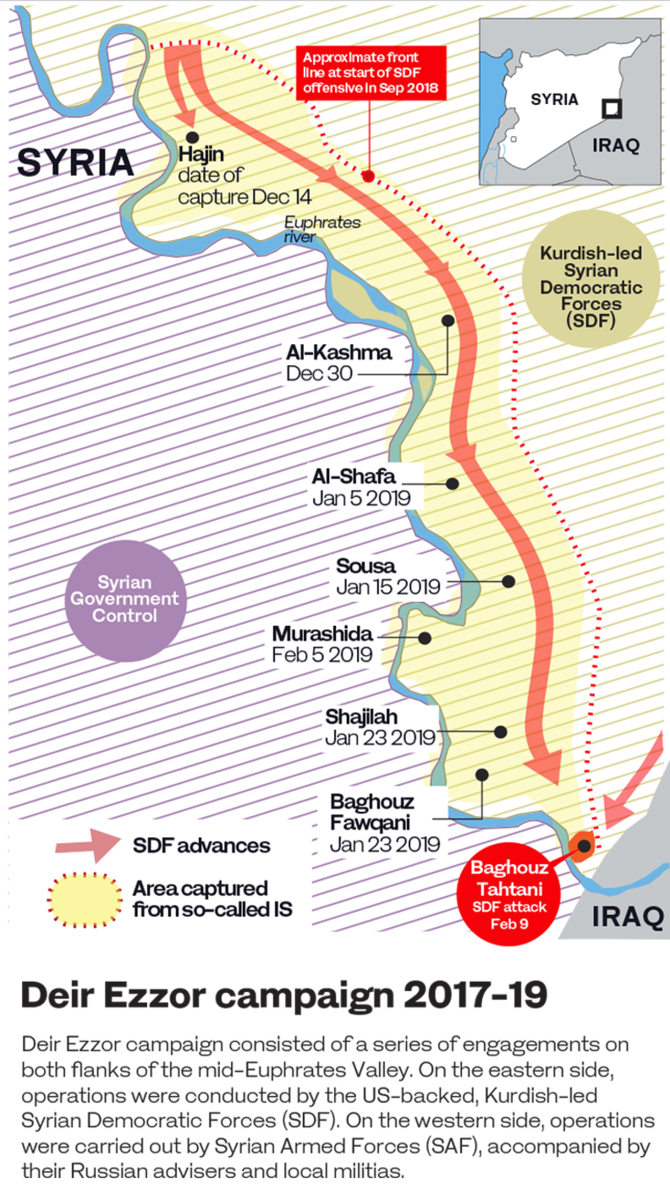
Experts say the terror group is now on the “brink of collapse” and territorially defeated, with US-backed forces in the process of taking its last pocket of land in the village of Baghouz, eastern Syria.
For weeks the world has been waiting for the “end of Daesh,” after US President Donald Trump predicted “great announcements” about Syria as the American-backed Syrian Democratic Forces (SDF) cornered the remaining militants.
The SDF had paused its months-long offensive many times to allow people to flee, but late on Sunday told the remaining Daesh fighters their time was up. On Monday, Agence France-Presse reported that the SDF had seized several positions from the terrorists still holed up in Baghouz.
But even when the last enclave falls, how defeated will Daesh really be?
David Reaboi, senior vice president for strategic operations at the Security Studies Group think tank, said the collapse of the Baghouz stronghold represents an almost total defeat.
“The (Daesh) phenomenon seems to have run its course, and disaffected Muslims from the West no longer view this particular Islamic State as a cause to join and from which to draw inspiration,” he said.
“The draw of a reconstituted caliphate has been central to historical and religious interpretations of Islam, so there was a fraught initial period in Daesh’s development when many were concerned that it would attract millions of adherents.” Thankfully, said Reaboi, a surge in followers failed to happen.
“This is because the obvious cruelty of the Islamic State in practice was off-putting to all but the most ideologically committed and otherwise disaffected.
“In subsequent years, several factors have led to the rise of national identities in the Middle East and in their European and American diasporas. Many young people, especially, now identify with their nation rather than with a pan-Islamic identity and are concentrating on supporting and ensuring positive change in their own societies,” he added.
“All this lessens a future caliphate temptation and ensures that the rise of another dead-end group such as Daesh is rejected by most young Muslims in the region.”
However, other analysts believe celebrations over the defeat of Daesh might be premature and should be coupled with caution, claiming terrorism cannot be “defeated,” only contained.
Columb Strack, a principal analyst at IHS Markit research group, warned of signs that the militants are regrouping to keep their foothold in the region.
“Islamic State has regrouped in Iraq since it was declared defeated by the Iraqi government in December 2017, and we are now seeing a resurgence in central Iraq,” said Strack. “We expect the same thing to happen in Syria.”

Michael Knights, a senior fellow at the Washington Institute for Near East Policy, told Arab News it was difficult to determine a definite end to the terror group. “No one can ever say with certainty that Daesh is permanently defeated: They have come back from the grave once already, having faced almost total defeat in Iraq in 2007-2010,” he said.
“(But) as a ground-holding caliphate, they have certainly been territorially defeated in the daytime and in terms of their control of cities.”
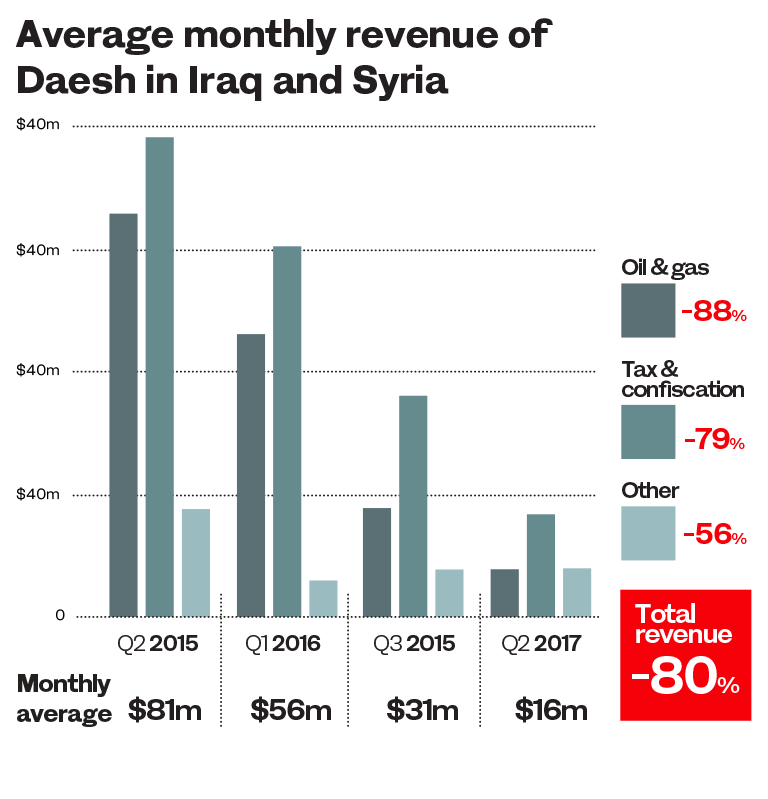
In a recent study on Daesh’s “Second Resurgence,” Brandon Wallace and Jennifer Cafarella, of the Washington-based Institute for the Study of War, said the jihadist group has already restructured its operations to return to a regional insurgency. “(Daesh) is finding new sources of revenue and rebuilding command-and-control over its scattered remnant forces in order to prepare for a future large-scale insurgency in both Iraq and Syria,” their report said.
Last month, the US Department of Defense also warned that Daesh in Syria could regroup if counter-terrorism measures were not put in place in the war-torn country.
Bruce Hoffman, a political analyst specializing in the study of terrorism and counterterrorism, agreed that caution needed to be applied.
“The White House’s own national strategy for counter-terrorism from October 2018 states that, notwithstanding the defeat of the caliphate, Daesh maintains eight official branches and more than two-dozen networks scattered across Africa, the Middle East, South Asia and South-East Asia, so claims that it has been defeated for good are contradicted by the administration’s own statement about its counter-terrorism strategy.”
Hoffman, a professor at Georgetown University’s Walsh School of Foreign Service, said that an ideology cannot be easily defeated, and “of course Daesh remains a long-term threat.”
“Only when it is incapable of resurrecting itself in any meaningful way, when its ideology no longer resonates, when recruits and money no longer are a factor in its longevity, and when lone wolves no longer heed its calls to violence, will it be permanently defeated,” Hoffman said.
Since June 29, 2014, Daesh has been linked to a string of deadly strikes in more than 24 countries.
The brutality of attacks claimed by the militants made global headlines: Paris in 2015, when teams of gun-wielding suicide bombers struck the French capital, killing at least 130 people and wounding 494 others; the 2016 assaults on a Brussels airport and subway station, which left more than 30 people dead and 270 wounded; the 2016 attacks at Turkey’s Istanbul Ataturk Airport, in which at least 44 people died and more than 230 were wounded.
One of the deadliest attacks by the group was in 2016, when a suicide car bomb in a Baghdad shopping district killed at least 292 people and injured another 200.
These atrocities, along with the execution of British aid worker David Haines in 2014, and the 2017 Manchester Arena suicide bombing which killed 22 people, caused world outrage.
Hoffman said there is “no doubt” that the brutality and far-ranging attacks claimed by Daesh in the past four years have been among the worst in living memory. “Even Al-Qaeda now seems ‘moderate’ in comparison and Al-Qaeda trades on its new status as self-described ‘moderate extremists’ to gather new longevity and, in some quarters, support.”
Although Daesh fighters still hold out in a tiny pocket of central Syria’s remote desert and have gone underground, their territorial rule is almost over.
Hoffman said the question now is what to do with hundreds of Daesh fighters captured in Syria. Last month, Trump urged “Britain, France, Germany and other European allies” to take back the militants captured by the US in Syria, but Hoffman believes the likelihood of that is low.
“None of these countries, including the US, knows what to do with the former fighters since in many cases evidence cannot be presented in open court, because it is either lacking or based on sensitive intelligence.”


