

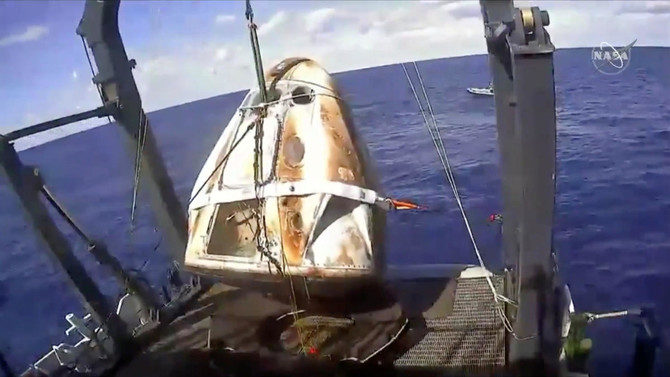

WASHINGTON: SpaceX’s Crew Dragon capsule completed its NASA demonstration mission Friday with a successful splashdown in the Atlantic Ocean, paving the way for the resumption of manned space flights from the US.
After hours of suspense, the Crew Dragon touched down in the Atlantic Ocean at 8:45 am some 230 miles (370 kilometers) off the coast of the US state of Florida.
The capsule brought its “crew” of one test dummy back to Earth in the same way that American astronauts returned to the planet in the Apollo era in the 1960s and 1970s, before the 1981-2011 Space Shuttle Program.
Successful splashdown of the #CrewDragon right on time at 8:45 a.m. ET. pic.twitter.com/0qHhHzD4Js
— NASA Commercial Crew (@Commercial_Crew) March 8, 2019
NASA TV footage showed the capsule gently drifting into the ocean, its decent slowed by its four main orange and white parachutes, which folded into the water around it as boats sped toward the site.
“Good splashdown of Dragon confirmed!” the SpaceX Twitter account tweeted.
“Beautiful parachute deployment,” said Benji Reed, the director of crew mission management at SpaceX. “I’m still shaking.”

An unmanned capsule of the SpaceX Crew Dragon spacecraft descends down into the Atlantic Ocean, after a short-term stay on the International Space Station, about 200 miles off the Florida coast, US. (NASA via Reuters)
NASA Administrator Jim Bridenstine hailed the splashdown, saying it “marked another milestone in a new era of human spaceflight.”
Launched on Saturday from the Kennedy Space Center in Florida, Dragon docked at ISS the following day before successfully undocking Friday some 250 miles over Sudan.
On NASA TV, it looked like a slow-motion ballet, even though the two craft were actually orbiting Earth at 17,500 miles per hour.
The re-entry into Earth’s atmosphere tested the vehicle’s heat shield for the first time, and SpaceX founder Elon Musk had previously said that the phase was “probably my biggest concern.”
“You see the light from the atmosphere as it heats up,” astronaut Bob Behnken said of re-entry. “You see some orange light flickering.”
While Dragon’s crew member was a dummy named Ripley this time, the mission sets the stage for a manned flight, which will see two US astronauts — one of them Behnken — book a return trip to the ISS sometime before the end of the year, according to NASA.
Boeing is also in on the project to resume manned space flight from US soil after an eight year hiatus.
“It won’t be long before our astronaut colleagues are aboard Crew Dragon and Boeing Starliner vehicles, and we can’t wait,” US astronaut Anne McClain said on behalf of the ISS crew after the capsule left the station.
NASA and the administration of President Donald Trump have spent all week extolling the historic nature of the mission.
It represents the first private space mission to the ISS, as well as the first time a space vessel capable of carrying people was launched by the US in eight years.
Dragon also marks a return to a “vintage” format: it is the first US capsule since the pioneering Apollo program.
Capsules have no wings and fall to the earth, their descent slowed only by parachutes — much like the Russian Soyuz craft, which lands in the steppes of Kazakhstan.

SpaceX’s swanky new crew capsule undocks from the International Space Station. The Dragon capsule pulled away from the orbiting lab early Friday, a test dummy named Ripley its lone occupant. (NASA TV via AP)
The last generation of US spacecraft, the Space Shuttles, landed like airplanes. Shuttles took American astronauts to space from 1981 to 2011, but their cost proved prohibitive, while two of the original four craft had catastrophic accidents, killing 14 crew members.
After the program was retired, the US government, under then president Barack Obama, turned toward SpaceX and Boeing to develop a new way to ferry its crews, paying the firms for their transport services.
Due to about three years of development delays, the switch has come to fruition under Trump.
“I realize I’ve been holding my breath for five years. Not exactly time to fully exhale, but another big milestone behind us,” said Lori Garver, the former deputy administrator of NASA who took part in awarding the initial contracts to SpaceX.
For now, Russia will continue to be the only country taking humans to the ISS.
Space station astronauts have been stuck riding Russian rockets since NASA’s shuttles retired eight years ago. NASA is counting on SpaceX and Boeing to start launching astronauts this year. SpaceX — which has been delivering station cargo for years — is shooting for summer.
The launch systems are aimed at ending US reliance on Russian Soyuz rockets for $80 million-per-seat rides to the $100 billion orbital research laboratory, which flies about 250 miles (400 km) above earth.


