


LAHORE: For a few blocks of quiet streets, Asma Rani had Lahore’s upmarket Model Town neighborhood to herself.
There were no other cars or motorcycles around her as she zoomed through the winding alleys, afraid the winter air would soon cool the steaming order of fried chicken and chips in her barbie-pink food delivery kit.
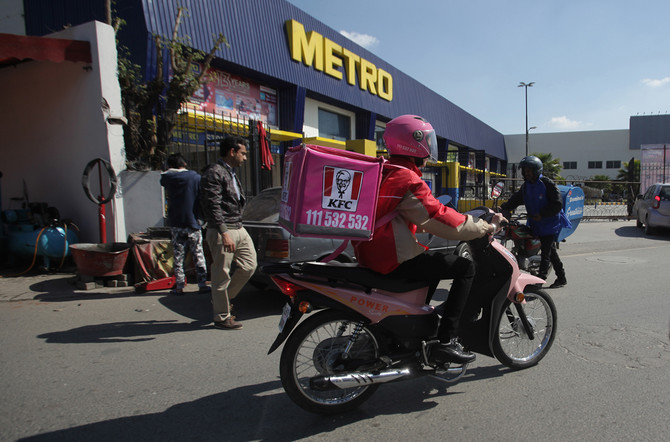
As Rani emerged on Model Town’s main Link Road, a man on a motorbike first slowed down as he caught sight of her pink scooter, then sped up, to match her pace. “Oh! Hello!” he shouted. A rickety white carry van with a sticker bearing the first Kalima of Islam plastered across its front windshield also tried to catch up.
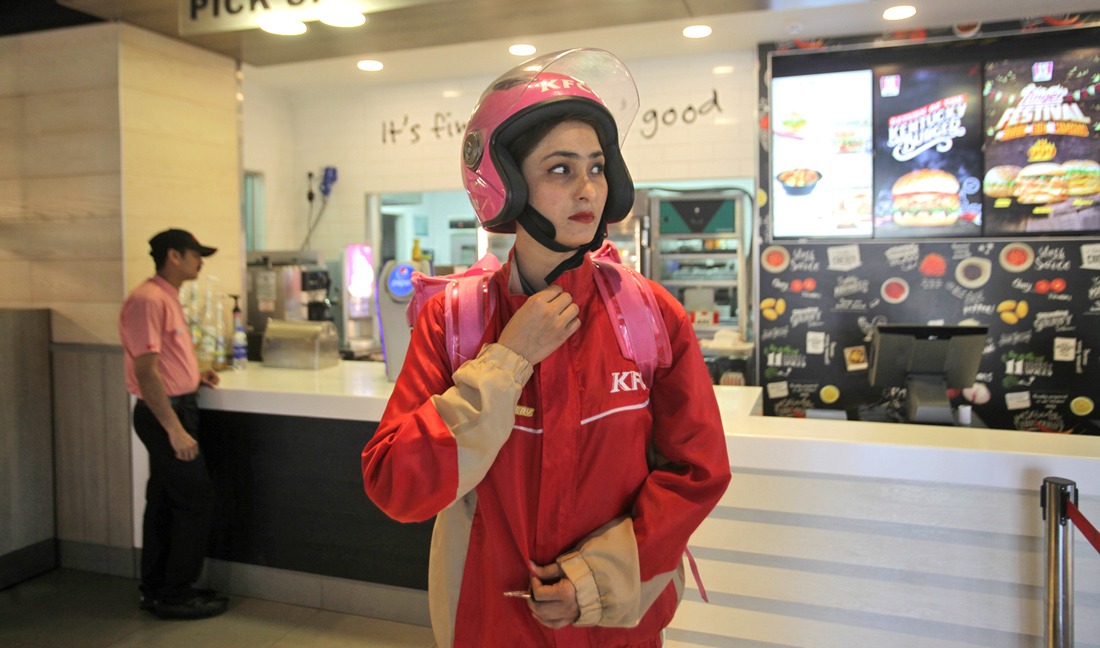
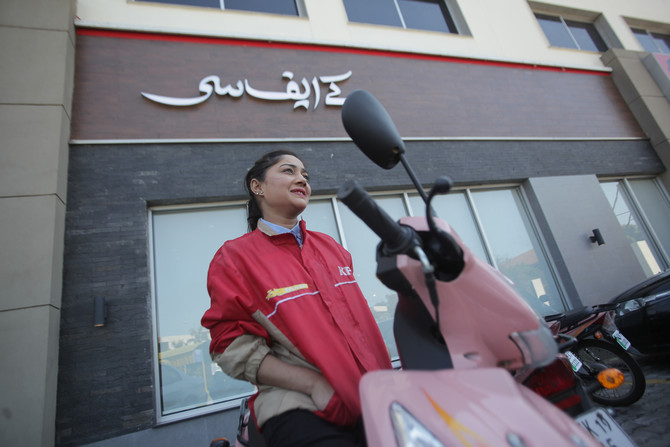
Asma Rani, 27, adjusts the strap of her pink helmet as she prepares to go deliver an order on March 6, 2019. On a recent delivery run, an old man emerged from his house to collect his order and put his hand out to shake hers. When she quickly took off her helmet, he was shocked to see it was a woman. “He put his hand on my head, gave me love,” Rani said. “He said, well done, my daughter.” (AN photo by Mohsin Raza)
For more photos, click here.
Rani drove on, her engine revving, unfazed by the stir the sight of a woman on two wheels was causing on one of Lahore city’s busiest thoroughfares.
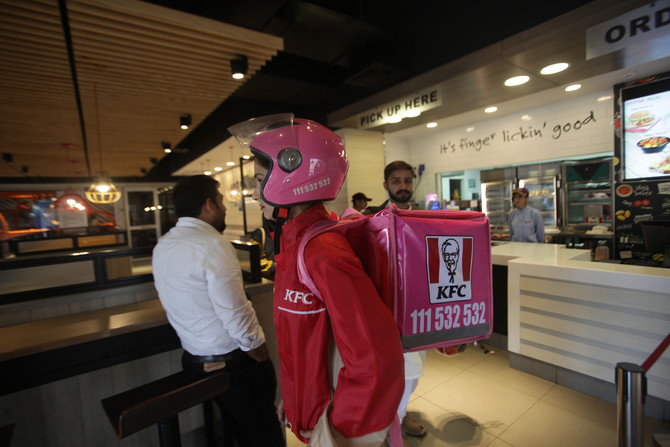
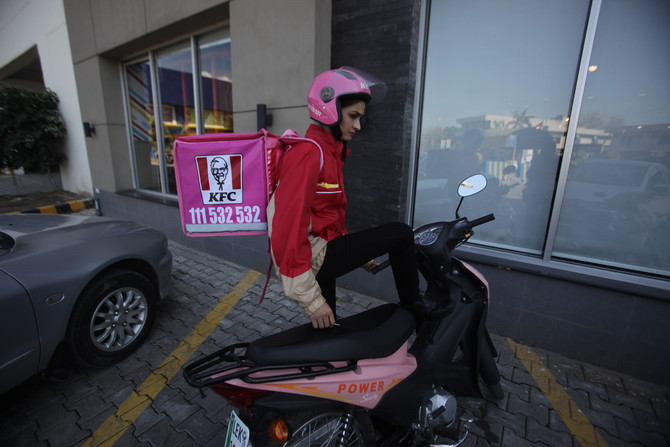
The 27-year old is one of ten women who make up Pakistan’s first all-female food delivery crew. For the last two months, the “Dame Riders” have been cruising around Lahore, Pakistan’s second-largest city, delivering KFC orders. They are hard to miss in their fluorescent pink helmets and blazing red windbreakers, their custom-made scooters painted a soft tea-pink.
The project, a partnership between KFC and the microfinance wing of a local NGO, Community Support Concern (CSC), is a bold and rare initiative in a conservative Muslim country where women barely account for 22 percent of the workforce and where fathers, brothers and husbands often dictate women’s movements, even in modern metropoles. Restrictions imposed on women by men against using most forms of public transport limit their ability to leave their neighborhoods for work or education, according to a 2017 study by the International Growth Center.
“There is a message in this project: that the roads belong to women also,” said CSC CEO Shaista Jan, who first conceived the idea of female delivery workers three years ago.
Nayab Jan, the head of business development at CSC, said the project was all about achieving “mobility equality.”
“Why can’t women drive scooters?” she said. “And why can’t women drive scooters and using them to do the kind of jobs, like delivering food, that men do all the time? That’s the thinking behind this.”
A major catalyst for the project was Women on Wheels, a campaign launched by Pakistan’s largest province of Punjab last year in which 3,500 women from poor backgrounds were trained to ride bikes.
In its first phase, CSC has taught existing KFC women employees to ride motorcycles and loaned them the cash to purchase scooters at an interest rate of 15 percent — much lower than the 26 percent market rate — which the girls have to pay back in two years. The down payments for the bikes were covered by KFC, which also pays for the girls’ fuel and insurance.
The project was launched in January with a first batch of ten women. By 2019, CSC’s Nayab Jan said, she hoped to see at least 80 young girls like Rani and her crew out delivering food on the streets of Lahore.
“Right now another ten girls are under training and will be added to the crew soon,” said Muhammad Nawaz, who runs the project for KFC.
Other than the occasional catcalls, none of the delivery girls reported any harassment while on their runs. The reason might be a system of checks that KFC and CSC have instituted to ensure the girls’ safety.
The girls mostly take orders from KFC’s trusted customers, women and commercial offices, and deliver between the hours of 12-6pm. Next mont, KFC plans to launch a GPS tracking system that will give the customer and the restaurant access to the riders’ movements.
Standing outside a KFC branch in Model Town, Bisma Mujahid, 24, laughed as she said she did not even know how to ride a bicycle a few months ago.
“In the beginning I used to be very scared,” she said, playing with the plastic blue frames of her glasses. “Now, I’m teaching girls in my neighborhood how to ride. And I can get home quickly to watch PSL,” she added, referring to an ongoing tournament of Pakistan’s national cricket league.
A few weeks ago, Mujahid said a traffic policeman signalled her to stop while she was on a delivery run and her heart sank thinking she was about to get a ticket.
“But he just told me, ‘well done, you’re doing great,’” Mujahid said. “And then he asked me where I got my scooter from, he said maybe he would buy one for his daughter.”
At home, Mujahid has aging parents and four sisters to support and says her wages and tips from delivering food have made “everything easier.”
The delivery women are paid a base salary of Rs.20,000 ($143) a month. Tips and a fuel allowance almost double their take-home.
Last month, Rani said she delivered 86 orders. A tall women with flowing silky hair dyed a deep mahogany, Rani arrived in Lahore two years ago from small town Kasur in eastern Pakistan to study and find means to support her parents and four siblings. She began by working at a boutique and later at a beauty salon before getting a job as a cashier at KFC.
When she heard last year that the restaurant would be training girls to become delivery workers, she immediately signed up.
“Because of this, I have escaped so many problems in my life,” Rani said, pursing her wide, red mouth. “I can’t explain it but I just want to say that my life has changed completely.”
On a delivery round in early March, a woman customer exchanged a few words with Rani and then handed over Rs.500 ($3.5).
“That’s really good,” she said as she got back on her bike and sped away to deliver her next order, her eyes darting between the road and incoming traffic.
Usually, she explained when she returned to the restaurant, delivery workers made less than a thousand rupees ($7) in tips each day. But people often gave the girls a little extra.
But the best part of her job, said Beenish Maria, a petite, 24-year-old wearing bubblegum pink lipstick, was that it was “fun.”
Maria moved to Lahore with her family as a young child from a tiny village on the outskirts of Faisalabad. Until a year ago, she made about Rs,5,000 ($38) a month teaching physics to high schoolers.
When she first became a delivery worker, people in her family and neighborhood passed “disheartening comments.”
“They said ‘you are a girl, what are you doing,’” she said as she wiped the seat of her scooter. “I used to feel bad but then I think about what I am doing, that I am different, and I feel okay.”
During a recent phone chat with relatives from her village, Maria felt vindicated when a cousin asked her if Maria would give her a ride on her scooter when she next visited Lahore.
“I’ve learnt to stop worrying and just have fun,” she said. “You just have to keep doing what you have to do.”
As the sun set over the KFC branch, Sadia Eida, 24, said she was going to stop at the beauty salon before heading home.
“It’s time for a facial,” she said with a smirk. As the girls wheeled their bikes out of the KFC parking lot, I asked them what the worst part of their job was.
“Having to tell people again and again, ‘No, this is not my brother’s bike,’” said Rani, rolling her eyes. “Or my husband’s,” said Beenish as she hopped on her scooter. “God, I don’t even have a husband.”


