Driven to ‘help my women’, a midwife in limbo in S.Sudan

1 / 6
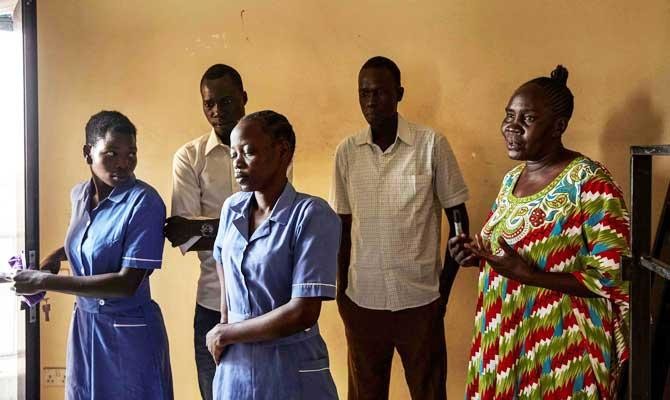
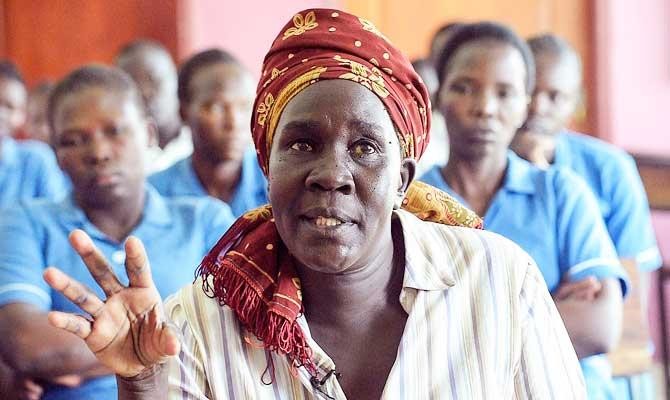
Grace Losio, 50, who teaches a midwifery class at the Kajo Keji Health Sciences Institute, speaks during an interview with AFP in Juba on March 2, 2019. (AFP)
2 / 6
Grace Tindilo Lois (R), 50, teaches a midwifery class at Kajo Keji Health Sciences Institute in Juba on March 4, 2019. (AFP)
3 / 6
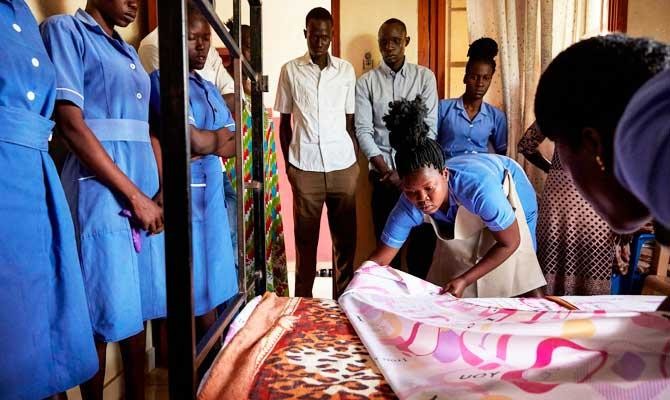
Students of the Juba branch of the Kajo Keji Health Sciences Institute perform practical exercises during a midwifery class in Juba on March 4, 2019. (AFP)
4 / 6
Grace Losio, 50, who teaches a midwifery class at the Kajo Keji Health Sciences Institute, speaks during an interview with AFP in Juba on March 2, 2019. (AFP)
5 / 6
Students of the Juba branch of the Kajo Keji Health Sciences Institute perform practical exercises during a midwifery class in Juba on March 4, 2019. (AFP)
6 / 6
Grace Tindilo Lois, 50, teaches a midwifery class at Kajo Keji Health Sciences Institute in Juba on March 4, 2019. (AFP)
Updated 07 March 2019
Follow

Driven to ‘help my women’, a midwife in limbo in S.Sudan

  • In 2018, 36 of those students graduated as midwives, and new ones have since joined from across the country
  • South Sudan’s population was last officially estimated at about 12 million, and UN figures show war has scattered millions of them

JUBA: In a small classroom in Juba, male and female students listen attentively as Grace Losio launches into a lesson on what it takes to be a midwife.
Like Losio, many of the students have come here with a passion.
They are driven by memories of women in their villages bleeding helplessly to death, or babies dying from avoidable complications, with no health care workers for miles around.
But despite her enthusiasm, Losio, 50, knows that with its three classrooms and crammed makeshift dormitories, the Kajo-Keji Health Science Institute where she is principal is a shadow of its former self.
For one, it is now several hours away from where it is meant to be, in the southern town of Kajo-Keji near the Ugandan border.
When fighting erupted in Kajo-Keji in 2017, and tens of thousands of people poured over the border into Uganda, Losio and her students tried to wait it out.
But the constant gunfire and their increased isolation became too much to bear.

So with about 20 teaching staff and 100 students they fled to Moyo in northern Uganda where they stayed for a month.
They then relocated to South Sudan, in Juba — more than 300 kilometers (about 190 miles) by road from Kajo-Keji, with the support of the International Medical Corps (IMC).
“We were in a very hard situation. When we arrived in Moyo they (the students) slept without food... moving with a number of people is not easy,” Losio told AFP.
In 2018, 36 of those students graduated as midwives, and new ones have since joined from across the country.
But Losio prays for the day she can return home and serve the women of her community.
South Sudan has one of the world’s worst rates of maternal mortality, with 780 deaths per 100,000 live births, according to UN figures.
Even so, this grim figure is under a third of what it was a decade ago, thanks to a drive to train more midwives. Around 900 have now registered, according to health ministry statistics.
South Sudan’s population was last officially estimated at about 12 million, and UN figures show war has scattered millions of them.
More than five years of conflict has left many women on their own in childbirth.
“In my village, most of the ladies you find they deliver at home because we don’t have trained health personnel like midwives. You find most of them losing their kids and even they lose their lives,” said Augustino John Kuluel, 28, one of Losio’s male students from a village in central Gok State.

South Sudan is famously nicknamed the world’s youngest nation, although it is also one of the most tragic, for it plunged into civil war just two years after gaining independence from Sudan in 2011.
The country is the size of France but has only an estimated 200 kilometers (120 miles) of paved roads, with the majority of the population living in traditional villages or as nomadic cattle herders.
Losio, like much of the population, has known a life mainly marked by war.
She was carried as a baby into a Ugandan refugee camp by her mother after her father was killed and their house burned down as war raged between Khartoum and southern rebels agitating for greater autonomy.
“When I was a child I admired the nurse’s uniform. Nurses used to come and take care of patients within the refugee camp,” she recalled.
Losio said she decided to follow in their footsteps because “I needed to help my women.”
After independence, an NGO-backed initiative to train midwives took off across the country.
After studying nursing in Uganda, Losio returned to South Sudan in 2006 and began training midwives two years later with IMC.
“The whole aim was to reduce burdens of women who were pregnant having problems. Already we had trained a number of midwives who had gone out there to assist mothers,” she said.
But now, because of the insecurity, “the question is where do you find the mother, and can I reach where that mother is? We are supposed to serve the community of Kajo-Keji and the surrounding area but currently where are we? We are in Juba, no one is there for them.”

Losio was able to visit the town briefly last year, and found it largely abandoned, and the health institute had been looted.
Kajo-Keji lies in Yei River State, a region once untouched by the conflict that broke out between supporters of President Salva Kiir and his former vice president Riek Machar in 2013.
But when a peace deal collapsed in 2016 and fighting spread across the country, it was hit by violent battles.
A new peace agreement signed in September has largely stopped fighting, but in Yei a holdout rebel group has been battling government forces, prompting thousands to flee fresh violence.
“I shed tears because that was not the town that I left... but we are hoping we can go back to Kajo-Keji,” Losio said.


Arts festival’s decision to exclude Palestinian author spurs boycott

Randa Abdel Fattah. (Photo/Wikipedia)
Updated 12 January 2026
Follow

Arts festival’s decision to exclude Palestinian author spurs boycott

  • A Macquarie University academic who researches Islamophobia and Palestine, Abdel-Fattah responded saying it was “a blatant and shameless act of anti-Palestinian racism and censorship,” with her lawyers issuing a letter to the festival

SYDENY: A top Australian arts festival has seen ​the withdrawal of dozens of writers in a backlash against its decision to bar an Australian Palestinian author after the Bondi Beach mass shooting, as moves to curb antisemitism spur free speech concerns.
The shooting which killed 15 people at a Jewish Hanukkah celebration at Sydney’s Bondi Beach on Dec. 14 sparked nationwide calls to tackle antisemitism. Police say the alleged gunmen were inspired by Daesh.
The Adelaide Festival board said last Thursday it would disinvite Randa ‌Abdel-Fattah from February’s ‌Writers Week in the state of South Australia because “it ‌would not ​be ‌culturally sensitive to continue to program her at this unprecedented time so soon after Bondi.”

FASTFACTS

• Abdel-Fattah responded, saying it was ‘a blatant and shameless act of anti-Palestinian racism and censorship.’

• Around 50 authors have since withdrawn from the festival in protest, leaving it in doubt, local media reported.

A Macquarie University academic who researches Islamophobia and Palestine, Abdel-Fattah responded saying it was “a blatant and shameless act of anti-Palestinian racism and censorship,” with her lawyers issuing a letter to the festival.
Around 50 authors have since withdrawn from the festival in protest, leaving it in doubt, local media reported.
Among the boycotting authors, Kathy Lette wrote on social media the decision to bar Abdel-Fattah “sends a divisive and plainly discriminatory message that platforming Australian Palestinians is ‘culturally insensitive.'”
The Adelaide Festival ‌said in a statement on Monday that three board ‍members and the chairperson had resigned. The ‍festival’s executive director, Julian Hobba, said the arts body was “navigating a complex moment.”

 a complex and ‍unprecedented moment” after the “significant community response” to the board decision.
In the days after the Bondi Beach attack, Jewish community groups and the Israeli government criticized Prime Minister Anthony Albanese for failing to act on a rise in antisemitic attacks and criticized protest marches against Israel’s war in ​Gaza held since 2023.
Albanese said last week a Royal Commission will consider the events of the shooting as well as antisemitism and ⁠social cohesion in Australia. Albanese said on Monday he would recall parliament next week to pass tougher hate speech laws.
On Monday, New South Wales state premier Chris Minns announced new rules that would allow local councils to cut off power and water to illegally operating prayer halls.
Minns said the new rules were prompted by the difficulty in closing a prayer hall in Sydney linked to a cleric found by a court to have made statements intimidating Jewish Australians.
The mayor of the western Sydney suburb of Fairfield said the rules were ill-considered and councils should not be responsible for determining hate speech.
“Freedom ‌of speech is something that should always be allowed, as long as it is done in a peaceful way,” Mayor Frank Carbone told Reuters.