


Canadian couple builds world’s largest snow maze

1 / 5
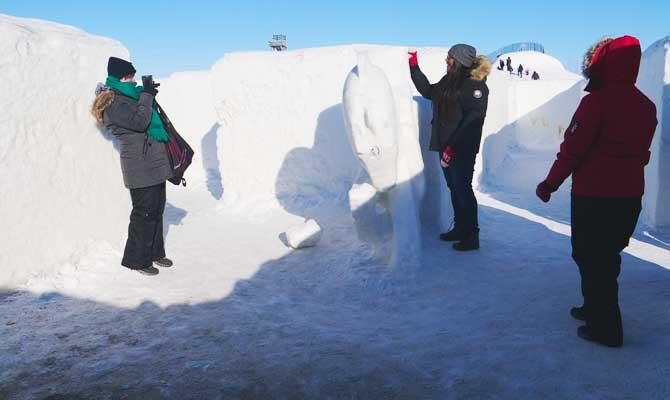
People take pictures near a statue carved out of snow and located within the world's largest snow maze in ST. Adolphe, Manitoba, Canada, on March 2, 2019. (AFP)
2 / 5
Clint Masse, farmer and owner of the maze, which took his family and employees more than three weeks to design and build poses at the entrance in ST. Adolphe, Manitoba, Canada, on March 2, 2019. (AFP)
3 / 5
People play in a maze built by farmers Clint and Angie Masse in St. Adolphe, Canada, on March 3, 2019. (AFP)
4 / 5
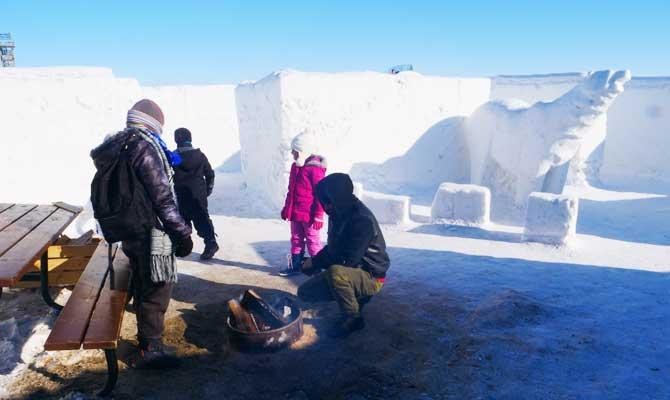
A family rests and warms near a firepit located within the snow maze in St. Adolphe, Manitoba, Canada, on March 2, 2019. (AFP)
5 / 5
A sign welcomes visitors at the world's largest snow maze in St. Adolphe, Manitoba, Canada, on March 2, 2019. (AFP)
Updated 06 March 2019
Follow

Canadian couple builds world’s largest snow maze

  • The couple used commercial computer-aided design and drafting software

ST. ADOLPHE, Canada: A-maze-ing: a snow labyrinth in the frigid, windswept prairies of Western Canada has broken the record for the world’s biggest.
According to Guinness World Records, the whopping 2,789.11 square meters (30,0021.73 square feet) of terrain dwarfs the previous Canadian record holder at the Fort William Historical Park in Thunder Bay, Ontario.
For years, farmers Clint and Angie Masse would ring in the fall harvest by building a corn maze on their property just outside of the small town of St. Adolphe, a short drive from Winnipeg, Manitoba.
With a long, cold winter in the Canadian forecast, they decided late last year to try to extend the experience of finding one’s way through the network of paths and hedges by several months.
And despite temperatures plunging to a low of -40 degrees Celsius (-40 Fahrenheit) in January, people kept coming in droves.
But it was no easy feat, Clint Masse told AFP. He said building the maze required weeks of planning, tens of thousands of dollars and 370 truckloads of snow to supplement the relatively thin powder on their fields.
“Making snow is really expensive,” he said, pointing to the cost of renting generators, tractors and other equipment, fuel and weeks of labor.
There were design challenges too.
“You’re not designing a path, what you are is designing walls and every wall has a double duty: it’s got a path on this side and a path on that side,” Masse said.
“I wanna say it took me a better part of a week. The corn maze I think I could do in a day and a half so it’s a lot of more work to design.”

The couple used commercial computer-aided design and drafting software.
Inside the labyrinth, visitors walk between walls of snow that are 1.8 meters (six feet) high, and atop a layer of snow packed tightly to prevent it from melting too soon into slush under the pedestrian traffic.
They are greeted by ice sculptures around several corners, and benches have been set up around campfires burning in five nooks to allow visitors to warm up before continuing on and trying to solve the puzzle.
The fire pits also act as markers, which first-timers Jillian Crooks and Cassidy Wegner said were indispensable for finding their way.
“It was fun,” Crooks said. “We just kept turning every which way. It took us a while. We didn’t time it, we should have. Maybe like half an hour? Yep!“
That bested the posted average of 30-45 minutes.
If cold temperatures hold, the labyrinth could stay open for a few more weeks, by which time Clint Masse said he hopes to have had more than 10,000 visitors and turn a small profit.


Cambodia takes back looted historic artifacts handled by British art dealer

Updated 28 February 2026
Follow

Cambodia takes back looted historic artifacts handled by British art dealer

  • The objects were returned under a 2020 agreement between the Ministry of Culture and Fine Arts and the family of the late Douglas Latchford, a British art collector and dealer who allegedly had the items smuggled out of Cambodia

PHNOM PENH, Cambodia: Cambodian officials on Friday received more than six dozen historic artifacts described as part of the country’s cultural heritage that had been looted during decades of war and instability.
At a ceremony attended by Deputy Prime Minister Hun Many, the 74 items were unveiled at the National Museum in Phnom Penh after their repatriation from the United Kingdom.
The objects were returned under a 2020 agreement between the Ministry of Culture and Fine Arts and the family of the late Douglas Latchford, a British art collector and dealer who allegedly had the items smuggled out of Cambodia.
“This substantial restitution represents one of the most important returns of Khmer cultural heritage in recent years, following major repatriations in 2021 and 2023 from the same collection,” the Culture Ministry said in a statement. “It marks a significant step forward in Cambodia’s continued efforts to recover, preserve, and restore its ancestral legacy for future generations.”
The artifacts were described as dating from the pre-Angkorian period through the height of the Angkor Empire, including “monumental sandstone sculptures, refined bronze works, and significant ritual objects.” The Angkor Empire, which extended from the ninth to the 15th century, is best known for the Angkor Wat archaeological site, the nation’s biggest tourist attraction.
Latchford was a prominent antiquities dealer who allegedly orchestrated an operation to sell looted Cambodian sculptures on the international market.
From 1970 to the 1980s, during Cambodia’s civil wars and the communist Khmer Rouge ‘s brutal reign, organized looting networks sent artifacts to Latchford, who then sold them to Western collectors, dealers, and institutions. These pieces were often physically damaged, having been pried off temple walls or other structures by the looters.
Latchford was indicted in a New York federal court in 2019 on charges including wire fraud and conspiracy. He died in 2020, aged 88, before he could be extradited to face charges.
Cambodia, like neighboring Thailand, has benefited from a trend in recent decades involving the repatriation of art and archaeological treasures. These include ancient Asian artworks as well as pieces lost or stolen during turmoil in places such as Syria, Iraq and Nazi-occupied Europe. New York’s Metropolitan Museum of Art is one of the prominent institutions that has been returning illegally smuggled art, including to Cambodia.
“The ancient artifacts created and preserved by our ancestors are now being returned to Cambodia, bringing warmth and joy, following the country’s return to peace,” said Hun Many, who is the younger brother of Prime Minister Hun Manet.