


ABU DHABI: Ambitious plans to map the entire global ocean floor could “absolutely” piece together the puzzle of the missing Malaysian airliner MH370, which disappeared five years ago this week, a leading expert told Arab News in an exclusive interview at the World Ocean Summit on Monday.
A new project called Seabed 2030 plans to map the entire ocean floor by upgrading current mapping systems so that scientists can use state-of-the-art technology to explore every contour of the ocean in a little over 10 years. This could hold the answers still sought by the families of passengers on the missing MH370, setting off the longest and costliest search undertaken for a commercial airplane.
“Seabed 2030 is both amazing — and completely necessary,” said Wendy Watson-Wright, CEO of the Ocean Frontier Institute, a transnational hub for ocean research, speaking on the sidelines of the World Ocean Summit in Abu Dhabi this week.
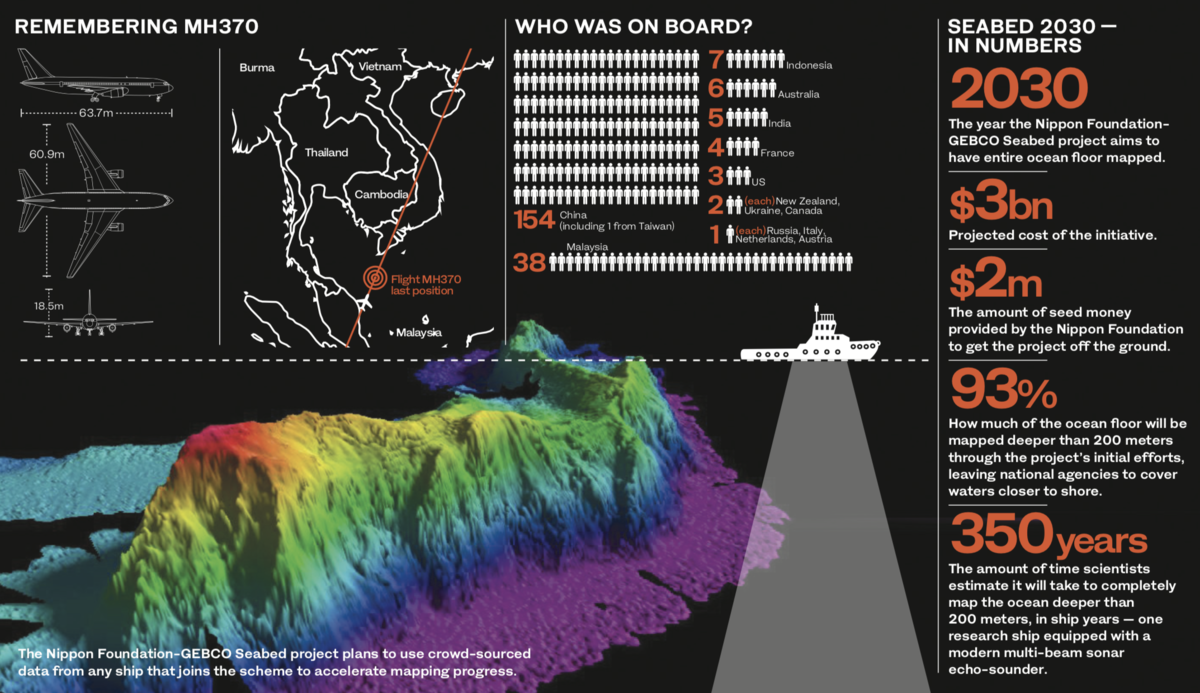 While the project’s main goal is to bring together all underwater data to produce a definitive map of the world ocean floor by 2030 and make it available to all, it could also have other uses, such as mapping hidden underwater mountains that Watson-Wright said are “much larger than Mount Everest” and which pose a threat to submarines, as well as uncovering missing wreckage such as MH370.
On March 8, 2014, the Boeing 777 carrying 239 people went missing on a flight between Kuala Lumpur and Beijing. While pieces of debris that washed up along the Indian Ocean coastline narrowed previous searches, this did not lead to the wreckage site. Just over two years ago, a $141-million underwater search effort by Malaysia, China and Australia was suspended after making little progress, leaving the families of the passengers continuing to question what happened to the aircraft. Barring any other ideas, ocean mapping could be the answer to one of history’s biggest aircraft mysteries.
Not only could it give the families of the MH370 passengers an insight into the disappearance of the plane, but in case of future incidents involving aircraft, it would offer explorers and search-and-rescue missions the knowledge they need.
“I was in San Diego last week at an international ocean conference at a panel talking about this Seabed 2030, and, yes, I hope (it will become a reality),” said Watson-Wright.
“We do need new technology — we can only down so far without it, and we need investment also — but it is a pittance of what is going into the Space program, and the potentials are endless.”
Watson-Wright said the comprehensive map would help to accelerate understanding of the ocean. “I think it is less than 5 percent of the current surface of the ocean which is mapped to a resolution that can be considered modern,” she said. “So if we are going to know what is going on in the ocean — and what we can find — then Seabed 2030 is completely necessary. Without it … well, it is like having no topographic maps of our countries: Can you imagine that?
“More than 71 percent of Earth’s surface is covered by ocean, but it is like 97 percent of the living space because it is three-dimensional. So we do not know what is down there, yet we have ridges and mountains much higher than Mount Everest.
“I think it can certainly be done, especially with new technology. There is real progress being made with autonomous technology. All these autonomous vehicles and this new technology and artificial technology are all going to come together. Sea mapping tells us what is there, what is possible. We are discovering new things all the time,” she said.
 “It would accelerate our understanding of the ocean and in order to have progress, we need to have information. And we do not have information at the moment about what is actually down there.”
That was partly the trouble with the search for MH370. A 120,000-sq-km search zone in the Indian Ocean and a fresh hunt by the US exploration firm Ocean Infinity, which was mounted on a “no-find, no-fee basis” last year for several months, using high-tech drones to scour the seabed, failed to locate the plane.
Hundreds of people, including some of the relatives of those on board, gathered at a Kuala Lumpur shopping mall on Sunday to mark the anniversary of the jet’s disappearance.
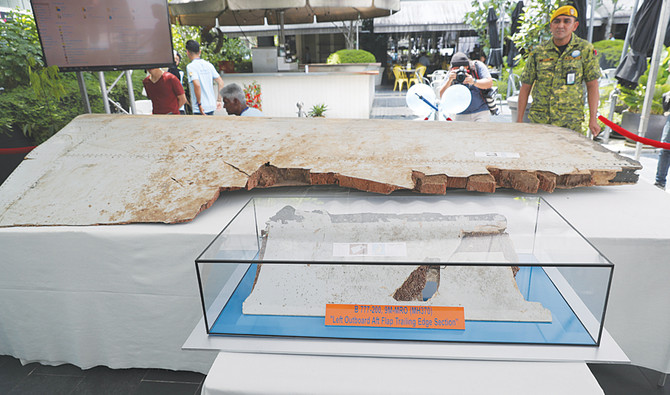
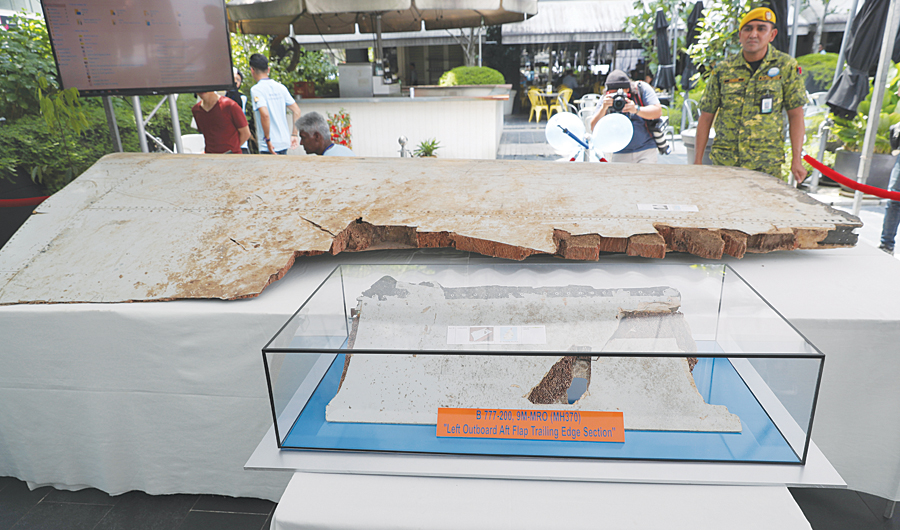
Only a few fragments of MH370 have been found, all on western Indian Ocean shores. Two of those pieces were put on display on Sunday for the first time at the memorial. The parts, now in the custody of the Malaysian government, include a 4-meter wing fragment found in Tanzania, the largest piece of debris found so far.
Families of those on board the plane hope that displaying the debris would help the public to understand their loss and spur efforts to continue searching for the aircraft, according to Grace Nathan, a lawyer whose mother Anne Daisy was an MH370 passenger.
“Because this piece, which is only a small part of the wing, is very large, it puts into perspective how large the entire plane was,” she told Reuters ahead of the event. “To think of it, I can’t believe this little piece of the plane traveled thousands and thousands of kilometers through the ocean to Africa over the span of two years. And I can’t help but wonder, where is my mother?”
There is no new search planned, but Malaysian Transport Minister Anthony Loke said at the event that the government was open to hearing proposals to resume the hunt. “If there are any credible leads and any specific proposals, especially from Ocean Infinity, we are more than willing to look at it,” he told AFP.
Jacquita Gonzales, whose husband Patrick Gomes was a crew member on the flight, told AFP there will be “no closure until the plane is found, until we exactly know what happened to the aircraft and our loved ones on board. It gets tougher every year because we are all expecting some answers.”
In a long-awaited final report into the tragedy released in July last year, the official investigation team pointed to failings by air traffic control and said that the course of the plane was changed manually. But they failed to come up with any firm conclusions, leaving families of those on board angry and disappointed.


