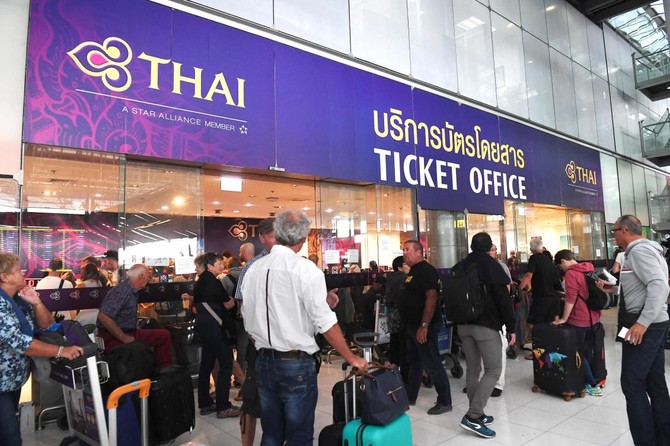
BANGKOK: Thousands of travelers were left scrambling on Thursday when Thai Airways International canceled more than a dozen flights to and from Europe after Pakistan closed its airspace amid rising tensions with India.
Flights to and from London, Munich, Paris, Brussels, Milan, Vienna, Stockholm, Zurich, Copenhagen, Oslo, Frankfurt, and Rome had been scheduled to fly over Pakistani airspace on Thursday, Thai Airways said in a statement.
That left passengers scheduled to leave Thailand’s main Suvarnabhumi International Airport searching to find alternative flights early on Thursday. Most of Thai’s European flights leave after midnight.
“Last night there were about 5,000 passengers who came to check-in but unable to fly, mostly Thai Airways,” Col. Umnart Chomshai, superintendent of tourism police at Suvarnabhumi Airport, told Reuters.
Another airport official said a help center had been set up for stranded travelers.
Thai Airways said later on Thursday it would resume flights after gaining permission from China to use its airspace for nearly a dozen flights to Europe set to leave on Thursday afternoon and Friday morning.
However, it said all flights to and from Pakistan were canceled. The airline operates one flight a day to Karachi and Lahore and four flights per week to Islamabad.
Thailand is among the world’s most popular tourist destinations, receiving more than 38 million visitors last year.
Pakistan closed its airspace after India and Pakistan both claimed to have shot down the other’s fighter jets on Wednesday, with Pakistan capturing an Indian pilot a day after Indian warplanes struck inside Pakistan for the first time since a 1971 war.
World powers have urged restraint between the two nuclear-armed South Asian neighbors, who have fought three wars over the disputed Himalayan region of Kashmir.
Many airlines route flights over Pakistan, so the closure of its airspace caused major disruptions on Wednesday.
Several airlines, including Emirates and Qatar Airways, suspended flights to Pakistan and others, such as Singapore Airlines and British Airways, were forced to reroute flights.
On Thursday, Singapore Airlines said all of its Europe-bound flights would now continue as planned, without the need for refueling stops, and they would reroute to avoid the affected airspace as necessary.
Malaysia Airlines said on its website it was not currently flying over the affected airspace and was avoiding Pakistan and northern Indian airspace for flights to and from Europe until further notice.
Tensions have been running high since at least 40 Indian paramilitary police were killed in a Feb. 14 suicide car bombing claimed by Pakistan-based militants in Indian-controlled Kashmir.

Thousands scramble as Thai Airways cancels flights over Pakistan

- About 5,000 passengers were affected by the issue
- Thailand is among the world’s most popular tourist destinations, receiving more than 38 million visitors last year
In South Africa’s affluent Western Cape, farmers lose cattle to drought
- Drought in country’s south follows flooding in north
- Farmers try to adapt but lose livestock
KNYSNA: In South Africa’s most visited and affluent province, Western Cape, one of the worst droughts in living memory is drying up dams, scorching grass and killing livestock, prompting the government to declare a national emergency this month.
Scientists say climate change is causing worsening droughts in the province, which draws tourists to its vineyards, beaches and the lush slopes of Table Mountain above Cape Town, but lies on the edge of the advancing semi-desert Karoo. In 2015, a drought almost dried up the taps in the city; farmers say this one has been even more brutal than a decade ago.
Over the weekend, mixed-race couple Christian and Ilze Pienaar were distributing feed to keep their hungry cattle alive. One cow had recently starved to death, its bones visible through its skin.
“The drought before wasn’t this bad because there was still ... grazing,” Ilze, 40, told Reuters. “Now there’s nothing, the dams are dry ... (and) we’re spending all our money on feed.”
She said she’d lost 16 cattle and 13 sheep since January alone.
The drought, which has also ravaged parts of Eastern Cape and Northern Cape, comes weeks after floods blamed on climate change and cyclical La Niña weather washed out the northeastern part of South Africa and killed 200 people across the region.
“The intensity and duration of both droughts and floods in this corner of the world is increasing,” Anton Cartwright, an economist with the African Center for Cities, said.
“Farmers (here) are very good at adapting to weather (but) ... the weather is just becoming much less predictable,” he said. “Seasons aren’t occurring, starting, ending at the same time of the year. It’s probably going to get worse.”
(Writing by Tim Cocks; editing by Philippa Fletcher)
Scientists say climate change is causing worsening droughts in the province, which draws tourists to its vineyards, beaches and the lush slopes of Table Mountain above Cape Town, but lies on the edge of the advancing semi-desert Karoo. In 2015, a drought almost dried up the taps in the city; farmers say this one has been even more brutal than a decade ago.
Over the weekend, mixed-race couple Christian and Ilze Pienaar were distributing feed to keep their hungry cattle alive. One cow had recently starved to death, its bones visible through its skin.
“The drought before wasn’t this bad because there was still ... grazing,” Ilze, 40, told Reuters. “Now there’s nothing, the dams are dry ... (and) we’re spending all our money on feed.”
She said she’d lost 16 cattle and 13 sheep since January alone.
The drought, which has also ravaged parts of Eastern Cape and Northern Cape, comes weeks after floods blamed on climate change and cyclical La Niña weather washed out the northeastern part of South Africa and killed 200 people across the region.
“The intensity and duration of both droughts and floods in this corner of the world is increasing,” Anton Cartwright, an economist with the African Center for Cities, said.
“Farmers (here) are very good at adapting to weather (but) ... the weather is just becoming much less predictable,” he said. “Seasons aren’t occurring, starting, ending at the same time of the year. It’s probably going to get worse.”
(Writing by Tim Cocks; editing by Philippa Fletcher)
© 2026 SAUDI RESEARCH & PUBLISHING COMPANY, All Rights Reserved And subject to Terms of Use Agreement.