Q&A: What’s at stake as India-Pakistan tensions rise?

1 / 2
Indian Border Security Force personnel walk along a fence at the India Pakistan border on the outskirts of Amritsar on February 27, 2019. (AFP / NARINDER NANU)
2 / 2
Pakistani soldiers patrol in the area where Indian planes were reportedly shot down by Pakistani forces, after India launched airstrikes Tuesday, in Jaba, near Balakot, Pakistan. (AP Photo/Aqeel Ahmed)
Updated 28 February 2019
Follow

Q&A: What’s at stake as India-Pakistan tensions rise?

  • Both India and Pakistan are believed to possess more than 100 nuclear warheads each and have conducted atomic weapon tests

ISLAMABAD: Nuclear-armed rivals India and Pakistan face their worst tension in years over the disputed region of Kashmir, with Islamabad saying they shot down two Indian warplanes Wednesday and captured two pilots. Pakistan immediately shut down its civilian airspace in response.
But how did the relations between these two Asian nations become so bad and what’s at stake in this rapidly worsening conflict that both sides say they want to de-escalate?
___
WHAT STARTED THIS LATEST TENSION?
On Feb. 14, a suicide car bomber attacked a paramilitary convoy on the Indian-controlled side of Kashmir in the Himalayas, killing more than 40 troops. The militant group Jaish-e-Mohammed, which is based in Pakistan, claimed responsibility for the attack. The suicide bomber was from Indian Kashmir. New Delhi long has accused Pakistan of cultivating such groups, something denied by Islamabad. India launched an airstrike on Pakistani territory early Tuesday that New Delhi called a pre-emptive strike against militant camps in Pakistan. India said its bombs killed a “very large number” of militants, while Pakistan said there were no casualties in an airstrike it described as being carried out “in haste.”
___
WHY IS THIS TENSION SO DANGEROUS?
Both India and Pakistan are believed to possess more than 100 nuclear warheads each and have conducted atomic weapon tests. Both countries have test-fired nuclear-capable missiles. Pakistan also has refused to renounce a first-strike option with its atomic bombs should it feel outgunned in a conventional war. It takes less than four minutes for a missile fired from Pakistan to reach India. The Bulletin of Atomic Scientists warns that “computer models have predicted that the physical impacts of a nuclear exchange between India and Pakistan, or even a single strike on a large city, would be devastating . and would reverberate throughout the world.”

___
HOW DID THE DISPUTE OVER KASHMIR BEGIN?
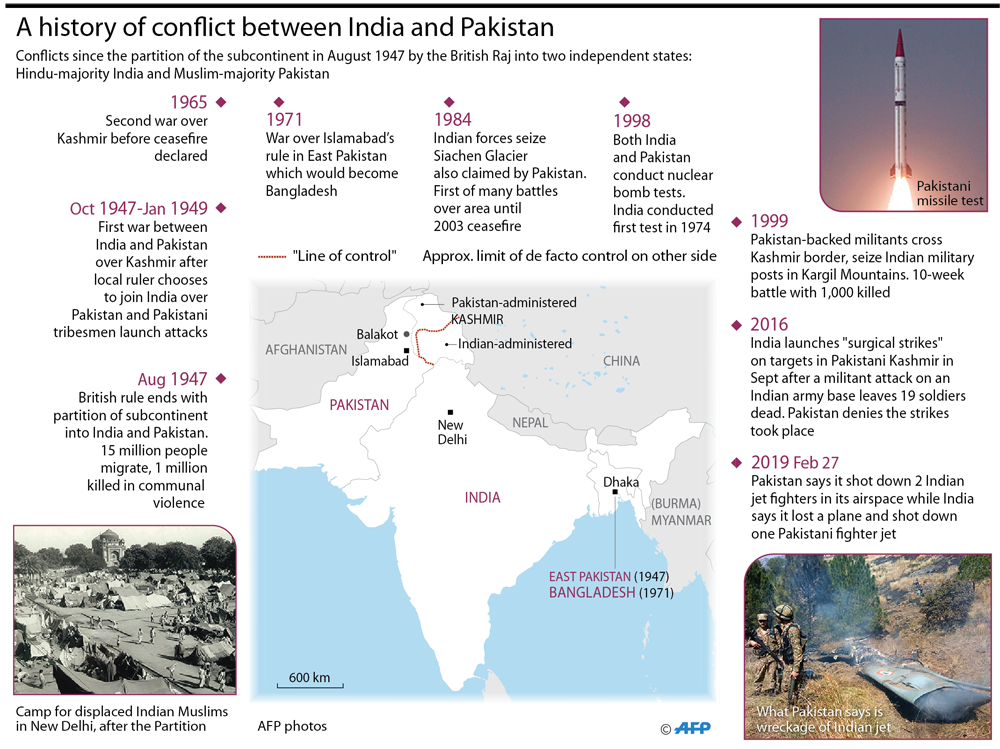
When Britain granted independence to the region in 1947, it divided the Indian subcontinent into a predominantly Hindu India and mostly Muslim Pakistan. Some areas could decide their own fate. In Kashmir, the only Muslim majority area ruled by a Hindu monarch, its ruler decided against giving the population a choice. That started the first India-Pakistan war in 1947. The conflict ended in 1949 when a United Nations resolution established the Line of Control dividing Kashmir between the two nations and calling for a direct vote on which country should control it. That vote has never been held. Indian and Pakistan fought a second war over Kashmir in 1965.
___
WHAT HAS HAPPENED SINCE?
India and Pakistan fought a third war in 1971 over what was East Pakistan, which later became an independent Bangladesh. In 1999 and 2000, after Pakistan’s military sent a ground force into Indian-controlled Kashmir at Kargil, the two countries faced off and a worried world urged both to pull back from the brink of war, fearing it could escalate into a nuclear conflict. Even in times of relative peace the two nations readily engage in brinkmanship and aggressive rhetoric.
___
HOW DO THE MILITARIES OF INDIA AND PAKISTAN COMPARE?
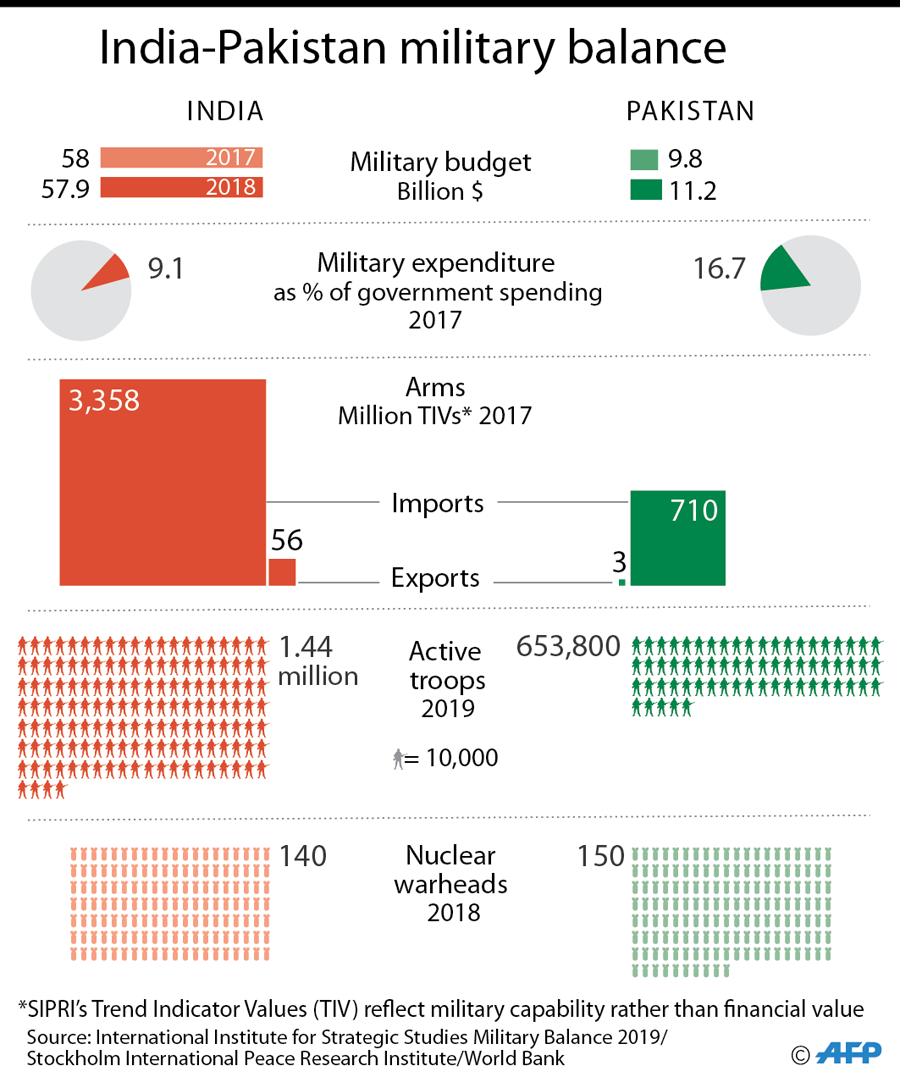
India, home to 1.3 billion people, has a conventional army of about 1.4 million soldiers. Pakistan, with a population of over 200 million people, has about 650,000 troops. Both countries have spent billions developing conventional arms. Last year, Pakistan spent about $11 billion or about 3.6 percent of its gross domestic product on defense. India meanwhile allocated about $58 billion, or 2.1 percent of its GDP on defense, according to the International Institute for Strategic Studies. India’s ballooning military spending has propelled it to the world’s fifth-biggest defense spender, surpassing the United Kingdom, according to the IISS.

_
__
HOW IS PAKISTAN REACTING?
Pakistan, which has a history of military coups and strong-arm rule from those tied to its intelligence services, has largely reacted to this conflict through its civilian government. Foreign Minister Shah Mahmood Qureshi took the lead to condemn the airstrike Tuesday, painting India as an aggressor who would suffer repercussions, without elaborating. Qureshi also accused Indian Prime Minister Narendra Modi of playing with regional stability to get votes in upcoming national elections. Prime Minister Imran Khan has called for a joint meeting of Pakistan’s upper and lower houses of parliament. Public criticism of India has been loud across Pakistani media, with sporadic protests against New Delhi breaking out across the country.
___
HOW IS INDIA REACTING?
Indian government officials called the airstrike Tuesday a counterterrorism operation based on credible intelligence that another attack against India was imminent. The tensions could be a boon for Modi, whose Hindu nationalist Bharatiya Janata Party aims to maintain power in elections due by May. The airstrike appears to have temporarily insulated the Modi government from criticism about it failing to create as many jobs as pledged in the 2014 elections. Opposition party leaders have responded with support for India’s air force. Meanwhile, Modi earned points with the powerful Hindu nationalist social group, the Rashtriya Swayamsevak Sangh, or RSS. RSS chief Mohan Bhagwat said Tuesday: “Truth and non-violence are fine, but the world understands the language of power.”
___
Associated Press writer Emily Schmall in New Delhi contributed to this report.


Mexican army kills leader of powerful Jalisco New Generation Cartel during operation to capture him

Updated 5 sec ago
Follow

Mexican army kills leader of powerful Jalisco New Generation Cartel during operation to capture him

  • The killing of the powerful drug lord set off several hours of roadblocks with burning vehicles in Jalisco and other states

MEXICO CITY: The Mexican army killed the leader of the Jalisco New Generation Cartel, Nemesio Rubén Oseguera Cervantes, “El Mencho, ” on Sunday, decapitating what had become Mexico’s most powerful cartel and giving the government its biggest prize yet to show the Trump administration its efforts.
Oseguera Cervantes was wounded in an operation to capture him Sunday in Tapalpa, Jalisco about a two-hour drive southwest of Guadalajara and he died while being flown to Mexico City, the Defense Department said in a statement. The state is the base of the cartel known for trafficking huge quantities of fentanyl and other drugs to the United States.
During the operation, troops came under fire and killed four people at the location. Three more people, including Oseguera Cervantes, were wounded and later died, the statement said. Two others were arrested and armored vehicles, rocket launchers and other arms were seized. Three members of the armed forces were wounded and receiving medical treatment.
Roadblocks and burning vehicles
The killing of the powerful drug lord set off several hours of roadblocks with burning vehicles in Jalisco and other states. Such tactics are commonly used by the cartels to block military operations. Jalisco canceled school in the state for Monday.
Videos circulating on social media showed plumes of smoke billowing over the tourist city of Puerto Vallarta in Jalisco, and people sprinting through the airport of the state’s capital in panic. On Sunday afternoon, Air Canada announced it was suspending flights to Puerto Vallarta “due to an ongoing security situation” and advised customers not to go to their airport.
In Guadalajara, the state capital, burning vehicles blocked roads. Mexico’s second-largest city is scheduled to host matches during this summer’s soccer World Cup.
The US State Department warned US citizens in Jalisco, Tamaulipas, Michoacan, Guerrero and Nuevo Leon states to remain in safe places due to the ongoing security operations. Canada’s embassy in Mexico warned its citizens in Puerto Vallarta to shelter in place and generally to keep a low profile in Jalisco.
Jalisco Gov. Pablo Lemus told residents to stay at home and suspended public transportation.
US had offered up to $15 million for his capture
The US State Department had offered a reward of up to $15 million for information leading to the arrest of El Mencho. The Jalisco New Generation Cartel, known as CJNG, is one of the most powerful and fastest growing criminal organizations in Mexico and was born in 2009.
In February, the Trump administration designated the cartel as a foreign terrorist organization.
Mexican President Claudia Sheinbaum, like her predecessor, has criticized the “kingpin” strategy of previous administrations that took out cartel leaders only to trigger explosions of violence as cartels fractured. While she has remained popular in Mexico, security is a persistent concern and since US President Donald Trump took office a year ago, she has been under tremendous pressure to show results against drug trafficking.
Known as aggressive cartel
The Jalisco cartel has been one of the most aggressive cartels in its attacks on the military — including on helicopters — and is a pioneer in launching explosives from drones and installing mines. In 2020, it carried out a spectacular assassination attempt with grenades and high-powered rifles in the heart of Mexico City against the then head of the capital’s police force and now federal security secretary.
The DEA considers the cartel to be as powerful as the Sinaloa cartel, one of Mexico’s most infamous criminal groups, with a presence in all 50 US states. It is one of the main suppliers of cocaine to the US market and, like the Sinaloa cartel, earns billions from the production of fentanyl and methamphetamines. Sinaloa, however, has been weakened by infighting after the loss of its leaders Ismael “El Mayo” Zambada and Joaquín “El Chapo” Guzmán, both in US custody.
Oseguera Cervantes, 59, was originally from Aguililla in the neighboring state of Michoacan. He had been significantly involved in drug trafficking activities since the 1990s. When he was younger, he migrated to the US where he was convicted of conspiracy to distribute heroin in the US District Court for the Northern District of California in 1994 and served nearly three years in prison.
Following his release from custody, Oseguera Cervantes returned to Mexico and reengaged in drug trafficking activity with drug lord Ignacio Coronel Villarreal, alias “Nacho Coronel.” After Villarreal’s death, Oseguera Cervantes and Erik Valencia Salazar, alias “El 85”, created the Jalisco New Generation Cartel around 2007.
Initially, they worked for the Sinaloa Cartel, but eventually split and for years the two cartels have battled for territory across Mexico.
Indicted several times in the United States
Since 2017, Oseguera Cervantes has been indicted several times in the United States District Court for the District of Columbia.
The most recent superseding indictment, filed on April 5, 2022, charges Oseguera Cervantes with conspiracy and distribution of controlled substances (methamphetamine, cocaine, and fentanyl) for the purpose of illegal importation into the United States and use of firearms during and in connection with drug trafficking offenses. Oseguera Cervantes is also charged under the Drug Kingpin Enforcement Act for directing a continuing criminal enterprise.
Last year, people searching for missing relatives founds piles of shoes and other clothing, as well as bone fragments at what authorities later said was a Jalisco cartel recruitment and training site.