



ISLAMABAD: Pakistani foreign minister Shah Mahmood Qureshi said on Tuesday that Indian jets violated the Line of Control (LoC), or the de facto border between the two nuclear-armed countries, and Islamabad has the right to an “appropriate response.”
Early Tuesday morning, Pakistan military spokesman Major General Asif Ghafoor announced in a series of Twitter posts that Indian jets had violated the LoC which splits the disputed Kashmir region into two areas, one administered by Pakistan and the other by India. However, he said the Indian aircraft had “hastily escaped” after Pakistan scrambled its own jets after them and “no infrastructure got hit” in the confrontation.
India’s breach has raised the possibility of military escalation between arch-rivals Pakistan and India who have fought three wars since they gained independence from the British empire in 1947, two of them over Kashmir — which the neighbors both claim in full but rule in part.
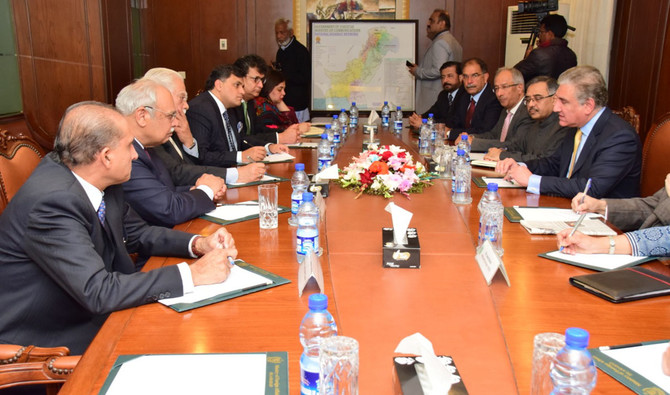
“I consider this a violation of the line of control,” Qureshi said about the early morning incursion in brief comments to the media after holding an “emergency meeting” of top officials and advisers. “Pakistan has the right to an appropriate response, it has the right to self defense.”
He added that he would now meet Prime Minister Imran Khan who had summoned a special meeting to discuss Pakistan’s options following the breach by the Indian side.
But contradicting Pakistan’s version of what transpired on Tuesday morning, Indian Foreign Secretary Vijay Gokhale said India had carried out an intelligence-based operation inside Pakistan, striking at “the biggest training camp” of the Jaish-e-Mohammad (JeM) militant group in Balakot.
Balakot is a town in the northwestern Pakistani province of Khyber Pakhtunkhwa, about 50 km from the LoC in Kashmir.
“In this operation, a very large number of JeM terrorists, trainers, senior commanders and groups of jihadis who were being trained for fidayeen [guerrilla] action were eliminated,” Gokhale said in a statement.
India’s minister of state for agriculture Gajendra Singh Shekhawat also said on Twitter that the Indian Air Force had carried out an aerial strike on “terror camps” across the LoC and completely destroyed them.
The latest confrontation comes after days of simmering tensions between Pakistan and India over a February 14 suicide bombing in Indian-administered Kashmir in which at least 40 Indian paramilitary troopers were killed. The attack was claimed by the JeM.
New Delhi blamed Islamabad for the assault and faced with election-year pressures, Prime Minister Narendra Modi promised a “strong response.” Pakistan denies any state complicity.
Although exchanges of artillery and light weapons on the LoC are not uncommon, Tuesday’s statements from Pakistan and India are rare public admissions of airspace violations by warplanes.
In September 2016, India said it had conducted “surgical strikes” on militants in Pakistan but Pakistan “completely rejected” the claim. The alleged strikes followed a separatist attack on an army base in Uri near Pakistan and India’s disputed frontier in which 17 soldiers perished.


