

US envoy meets top Taliban leader in Doha ahead of formal talks on Afghanistan’s future

The Taliban political office in Doha, Qatar. The presence of the Taliban’s deputy chief at talks with the United States suggests that the insurgent group’s negotiators could have the decision making authority they lacked before. (AP)
Updated 25 February 2019
Follow

US envoy meets top Taliban leader in Doha ahead of formal talks on Afghanistan’s future

  • Khalilzad thanks Pakistan for facilitating the travel of top Taliban leaders
  • Mullah Baradar will guide the Taliban negotiating team

PESHAWAR: US Special Representative for Afghanistan Zalmay Khalilzad held an introductory meeting with Taliban co-founder Mullah Abdul Ghani Baradar in Doha, confirmed Sohail Shaheen, the group’s spokesman in Doha, while talking to Arab News on Monday.

Shaheen said the meeting took place “in a promising environment,” adding: “Mullah Baradar Akhund introduced the members of the Taliban negotiating team to the American team. He then underscored the importance of the talks, the ability of his team, and discussed the future strategy.”

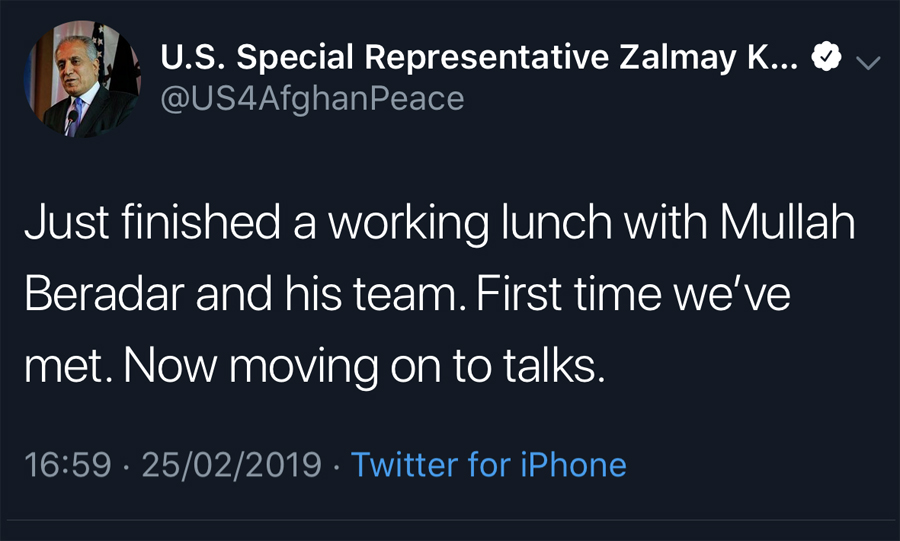
Khalilzad also tweeted about the congregation on Monday, saying it was the first time he had met Mullah Baradar and his team at a working lunch. He also indicated that the two sides were now prepared for the peace talks. 
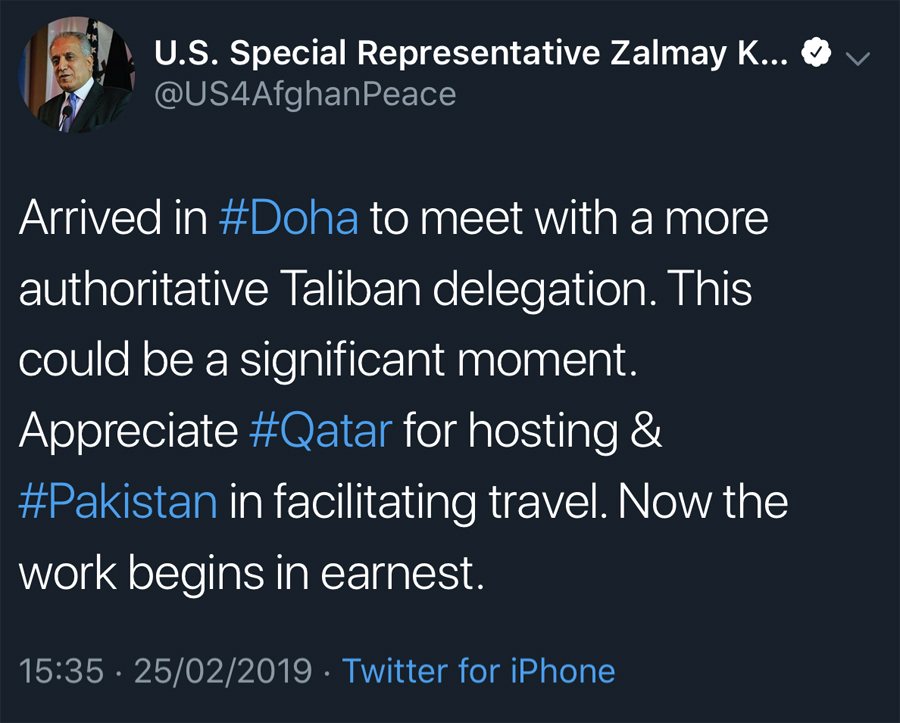
The US envoy had also tweeted about the significance of his meeting with a “more authoritative Taliban delegation” on his arrival to Doha. He had also appreciated Qatar for hosting the meeting and Pakistan for facilitating the travel of the Taliban leaders.

Mullah Baradar, Mullah Amir Khan Muttaqi, Mullah Abdul Lateef Mansoor and Maulvi Matiul Haq travelled to Doha on a chartered plane last Sunday after Pakistan made arrangements for their journey.

The US team for Monday’s meeting consisted of about 25 members, including officials of the State Department, Pentagon, Department of Defense, and some Congressmen.

The Taliban side was short of one man since Anas Haqqani, one of the 14 members of the negotiating team, remained in Afghan captivity. 
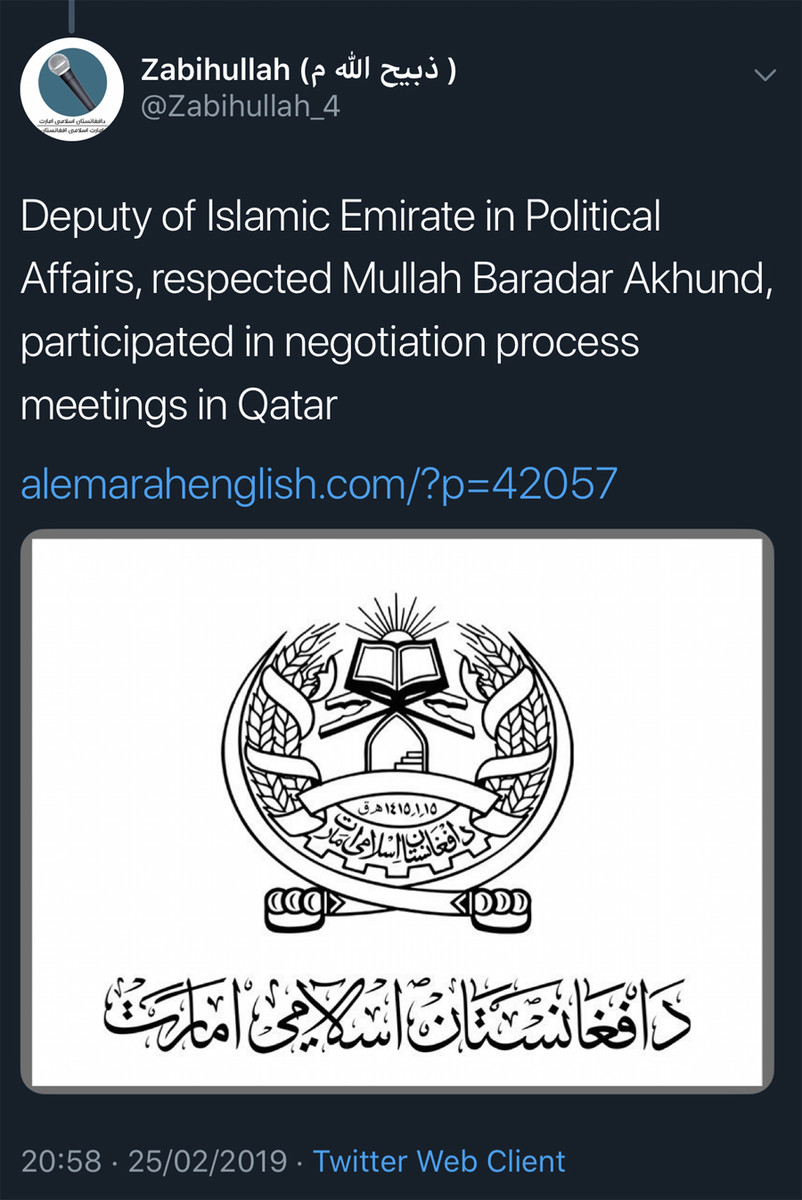
The Taliban spokesman further said the two sides would resume regular talks from Tuesday, as two working groups, created during previous rounds of talks, would begin their interaction.

The focus of their conversation would be the withdrawal of all foreign troops from Afghanistan and guarantees that the war-torn state would not be used by anyone to launch terrorist attacks against any other country.

Asked who would lead the Taliban in the future talks, Shaheen said Mullah Baradar had appointed Sher Muhammad Abbas Stanekzai for that purpose. “Being the head of the political commission, however, Mullah Baradar can join the meetings whenever he wishes,” he added. 
Earlier, Shaheen also said in a video message posted on a website that the two sides could reach an agreement at the end of the meeting.

Taliban Spokesman Zabihullah Mujahid also issued a statement about the “first day of the fifth sitting.” Apart from highlighting the significance of Monday’s meeting, the statement said the talks would take place under Stanekzai’s leadership and, whenever needed, the team would consult and seek guidance from Mullah Baradar.


Babar Azam dropped for scoring too slowly, says Pakistan coach Hesson

Updated 20 February 2026
Follow

Babar Azam dropped for scoring too slowly, says Pakistan coach Hesson

  • Shaheen Shah Afridi was left out after conceding 101 runs in three matches
  • Pakistan will now face New Zealand in the opening match of the second phase

COLOMBO: Batting great Babar Azam was dropped for Pakistan’s final T20 World Cup group game against Namibia for scoring too slowly, said head coach Mike Hesson on Friday.

Azam, who is the highest run-scorer in T20 international history with 4,571 runs, was left out for the must-win game against Namibia as Pakistan racked up 199-3 and secured a place in the Super Eights by 102 runs.

The 2009 champions face New Zealand in Colombo on Saturday in the opening match of the second phase.

“I think Babar is well aware that his strike rate in the power play in the World Cup is less than 100 and that’s clearly not the role we think we need,” Hesson told reporters after Pakistan’s final practice session on Friday was washed out by rain.

Pakistan left out Azam for the same reason at last year’s Asia Cup and even after dismal showing in the Big Bash League, he was still selected for the T20 World Cup.

“We brought Babar back in for a specific role post the Asia Cup,” said Hesson.

“We’ve got plenty of other options who can come in and perform that role toward the end.

“Babar is actually the first to acknowledge that.

“He knows that he’s got a certain set of skills that the team requires and there are certain times where other players can perform that role more efficiently.”

Hesson also defended dropping pace spearhead Shaheen Shah Afridi after he conceded 101 runs in three matches, including 31 in two overs against India.

“We made a call that Salman Mirza was coming in for Shaheen, and he bowled incredibly well,” said Hesson.

“To be fair, he was probably really unlucky to not be playing the second and third games.”

Hesson was wary of Pakistan’s opponents on Saturday.

“New Zealand have played a huge amount in the subcontinent in recent times so we have to play at our best.”