

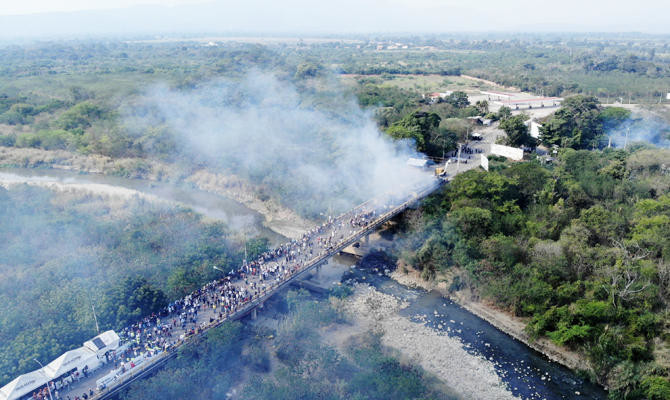

URENA, Venezuela: A high-risk opposition campaign to deliver humanitarian aid into Venezuela descended into deadly chaos Saturday after President Nicolas Maduro’s security forces fired on demonstrators and aid trucks were set ablaze as his blockade held firm.
Two people, including a 14-year-old boy, were killed in clashes with security forces on the Brazil-Venezuela border amid efforts to bring in aid there, a human rights group said.
Opposition leader Juan Guaido had set a Saturday deadline for the delivery of food and medical aid stockpiled in Colombia and Brazil.
Aid is also being held on the Caribbean island of Curacao because of Maduro’s ban. A boat from the US territory of Puerto Rico was also en route to Venezuela with humanitarian aid, Governor Ricardo Rossello said, without indicating its destination fort.
But hundreds of volunteers, many clad in white, were frustrated in their attempts to collect the aid at the Colombian border, pinned back by Maduro’s security forces.
Since dawn, protesters in the border towns of Urena and San Antonio were held at bay by the Venezuelan National Guard firing tear gas and rubber bullets.
Gunshots could be heard in the streets of Urena during hours of rioting. Civil defense officials in Colombia said at least 42 people had been injured in clashes on the main Simon Bolivar bridge crossing. Most were Venezuelan nationals who were trying to cross with aid parcels when they were pushed back by Venezuelan forces.
But the most serious incident came hundreds of miles away, at the Santa Elena de Uairen crossing point on the southern border with Brazil.
Two people were killed and 31 wounded when troops blocking the entry of aid opened fire on civilians hoping to gather it, according to rights group Foro Penal.
“They are massacring the people of Venezuela in Santa Elena de Uairen and San Antonio, where from seven o’clock in the morning they did not allow Venezuelans to gather to bring in humanitarian aid,” Guaido told reporters in Cucuta where he was coordinating the aid operation.
“From that moment, they deployed irregulars on Venezuelan territory, firing weapons to try to stop what is inevitable to stop,” he said.
Maduro’s supporters halted and set ablaze two trucks loaded with aid driven through barricades on a border bridge, sending a pall of black smoke into the sky over the Santander crossing linking Cucuta, Colombia with Urena, Venezuela.
“People are saving the bulk of what’s on the first truck, and looking after the humanitarian aid that Maduro the dictator ordered burned,” opposition lawmaker Gaby Arellano told reporters.
Some National Guard troops took advantage of the confusion to abandon their posts and cross into Colombia.
Colombia’s immigration service said at least 23 members of the security forces — 20 of them troops — had deserted by Saturday afternoon.
Guaido, recognized as interim leader by more than 50 countries — said they would be welcomed and not treated as traitors.
The opposition leader formally launched a long-planned distribution operation at a warehouse at the Tienditas border bridge in Cucuta joined by the presidents of Chile, Colombia and Paraguay.
“The humanitarian aid is definitely going to Venezuela in a peaceful and calm manner to save lives at this time,” said Guaido.
Shortly afterward, he claimed a first shipment had reached Venezuela to defy Maduro’s blockade. But the truck he was referring to remained stuck at the Brazilian border hours later.
Guaido has vowed humanitarian aid would enter his country despite the blockade.
His supporters planned to drive the aid from Colombia into Venezuela at the closed border crossings supported by a flood of volunteers and accompanied by Catholic priests in an attempt to avoid arrest.
Socialist leader Maduro has rejected the aid, which he’s dismissed as a show and pretext for a US invasion.
Angered by Colombia’s support for Guaido, Maduro announced Venezuela was severing diplomatic ties with Bogota, and gave Colombian diplomats 24 hours to leave the country.
“I will never bow down, I will never give in. I will always defend our country with my own life if necessary,” Maduro told a huge rally of his supporters in the capital Caracas, after thousands had marched through the city under the slogan “Hands off Venezuela.”
Humanitarian aid has become the centerpiece of the standoff between Maduro and Guaido, the 35-year-old leader of Venezuela’s National Assembly who declared himself interim president exactly one month ago.
Guaido has accused Maduro of rigging his re-election and is demanding a new vote.
As many as 300,000 Venezuelans are in dire need of food and medicine after years of shortages and malnutrition, according to Guaido. The country is gripped by a humanitarian crisis that has seen poverty soar during a prolonged recession.
United Nations figures show that some 2.7 million people have fled Venezuela since 2015 amid the crisis, and some 5,000 Venezuelans emigrate from their country each day.
On the eve of the faceoff, Guaido defied a government ban on leaving the country and attended a “Venezuela Live Aid” concert organized by British billionaire Richard Branson just over the border in Colombia with some of the biggest names in Spanish-language music.
Hours later, Caracas said it had closed much of the Colombian border, citing threats to Venezuela’s security.


