

Film Review: Hip-hop dream in ‘Gully Boy’ is music to the ears

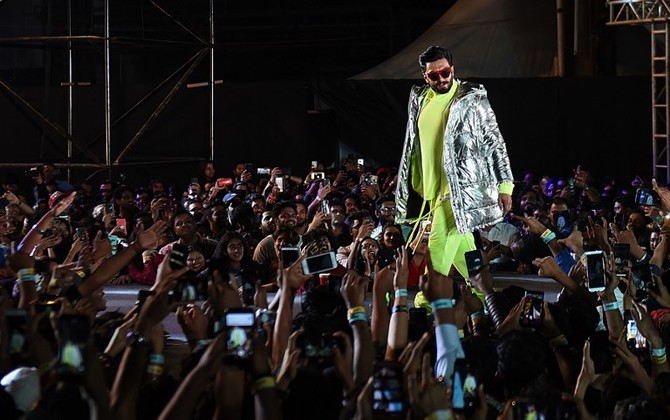
Bollywood actor Ranveer Singh performs during the launch of musical drama ‘Gully Boy’ in Mumbai on January 24, 2019. (AFP)
Updated 23 February 2019
Follow

Film Review: Hip-hop dream in ‘Gully Boy’ is music to the ears

CHENNAI: Stories about slums and poverty are not easy to script. They can easily turn into vulgar celebration, as Danny Boyle’s “Slumdog Millionaire” was seen by some, notably legendary Greek filmmaker Theo Angelopoulos.

But director Zoya Akhtar (“Zindagi Na Milegi Dobara” and “Luck by Chance”) manages to steer herself clear of slipping into this trap with her latest drama, “Gully Boy,” which emerges from one of the biggest slums in the world, Dharavi, in Mumbai.

There, thousands of people living in a sprawl of huts have a bewildering variety of experiences to narrate. One story is that of Murad’s (Ranveer Singh), whose chance meeting with a rapper, Sher (Siddhant Chaturvedi), opens a magical door.

The film, inspired by real-life rappers Naezy and Divine, focusses on Murad’s ambition to become a rapper, and how he achieves it, despite his driver father’s fears and his uncle’s disdain.

In one scene, the uncle tells Murad that a chauffeur’s son can only hope to be another chauffeur, a servant in other words. A humiliated Murad takes this to heart, but quietly vows to transform his dream into reality.

His sweetheart Safeena (Alia Bhatt), who is studying to be a doctor, pushes him towards a hip-hop life.

Witten by Akhtar along with Reema Kagti, “Gully Boy” is undoubtedly the director’s career best, and Ranveer’s too. In a role that literally overshadows his earlier outings (including “Bajirao Mastani” and “Padmaavat”), he brilliantly conveys the angst and struggle of an underdog, and how his unflattering social status attracts ridicule even among those merely aspiring to be rappers.

Ranveer infuses into Murad a quiet determination that helps him cross frightening social and cultural barriers.

Safeena is also imaginatively fleshed out as a fiery woman who helps Akhtar create his own brand of rap music (some grippingly done by Naezy and Divine).

What is even more exciting is that “Gully Boy” brings rap out of the shadows and in this process the city and the slum, sensitively lensed by Jay Oza, seem to be screaming that miracles are possible even in the face of Mumbai’s painful inequities.


BMW Art Cars mark 50 years at inaugural Art Basel Qatar

Updated 09 February 2026
Follow

BMW Art Cars mark 50 years at inaugural Art Basel Qatar

DOHA: BMW’s long-running Art Car initiative took center stage at the inaugural Art Basel Qatar, with Thomas Girst, BMW Group’s head of cultural engagement, reflecting on five decades of collaboration between artists, engineers and the automobile.

Speaking at the fair, Girst situated the Art Car program within BMW’s broader cultural engagement, which he said spanned “over 50 years and hundreds of initiatives,” ranging from museums and orchestras to long-term partnerships with major art platforms.

“Every time Art Basel moves — from Miami to Hong Kong to Qatar — we move along with them,” he said. “That’s why we’re here.”


A post shared by Art Basel (@artbasel)

The occasion also marked the 50th anniversary of the BMW Art Car series, which began in 1975 with Alexander Calder’s painted BMW 3.0 CSL. Since then, the project has grown into a global collection that brings together motorsport, engineering, design and contemporary art. “Those Art Cars speak to a lot of people at the intersection of motorsports, technology, racing engineering, arts, lifestyle and design,” Girst said.

For Girst, the relationship between art and the automobile has deep historical roots. He pointed to early modernist fascination with cars, noting that “since the inception of the automobile,” artists have seen it as both a subject and a symbol of modernity. “There’s a reason for arts and culture and cars to mix and mingle,” he said.

At Art Basel Qatar, visitors were invited to view David Hockney’s BMW Art Car — Art Car No. 14 — displayed nearby. Girst described the work as emblematic of the program’s ethos, highlighting how Hockney painted not just the exterior of the vehicle but also visualized its inner life. The result, he suggested, is a car that reflects both movement and perception, turning the act of driving into an artistic experience.

Central to BMW’s approach, Girst stressed, is the principle of absolute artistic freedom. “Whenever we work with artists, it’s so important that they have absolute creative freedom to do whatever it is they want to do,” he said. That freedom, he added, mirrors the conditions BMW’s own engineers and designers need “to come up with the greatest answers of mobility for today and tomorrow.”

The Art Car World Tour, which accompanies the anniversary celebrations, has already traveled to 40 countries, underscoring the project’s global reach. For Girst, however, the enduring value of the initiative lies less in scale than in its spirit of collaboration. Art, design and technology, he said, offer a way to connect across disciplines and borders.

“That’s what makes us human. We can do better things than just bash our heads in — we can create great things together,” he said.