

Pakistan, Saudi Arabia assure coordination council will implement $21b deals

Pakistani and Saudi foreign ministers on Monday addressed joint press briefing in Islamabad. (PID)
Updated 18 February 2019
Follow

Pakistan, Saudi Arabia assure coordination council will implement $21b deals

  • Technical and financial teams will implement agreements signed during crown prince’s visit, Saudi foreign minister says
  • Pakistani foreign minister says council has “specific timeline and action plan” to implement deals

ISLAMABAD: The Pakistani and Saudi foreign ministers on Monday said a coordination council would follow up on $21 billion in agreements signed during the visit to Pakistan of the Saudi crown prince and ensure their timely implementation.
The investments come at a time when Pakistan is fighting to secure its financial future in the face of a yawning current account deficit.
Crown Prince Mohammed bin Salman arrived in Pakistan on Sunday on the first stop of a trip to South Asia and China and signed memoranda of understanding [MoUs] worth $21 billion in the refining, petrochemical, renewable energy and mining sectors. An agreement to supply Pakistan crude oil and petroleum products was also signed. The crown jewel of the agreements is a $10 billion oil refinery to be set up in the port city of Gwadar in southwestern Pakistan.
“Now our technical and financial teams will look into all these projects to implement them,” Saudi foreign minister Adel bin Ahmed Al-Jubeir said at a press conference with his Pakistani counterpart Shah Mehmood Qureshi Monday morning.
Pakistan and Saudi Arabia have announced a “supreme coordination council” that will follow up on and ensure the timely implementation of all agreements signed during the visit of the crown prince. The council held its first meeting on Sunday night.
Jubeir said the coordination council would “involve almost every facet of our governments; whether it's security, political consultation, trade and investment, or culture.”
“We believe in the great potential of Pakistan for investments ... and the signing of the MoUs is just a beginning,” Al-Jubeir said.
He said the investments would benefit both countries mutually and clarified that the deals were “not charity”: “This is an investment,” he said.
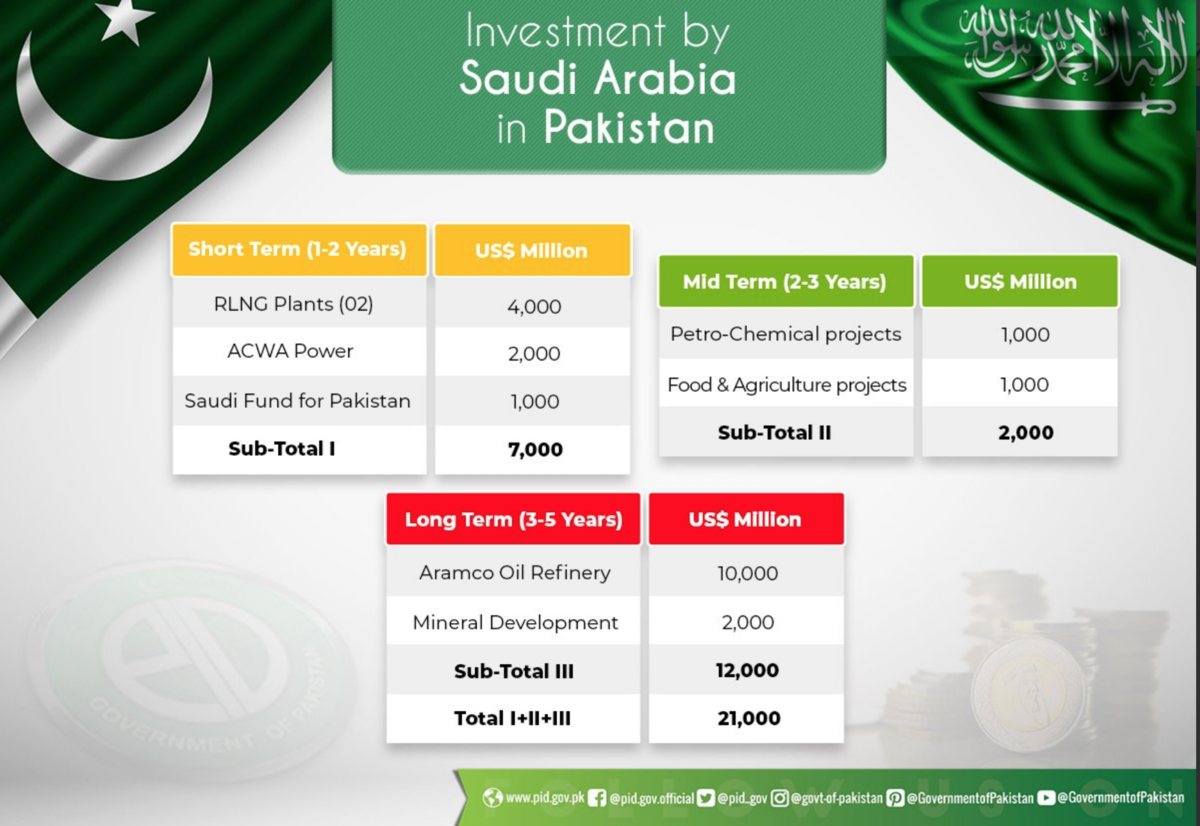


Chart of Saudi investments in Pakistan. (Source: PID)

The Pakistani foreign minister told reporters the coordination council had a “specific timeline and action plan” to implement agreements, adding that senior leaders of the two countries would meet once a year to review progress on the deals.
“Some of the MoUs are announced while a number of others are still in the pipeline and will be announced in due course of time,” Qureshi said, “This [signing of agreements shows] seriousness of Saudi leadership for investment in Pakistan.”
To a question about combating terrorism, the Saudi foreign minister said terrorism was a common enemy and Pakistan, Saudi Arabia and the United States were working together to counter it.
“Saudi Arabia has been a victim of terrorism,” he said. “We have been vigilant and unmerciful in going after the terrorists and those who support them and condone them.”
He also said Saudi Arabia was working with Pakistan and the U.S. to help reach a negotiated settlement to a 17-year-long war in neighboring Afghanistan and end a conflict between Taliban insurgents and the Western-backed Kabul government.
Commenting on tensions between nuclear-armed rivals Pakistan and India in the aftermath of a militant attack in Indian-administered Kashmir in which 44 paramilitary policemen were killed, the Saudi official said: “Both the countries should resolve all their differences peacefully.”


Pakistan to promote mineral sector at Saudi forum this month with 13 companies

Updated 02 January 2026
Follow

Pakistan to promote mineral sector at Saudi forum this month with 13 companies

  • Delegation will take part in the Future Minerals Forum in Riyadh from Jan. 13-15
  • Petroleum minister will lead Pakistan, participate in a 90-minute country session

ISLAMABAD: Around 13 Pakistani state-owned and private companies will attend the Future Minerals Forum (FMF) in Saudi Arabia from Jan. 13 to 15, an official statement said on Friday, as the country seeks to ramp up global engagement to develop its mineral resources.

The FMF is an international conference and investment platform for the mining sector, hosted by mineral-rich countries to attract global investors, companies and governments.

Petroleum Minister Ali Pervaiz Malik confirmed Pakistan’s participation in a meeting with the Saudi envoy, Nawaf bin Said Al-Malki.

Pakistan hosts one of the world’s largest copper-gold zones. The Reko Diq mine in southwestern Balochistan, with an estimated 5.9 billion tons of ore, is partly owned by Barrick Gold, which calls it one of the world’s largest underdeveloped copper-gold deposits. Its development is expected to boost Pakistan’s struggling economy.

“Upon an invitation of the Government of the Kingdom of Saudi Arabia, the Federal Minister informed the Ambassador that Pakistan will fully participate in the upcoming Future Minerals Forum (FMF), scheduled to be held in Riyadh later this month,” Pakistan’s Press Information Department (PID) said in an official statement.

The Pakistani minister will lead his country’s delegation at the FMF and take part in a 90-minute country showcase session titled “Unleashing Potential: Accelerating Pakistan’s Mineral Revolution” along with local and foreign investors.

Pakistan will also establish a dedicated pavilion to highlight the vast potential of its rich geological landscape to the global mineral community.

The Saudi envoy welcomed Pakistan’s decision to participate in the forum and discussed enhancing bilateral cooperation in the minerals and energy sectors during the meeting.

According to the statement, he highlighted the potential for cooperation between Saudi Arabia and Pakistan in the minerals and energy sectors, expressing confidence that the FMF would provide a platform to expand collaboration.
Pakistan’s mineral sector, despite its rich reserves of salt, copper, gold and coal, contributes only 3.2 percent to the country’s GDP and just 0.1 percent to global mineral exports.

However, many countries, including the United States, have shown interest in Pakistan’s underdeveloped mineral sector, particularly in copper, gold and other critical resources.

In October, Pakistan dispatched its first-ever shipment of rare earth and critical minerals to the United States, according to a Chicago-based US public relations firm’s report.