

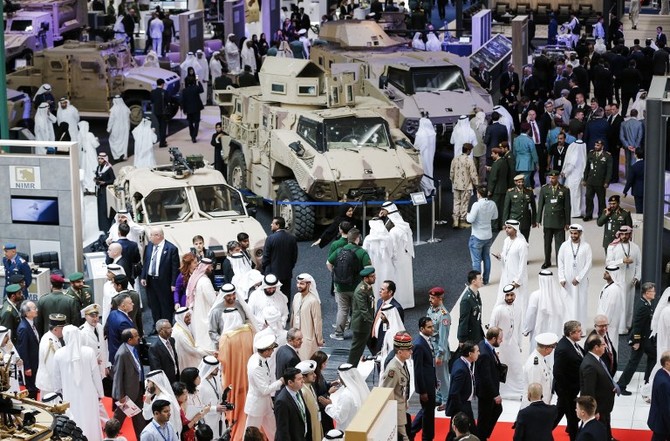
IDEX 2019: UAE armed forces sign new defense deals

1 / 3
The defense deals were signed at the week-long IDEX military exhibition in Abu Dhabi
2 / 3
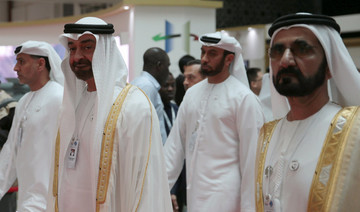
Sheikh Mohammed bin Rashid Al-Maktoum, left, Vice-President and Prime Minister of the UAE and Ruler of Dubai, attends the opening of the International Defense Exhibition and Conference on February 17, 2019. (AFP)
3 / 3
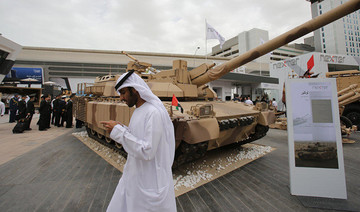
Members of the UAE armed forces show their military skills during the opening of the International Defence Exhibition and Conference on Sunday, February 17, in Abu Dhabi. (AFP)
Updated 19 February 2019
Follow

IDEX 2019: UAE armed forces sign new defense deals

  • Falcon was developed in response to the UAE’s request to replace the Hawk Air Defense System

ABU DHABI: The UAE armed forces has signed $1.17 million worth of defense contracts with local companies and $514.8 million with international companies, military spokesperson Brigadier General Mohammed Al-Hassani said on Tuesday.

The Emirates on Monday also awarded Raytheon a $1.55 billion contract to supply its air force with platform systems to launch missiles.

The agreement was signed at the week-long IDEX military exhibition in Abu Dhabi and followed the award on Sunday of a 1.3 billion-dirham contract to Raytheon to supply the UAE with patriot missiles.

The UAE armed forces signed a total of 7.2 billion dirhams in contracts on Monday, including 5.8 billion dirhams with international companies, Brig. Gen. Mohammed Al-Hassani said, speaking through a translator.

The UAE has signed a total of 12 billion dirhams in contracts since the IDEX exhibition started on Sunday, he said.

Lockheed Martin, Germany’s Diehl Defense, and Sweden’s Saab on Monday launched at IDEX the Falcon air defense weapon system, billed as a replacement to the Hawk system used by countries in the Middle East.

Falcon was developed in response to a UAE request for a replacement for the Hawk system and talks are underway to sell it to the Gulf state, Scott Arnold, Lockheed Martin’s vice president and deputy head of Integrated Air and Missile Defense said.

Weapons sales to the UAE have come under scrutiny over the past year due to the country’s involvement in the Yemen war that has killed tens of thousands of people and pushed the country to the brink of starvation.

The UAE and Saudi Arabia are leading a military coalition, which includes local forces drawn from Yemeni factions, that is trying to restore the internationally recognized government ousted from power in 2014 by the Iran-aligned Houthi movement.
SABIC posts $31bn revenue, maintains $9bn dividend despite loss 

Updated 13 sec ago
Follow

SABIC posts $31bn revenue, maintains $9bn dividend despite loss 

RIYADH: Saudi Basic Industries Corp. swung to a net loss of SR25.78 billion ($6.87 billion) in 2025, as divestment-related charges and weaker petrochemical prices weighed on earnings, even as the company generated SR116.53 billion in revenue. 

The loss compares with a net profit of SR1.54 billion a year earlier, while revenue declined 1.03 percent from 2024 levels, according to a Tadawul filing  

In a statement, the company attributed the slight fall in revenue to lower average selling prices across key products, partially offset by higher sales volumes. 

The company’s operational profit stood at SR4.37 billion in 2025, while earnings before interest, tax, depreciation and amortization amounted to SR17.88 billion. 

In a statement, ‏Abdulrahman Al-Fageeh, CEO of SABIC, said: “2025 reflected a moderately improving macroeconomic landscape. Yet, production overcapacity persisted in the petrochemical industry, continuing to squeeze margins and depress utilization rates.”  

He added: “Amid these conditions, SABIC remained focused on meeting its 2025 priorities.”  

Al-Fageeh, who is set to step down as SABIC’s CEO at the end of March, said the company achieved a total recordable incident rate of 0.07, the lowest in SABIC’s history. “This represents a 22 percent year-over-year improvement in performance across the combined areas of environment, health, safety, and security.”  

According to SABIC, losses from discontinued operations increased by SR20.8 billion compared to the previous year.  

This was primarily attributed to reporting non-cash losses of SR15.2 billion related to the fair value assessment of the planned exit from petrochemical assets in Europe and thermoplastic engineering businesses in the Americas and Europe.  

In a separate Tadawul filing, SABIC said its board approved the distribution of interim cash dividends totaling SR4.5 billion for the second half of 2025, equivalent to SR1.5 per share. The dividend will be paid on March 31 to shareholders registered as of March 8. 

The second-half payout follows a similar SR4.5 billion dividend distributed for the first half of 2025, bringing the company’s total shareholder distributions for the year to SR9 billion. 

“We remain committed to delivering value to our shareholders, announcing the distribution of SR9 billion in dividends for the full year of 2025,” added Al-Fageeh. 

The CEO revealed that construction of the SABIC Fujian petrochemical complex remained on track, reaching 95.3 percent completion. 

He further said that SABIC’s innovation program provided market-driven solutions for customers through 148 new product introductions in 2025. 

“All these achievements helped to strengthen SABIC’s brand value, which surpassed $5 billion for the first time. Having grown 5.4 percent over the year, the SABIC brand is now valued at $5.19 billion,” he concluded. 

SABIC also announced the appointment of Faisal Mohammed Al-Faqeer as its new CEO, effective April 1, 2026, replacing Abdulrahman Saleh Al-Fageeh. 

“SABIC Board of Directors extends its sincere thanks and appreciation to  Abdulrahman Saleh Al-Fageeh, who has been an instrumental figure in guiding the company through a crucial period of strategic optimization designed to ensure its long-term success and reinforce its role at the forefront of the global petrochemical industry,” the company said in a Tadawul statement. 

Al-Faqeer has extensive experience in the petrochemicals and refining industries. He currently serves as senior vice president of liquids-to-chemicals at Saudi Aramco.