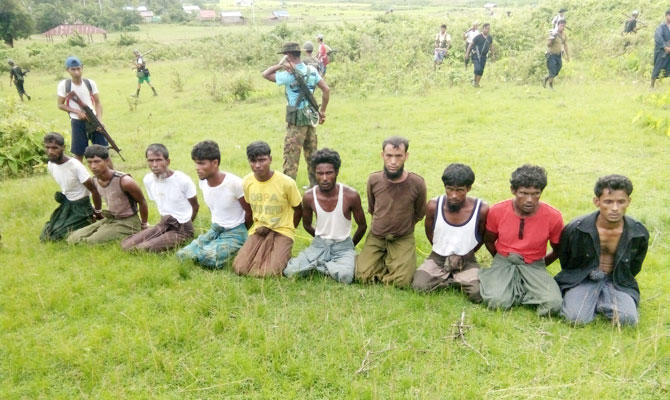

BANGKOK: Myanmar’s army chief should be prosecuted for genocide against the Rohingya Muslim minority, a UN human rights investigator said, adding that holding perpetrators to account for crimes was necessary before refugees who fled the country could return.
Yanghee Lee, the UN’s Special Rapporteur on Human Rights in Myanmar, was speaking during a trip to Thailand and Bangladesh, where she met officials and Rohingya driven out of western Rakhine state after an army crackdown in 2017.
“Min Aung Hlaing and others should be held accountable for genocide in Rakhine and for crimes against humanity and war crimes in other parts of Myanmar,” said Lee, who is barred from the country, referring to the military’s commander-in-chief.
Her interview marked the first time Lee has publicly called for the army chief to be prosecuted for genocide. A UN fact-finding mission on Myanmar last year said that the military campaign, which refugees say included mass killings and rape, was orchestrated with “genocidal intent” and recommended charging Min Aung Hlaing and five other generals with the “gravest crimes under international law.”
Since August 2017 some 730,000 Rohingya have fled Rakhine to Bangladesh, where they now live overcrowded camps.
“For any repatriation to happen ... the perpetrators must be held to account, because sending the refugees back with no accountability is going to really exacerbate or prolong the horrific situation in Myanmar,” Lee told Reuters in an interview in Thailand on Jan. 18. “And then we’ll see another cycle of expulsion again.”
Spokesmen for Myanmar’s military and government could not be reached for comment. The country has previously denied almost all allegations made by refugees against its troops, who it says were engaged in legitimate counterterrorism operations.
Legal routes
The UN Security Council in September voted to approve the establishment of an “ongoing independent mechanism” for Myanmar that would collect, consolidate, and preserve evidence of crimes that could be used in an eventual court case.
Lee said the independent mechanism would provide funds for “victim support,” including money for criminal cases.
Myanmar has said it “absolutely rejects” that the International Criminal Court (ICC) has jurisdiction to rule on its actions. The country is not a party to the Rome Statute that established the Hague-based court.
Non-parties can be referred to the ICC by the UN Security Council, though diplomats have said permanent members China and Russia would likely veto any such move. Britain has been drafting a Security Council resolution on Myanmar, but diplomats told Reuters in December it did not include a referral to the ICC.
Legal experts say other options for an international prosecution include referral by individual UN member states – five Latin American states recently successfully referred Venezuela – or an ad hoc tribunal.
’Dark ages’
Lee has been blocked from visiting Myanmar since 2017 over her vocal criticism of its treatment of the Rohingya.
She said Myanmar authorities had turned down her latest request to visit the country.
“They responded and reminded me that they had asked the Human Rights Council to replace me so they cannot engage with me,” she said.
The human rights record of the civilian government led by Nobel peace laureate Aung San Suu Kyi has been a “great disappointment,” she said.
Since Suu Kyi swept to power in a landslide election in 2015, 44 journalists have been arrested, according to Athan, a Yangon-based free speech group. That number includes two Reuters reporters, Wa Lone and Kyaw Soe Oo, sentenced to seven years after reporting on a military-led massacre of 10 Rohingya.
“It really is alarming that Myanmar is taking this path,” said Lee. “After 60, 70 years of isolation now is a big chance for them to come out and now they’re retreating back into the dark ages, which is very disappointing.”