


PARIS: When French President Emmanuel Macron hosted Abdel Fattah El-Sisi in Paris in October 2017, five months after taking office, he handed him a list of activists he believed the Egyptian president could release from prison.
El-Sisi looked at Macron, suggested he was naive and meticulously outlined the reasons why each person should not be released, stressing their links to militancy or the Muslim Brotherhood, three sources aware of the exchange told Reuters.
Taken aback, the young French president, who sees El-Sisi as a stabilizing force in the region and wants to bolster trade and defense ties with Cairo, told a subsequent news conference it was not up to him to “lecture” Egypt on civil liberties.
Fast-forward 13 months and Macron is nuancing his approach, French officials say. As he prepares for a three-day visit to Egypt starting on Sunday, he hopes to secure more business and defense contracts while not abandoning the human rights file.
Facing pressure
The problem Macron faces is that while he has been less outspoken on rights since his first meeting with El-Sisi, Egypt has not come through on defense and civilian deals, and rights groups say the crackdown on liberties has only worsened.
NGOs are piling pressure on Macron to be firm in confronting the Egyptian president, who in April secured a second term, shoring up his position as a powerbroker in the region.
The Elysee admits to an “evolution” in Macron’s thinking.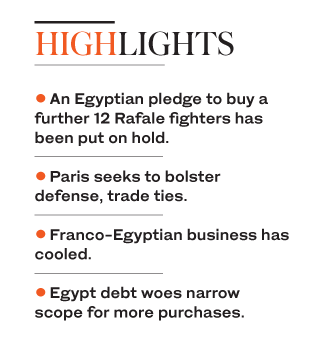
“The president’s approach in October 2017 was maybe a bit different ... but time has passed,” a presidential adviser said.
This time, rather than delivering a narrow list of names of people who should be released from prison, French authorities have sent Cairo a broader accounting of human rights shortcomings and jailed non-militant activists that they think El-Sisi will find it harder to dismiss out of hand.
Shared concerns
“I think Macron realizes that there have been limits to his silent diplomacy,” said a French diplomatic source. “He needs to find a balance between not upsetting El-Sisi and making a public point about human rights.”
After El-Sisi rose to power in 2014, Franco-Egyptian relations strengthened. Both countries shared concerns about a political vacuum in Libya and the threat from militant groups in Egypt.
Former French President Francois Hollande took a quiet approach on rights, and defense deals were signed, including the sale of 24 Rafale combat aircraft, a multi-mission frigate and two Mistral warships, deals worth some €6 billion.
“Partly in return for France’s blind eye in the realm of human rights and democratic standards, Cairo bought billions’ worth of weaponry,” said Jalel Harchaoui, a geopolitics lecturer at the University of Versailles. “But things have changed a bit lately. El-Sisi’s grip on power is much firmer.”
Since Macron came to power, business has cooled. France’s trade surplus with Egypt has not improved in three years, hovering at about €1 billion. Germany and other states have managed to secure major civilian contracts.
An Egyptian pledge to buy a further 12 Rafale fighters has been on hold for almost two years. French officials hope that may change in the coming weeks, although there is an awareness that signing such a contract during Macron’s visit would be poor optics amid the clamor over human rights.
“In private, they are saying Macron has understood, but the test for him will be whether it’s just words to keep us happy or there is something concrete like the release of prisoners at the end of it,” said one official with a Paris-based NGO.
Whether Macron can find a formula of words and actions that keeps human rights on the agenda and convinces El-Sisi to re-engage on trade remains unclear. But even if he can convince the Egyptian president that France is a trusted partner, it may not be enough, given Cairo’s financial situation.
“Egypt’s debt crisis makes additional high-profile purchases of French hardware by Cairo less likely,” Harchaoui said, referring to the state’s heavy IMF borrowing. “Amid that new environment, France’s ideological support remains unwavering, but has become less relevant.”


