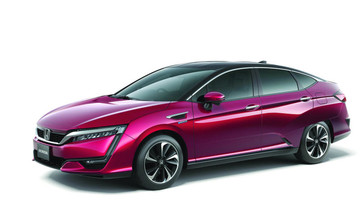
LONDON: Saudi Aramco is set to build the first hydrogen fuel cell vehicle fueling station in Saudi Arabia.
It follows the signing of a deal with New York-listed Air Products to establish a pilot fleet of fuel cell vehicles for which high-purity compressed hydrogen will be dispensed at the new fueling station.
The hydrogen refueling station, the first in the Kingdom, is expected to be operational in the second quarter of 2019, Aramco said in a statement on Friday.
“Hydrogen fuel cells offer an effective means for the electrification of transport while maintaining easy, 5 minute refueling and long driving ranges,” said Aramco Chief Technology Officer Ahmad O. Al Khowaiter.
“The use of hydrogen derived from oil or gas to power fuel cell electric vehicles represents an exciting opportunity to expand the use of oil in clean transport,” he added.
The hydrogen refueling station will be located within the grounds of Air Products world-class Technology Center in the Dhahran Techno Valley Science Park.
Toyota Motor Corporation will supply Toyota Mirai Fuel Cell Vehicles for testing in this pilot project. Toyota has been investing in hydrogen for over 20 years and in 2014 introduced the Mirai, its first mass-produced hydrogen fuel cell vehicle.

Aramco to build Saudi Arabia’s first hydrogen fuel cell filling station
- Deal struck with US=based Air Products
- Operational by second quarter of 2019
Fitch reaffirms Saudi Arabia at A+ on fiscal, external strength
RIYADH: Saudi Arabia’s sovereign credit rating was affirmed at A+ with a stable outlook by Fitch Ratings, reflecting the Kingdom’s strong fiscal and external balance sheets.
In its latest report, Fitch said Saudi Arabia continues to benefit from large sovereign net foreign assets and substantial fiscal buffers, including government deposits and other public-sector holdings.
These strengths place the Kingdom well above both “A” and “AA” peers on key balance-sheet metrics, the agency said.
The latest rating action comes as the Kingdom continues to navigate the impact of lower oil prices while advancing its economic diversification agenda.
Underscoring the strength of Saudi Arabia’s economic growth, the World Bank earlier this month said the Kingdom’s gross domestic product is expected to expand by 4.3 percent in 2026 and 4.4 percent in 2027, up from an expected 3.8 percent in 2025.
In its latest report, Fitch stated: “Oil dependence, World Bank Governance Indicators and vulnerability to geopolitical shocks have improved but remain weaknesses.”
It added: “Deep and broad social and economic reforms implemented under Vision 2030 are diversifying economic activity, albeit at a meaningful cost to the balance sheets.”
The US-based agency added that Saudi Arabia’s reserves are projected at 11.6 months of current external payments in 2026, well above the peer median of 1.9 months.
The Kingdom’s sovereign net foreign assets are expected to decline due to higher borrowing but will remain a clear credit strength, at 41.2 percent of GDP at end-2026, compared with a peer median of 3.6 percent.
Fitch also forecast a widening of the current account deficit to 4.3 percent of GDP in 2026 from an estimated 3 percent in 2025, reflecting the cost of imported inputs linked to high domestic spending and a small increase in oil export receipts.
“The deficit should narrow slightly in 2027 as revenues benefit from higher oil export volumes, new export facilities coming on stream and higher tourism inflows, supported by slower import growth from lower project spending,” it said, adding that external borrowing and a further reorientation of public assets to domestic from foreign investments should keep reserves stable.
Fiscal deficit to narrow
Saudi Arabia’s fiscal deficit is expected to narrow to 3.6 percent of GDP by 2027 after lower oil revenues and overspending pushed it to an estimated 5 percent in 2025.
Oil revenues are expected to rise from 2025 as higher production offsets the impact of lower prices.
“Non-oil revenues will continue to benefit from buoyant economic activity and improved collection techniques. Fitch assumes spending growth will be low, as capex has likely peaked and measures are in place to contain current spending,” added the report.
Solid growth and reform momentum
According to the report, Saudi Arabia’s economy is expected to expand by 4.8 percent in 2026, following an estimated 4.6 percent growth in 2025.
This expansion will be driven by higher oil production, reflecting OPEC+-related output increases over 2025, as well as robust growth in the non-hydrocarbon sector.
“Prospects for the non-oil sector remain healthy, underpinned by reform, high levels of government and GRE (government-related entities) spending, new projects coming on stream and buoyant consumer spending,” said the report.
Earlier this month, a separate analysis by Standard Chartered echoed similar expectations, forecasting the Kingdom’s GDP to expand by 4.5 percent in 2026, outperforming the projected global growth average of 3.4 percent, supported by momentum in both hydrocarbon and non-oil sectors.
In October, the International Monetary Fund said Saudi Arabia’s economy is projected to expand by 4 percent in both 2025 and 2026.
Fitch added that reform momentum remains strong, citing recent steps including a new investment law and a greater opening of the real estate and stock markets to foreign investors.
“A removal of fees on some expat workers in the industrial sector highlights an understanding of the need to ease near-term bottlenecks. Nonetheless, the resilience of non-oil growth to a period of lower government and GRE spending remains to be tested,” said Fitch.
The report also underscored the health of Saudi Arabia’s banking system, noting that credit growth and high net interest margins have supported profitability.
Over the first three quarters of 2025, capital adequacy edged up to 20 percent, while non-performing loans fell to an all-time low of 1.1 percent.
“Credit growth is slowing owing to macroprudential measures, but should remain just above nominal non-oil GDP growth,” Fitch said, adding that lending growth has continued to outpace deposit growth, leading to a further deterioration in the sector’s net foreign asset position. “However, this remains relatively small compared to total assets of the banking sector and is in stable forms,” it added.
Potential rating sensitivities
Fitch said greater non-oil revenue generation or rationalisation of expenditure, while maintaining the strength of the wider public-sector balance sheet, could support an upgrade of Saudi Arabia’s rating.
A continuation of economic reforms that underpin strong non-oil growth, combined with higher oil prices, could also improve the Kingdom’s credit profile.
On the downside, a deterioration in public finances or a major escalation of geopolitical tensions could lead to a downgrade.
In March 2025, S&P Global also raised Saudi Arabia’s rating to ‘A+’ from ‘A’ with a stable outlook, citing the Kingdom’s ongoing social and economic transformation.
In December, the Public Investment Fund secured an inaugural A-1 short-term credit rating with a stable outlook from S&P Global Ratings, marking a milestone for the sovereign wealth fund as it strengthens its global financial standing.
S&P said the rating reflects PIF’s “robust balance sheet, strong liquidity position, and disciplined financial management,” and aligns with Saudi Arabia’s own short-term sovereign rating.