

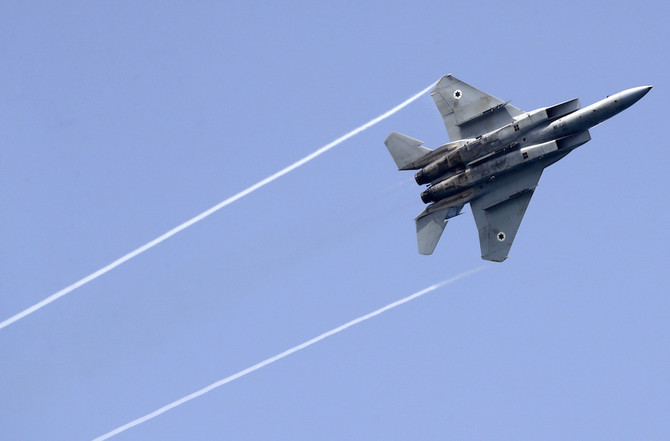

JEDDAH: Israel launched a wave of cruise missile and guided bomb attacks early on Monday against sites in Syria operated by Hezbollah and the Quds Force, the foreign unit of Iran’s Revolutionary Guards.
The targets included munitions storage facilities, an intelligence site and a military training camp. Israeli jets then targeted Syrian defense batteries after coming under fire. The Russian military said 30 cruise missiles had been shot down.
Eleven people were killed in the pre-dawn strikes, which lasted for nearly an hour and were the most intense Israeli attacks since May, the Syrian Observatory for Human Rights said.
Russia said four Syrian troops were among those killed in the airstrikes, which also damaged infrastructure at Damascus airport.
The attacks followed a previous night of cross-border fire, which began when Iranian troops fired an Iranian-made surface-to-surface missile from an area near Damascus at a ski resort in the Israeli-occupied Golan Heights.
Lt. Col. Jonathan Conricus, an Israeli military spokesman, said the missile had been smuggled into Syria specifically for that purpose. It was of a type that had not been used in the Syrian was and had “no business” being in Syria, he said.
Prime Minister Benjamin Netanyahu said Israel “pounded” the Iranian sites in response to the missile attack. “We don’t allow such acts of aggression to go unanswered as Iran attempts to establish itself militarily in Syria,” he said. “Whoever tries to harm us, we will harm them.”
An official from the so-called “Axis of Resistance” — led by Iran and made up of Syria, Iraqi Shiite militias, Hezbollah and other groups — said: “The conditions are getting closer to war every day and a war might break out on several fronts.”
Israeli political and military leaders had previously refused to confirming attacks, and have only recently acknowledged hundreds of strikes against Iranian and Hezbollah targets in Syria in recent years.
Monday’s announcement went a step further, reporting the strikes in real time and detailing the targets. There is speculation in Israel that the new openness may be linked to domestic politics before elections in April.
Former defense minister Moshe Yaalon said the military had no choice but to comment on the strikes after Netanyahu took public credit. Yaalon said he supported the strikes but not the “chatter” around them, and he accused Netanyahu of playing politics with Israel’s security.
“Unfortunately ... everything is connected to his political survival,” Yaalon said. “What does the publication give us? Can someone tell me what the benefit is, besides politics?”


