BAGHDAD: Roaring along Baghdad’s highways, the “Iraq Bikers” are doing more than showing off their love of outsized motorcycles and black leather: they want their shared enthusiasm to help heal Iraq’s deep sectarian rifts.
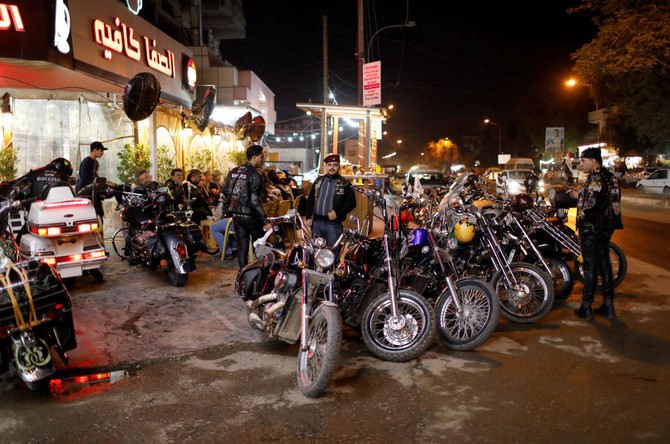
Weaving in and out of traffic, only the lucky few ride Harley Davidsons — a rare and expensive brand in Iraq — while others make do with bikes pimped-up to look something like the “Easy Rider” dream machines.
“Our goal is to build a brotherhood,” said Bilal Al-Bayati, 42, a government employee who founded the club in 2012 with the aim of improving the image of biker gangs and to promote unity after years of sectarian conflict.
That is why the first rule of his bikers club is: you do not talk about politics.
“It is absolutely prohibited to talk politics among members,” Bayati told Reuters as he sat with fellow bikers in a shisha cafe, a regular hangout for members.
“Whenever politics is mentioned, the members are warned once or twice and then expelled. We no longer have the strength to endure these tragedies or to repeat them,” he said, referring to sectarian violence.
With his black bandana and goatee, the leader of the Baghdad pack, known as “Captain,” looks the epitome of the American biker-outlaw.
But while their style is unmistakably US-inspired — at least one of Bayati’s cohorts wears a helmet emblazoned with the stars and stripes — these bikers fly the Iraqi flag from the panniers of their machines.
The Iraq Bikers — who now number 380 — are men of all ages, social classes and various faiths. One of their most recent events was taking party in Army Day celebrations.
Some are in the military, the police and even the Popular Mobilization Forces, a grouping of mostly Shiite militias which have taken part in the fight to oust Islamic State from Iraq in the last three years.
“It is a miniature Iraq,” said member Ahmed Haidar, 36, who works with an international relief agency.
But riding a chopper through Baghdad is quite different from Route 101. The bikers have to slow down at the many military checkpoints set up around the city to deter suicide and car bomb attacks.
And very few can afford a top bike.
“We don’t have a Harley Davidson franchise here,” said Kadhim Naji, a mechanic who specializes in turning ordinary motorbikes into something special.
“So what we do is we alter the motorbike, so it looks similar ... and it is cheaper.”

No politics please for Baghdad bikers aiming to unite Iraq
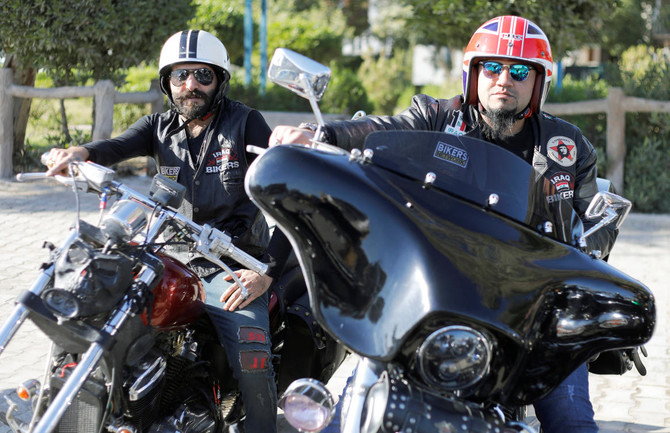
- That is why the first rule of his bikers club is: you do not talk about politics
- The Iraq Bikers — who now number 380 — are men of all ages, social classes and various faiths
In southeast Pakistan, Ramadan brings Hindus and Muslims closer
MITHI: Partab Shivani, a Hindu in Muslim-majority Pakistan, has fasted on and off during Ramadan for years, but this time is different as he practices abstinence for the entire holy month.
Every year, he and his friends in the southeastern city of Mithi arrange iftar, when Muslims break their daily fast, to foster peace and solidarity between the two religions.
“I believe we need to promote interfaith harmony. First, we are humans — religions came later,” Shivani, a 48-year-old social activist, told AFP, adding that he also reads the teachings of the Buddha.
“His message is about peace and ending war. Peace can spread through solidarity and by standing with one another. Distance only widens the gap between people,” he added.
Ninety-six percent of Pakistan’s 240 million people are Muslim. Just two percent are Hindu, most of them living in rural areas of Sindh province where Mithi is located.
In Mithi itself, most of the 60,000 inhabitants are Hindu.
Many of the city’s Hindus also observe Ramadan and iftar has become a social gathering where people from both faiths happily participate.
“This has been a wonderful tradition of ours for a very long time,” said Mir Muhammad Buledi, a 51-year-old Muslim friend who attended Shivani’s iftar gathering.
“It is a beautiful example of harmony between the two communities.”
Like brothers
Discrimination against minorities runs deep in Pakistan.
Following the end of British rule in South Asia in 1947, the subcontinent was partitioned into mainly Hindu India and Muslim-majority Pakistan.
That triggered widespread religious bloodshed in which hundreds of thousands were killed and millions displaced.
According to the Human Rights Commission of Pakistan, freedom of religion or belief is under constant threat, with religiously motivated violence and discrimination increasing yearly.
State authorities, often using religious unrest for political gain, have failed to address the crisis, the independent non-profit says.
But such tensions are absent in Mithi.
“I am a Hindu but I keep all the fasts during this month,” said Sushil Malani, a local politician. “I feel happy standing with my Muslim brothers.
“We celebrate Eid together as well. This tradition in the region is very old.”
Restaurants and tea stalls are closed across Pakistan during Ramadan.
Ramesh Kumar, a 52-year-old Hindu man who sells sweets and savoury items outside a Muslim shrine, keeps his push cart covered and closed until iftar.
“There is no discrimination among us if someone is Muslim or Hindu. I have been seeing this since my childhood that we all live together like brothers,” he said.
Muslim shrine, Hindu caretaker
Locals say Mithi’s peaceful religious coexistence can be traced to its remote location, emerging from the sand dunes of the Tharparkar desert, which borders the modern Indian state of Rajasthan.
Cows — considered sacred in Hinduism — roam freely in Mithi city, as they do in neighboring India.
At two Sufi Muslim shrines in the middle of the city, Hindu families arrange meals, bringing fruit, meals and juices for their Muslim neighbors to break their fasts.
“We respect Muslims,” said Mohan Lal Malhi, a Hindu caretaker of one of the shrines.
Mohan said his parents and elders taught him to respect people regardless of religion or color, and the traditions pass from one generation to the next.
Local residents said both communities consider their social relationships more important than their religious identity.
“You will see a (Sikh) gurdwara, a mosque, and a shrine standing side by side here,” Mohan said. “The atmosphere of this area teaches humanity.”


