PARIS: Saudi Arabia demonstrated its resolve to lift oil prices by slashing output ahead of the entry into force of new pact limiting production while Russia boosted output to a record level, the International Energy Agency said Friday.
World oil markets have been on a rollercoaster ride in recent months, with OPEC and its partners including Russia, often called OPEC+, agreeing to cut back production again from January in order to reverse a slump in oil prices on abundant production and worries about slower global growth.
In its latest monthly report, the Paris-based International Energy Agency said the Saudis took the lead by cutting output in December as prices tumbled by more than a third in just two months.
“Recently, leading producers have restated their commitment to cut output and data show that words were transformed into actions,” said the IEA.
“While Saudi Arabia is determined to protect its price aspirations by delivering substantial production cuts, there is less clarity with regard to its Russian partner,” it added.
But the cut was mostly due to the Saudis, with data indicating several OPEC members increased production last month.
The IEA said data show that Russia increased crude oil production in December “to a new record near 11.5 mbd (million barrels per day) and it is unclear when it will cut and by how much.”
OPEC members along with allies including Russia agreed in early December to trim production by 1.2 mbd from Jan. 1, in a bid to eliminate a production glut and shore up prices.
Just months earlier, they had relaxed production caps as prices shot higher on market worries about the impact of US sanctions on Iran, but Washington eventually granted waivers allowing several countries to continue to import Iranian oil.
Meanwhile, US production rose considerably more than expected last year, adding further to supplies, while concerns about demand emerged as the US-China trade spat deepened in the second half of last year.
The IEA said the US increased output by 2.1 mbd last year, the “highest ever” annual growth ever recorded.
The boom of shale oil production in the US this decade has redrawn the map of global energy politics as the nation no longer depends as heavily on imports and has even resumed exports.
The IEA said “the US, already the biggest liquids supplier, will reinforce its leadership as the world’s number one crude producer” in 2019.
“By the middle of the year, US crude output will probably be more than the capacity of either Saudi Arabia or Russia.”
The IEA left its estimate for global oil growth in 2019 unchanged at an increase of 1.4 mbd, saying “the impact of higher oil prices in 2018 is fading, which will help offset lower economic growth.”
It said there were signs that the rebalancing of the oil market will be gradual.


Saudis cut, Russians hiked output ahead of pact: IEA

Saudis cut, Russians hiked output ahead of pact: IEA
- OPEC members along with allies including Russia agreed in early December to trim production by 1.2 mbd from Jan. 1


PIF’s Humain invests $3bn in Elon Musk’s xAI prior to SpaceX acquisition
JEDDAH: Humain, an artificial intelligence company owned by Saudi Arabia’s Public Investment Fund, invested $3 billion in Elon Musk’s xAI shortly before the startup was acquired by SpaceX.
As part of xAI’s Series E round, Humain acquired a significant minority stake in the company, which was subsequently converted into shares of SpaceX, according to a press release.
The transaction reflects PIF’s broader push to position Saudi Arabia as a central hub in the global AI ecosystem, as part of its Vision 2030 diversification strategy.
Through Humain, the fund is seeking to combine capital deployment with infrastructure buildout, partnerships with leading technology firms, and domestic capacity development to reduce reliance on oil revenues and expand into advanced industries.
The $3 billion commitment offers potential for long-term capital gains while reinforcing the company’s role as a strategic, scaled investor in transformative technologies.
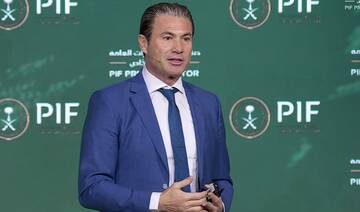
CEO Tareq Amin said: “This investment reflects Humain’s conviction in transformational AI and our ability to deploy meaningful capital behind exceptional opportunities where long-term vision, technical excellence, and execution converge, xAI’s trajectory, further strengthened by its acquisition by SpaceX, one of the largest technology mergers on record, represents the kind of high-impact platform we seek to support with significant capital.”
The deal builds on a large-scale collaboration announced in November at the US-Saudi Investment Forum, where Humain and xAI committed to developing over 500 megawatts of next-generation AI data center and computing infrastructure, alongside deploying xAI’s “Grok” models in the Kingdom.
In a post on his X handle, Amin said: “I’m proud to share that Humain has invested $3 billion into xAI’s Series E round, just prior to its historic acquisition by SpaceX. Through this transaction, Humain became a significant minority shareholder in xAI.”
He added: “The investment builds on our previously announced 500MW AI infrastructure partnership with xAI in Saudi Arabia, reinforcing Humain’s role as both a strategic development partner and a scaled global investor in frontier AI.”
He noted that xAI’s trajectory, further strengthened by SpaceX’s acquisition, exemplifies the high-impact platforms Humain aims to support through strategic investments.
Earlier in February, SpaceX completed the acquisition of xAI, reflecting Elon Musk’s strategy to integrate AI with space exploration.
The combined entity, valued at $1.25 trillion, aims to build a vertically integrated innovation ecosystem spanning AI, space launch technology, and satellite internet, as well as direct-to-device communications and real-time information platforms, according to Bloomberg.
Humain, founded in August, consolidates Saudi Arabia’s AI initiatives under a single entity. From the outset, its vision has extended beyond domestic markets, participating across the global AI value chain from infrastructure to applications.
The company represents a strategic initiative by PIF to diversify the Kingdom’s economy and reduce oil dependence by investing in knowledge-based and advanced technologies.