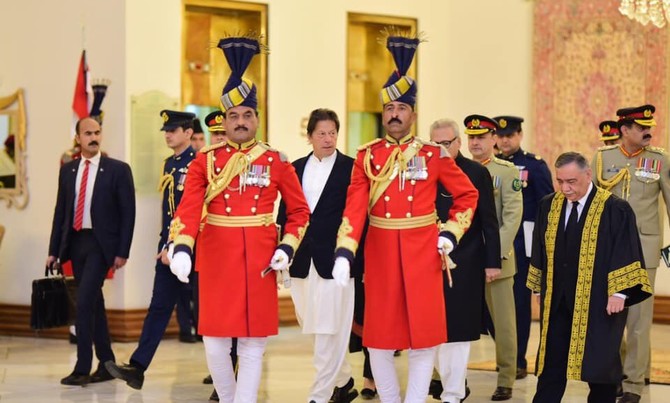
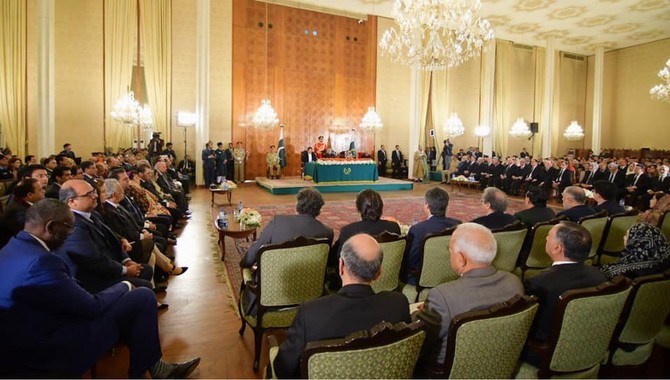
ISLAMABAD: Justice Asif Saeed Khan Khosa was sworn in as Pakistan’s new Supreme Court chief justice on Friday at a ceremony attended by top civilian and military leaders, diplomats and foreign dignitaries.
President Dr. Arif Alvi administered oath to the country’s top judge before an audience that included Prime Minister Imran Khan, Army Chief Qamar Javed Bajwa and other top government and military officials.
“I will do right to all manner of people, according to law, without fear or favor,” Khosa said as he read out the oath.
The incoming chief justice is known as a competent and proficient judge, and has decided around 55,000 cases in a career spanning over two decades long career.
“The legal fraternity expects him [Khosa] to devise a permanent mechanism to clear backlog of around 1.9 million cases pending in the courts as justice delayed is justice denied,” said Habibullah Khan, a senior lawyer of Supreme Court, adding that unlike his predecessor who had cultivated a reputation for judicial activism, Khosa would act as a more classical judge.
At outgoing chief justice Mian Saqib Nisar’s full court reference on Thursday, Justice Khosa said that he would try his best to remove delays in the disposition of cases at all levels of the judicial hierarchy.
In reference to the outgoing chief justice’s crusade to raise funds to build dams in Pakistan, Khosa said on Thursday: “I would also like to build some dams, a dam against undue and unnecessary delays in judicial determination of cases, a dam against frivolous litigation and a dam against fake witnesses and false testimonies and would also try to retire a debt, the debt of pending cases which must be decided at the earliest possible.”
Khosa said that he was aware of the problems in the judicial system, “but I may assure you that no stone shall be left unturned in attending to such issues and in trying to improve the situation.”
Khosa is known to have a penchant for literary quotations and began the 2017 verdict in the Panama Papers case with the line “Behind every great fortune there is a crime” from the popular 1969 novel, “The Godfather,” by Mario Puzo.
Khosa headed the bench that upheld the death penalty for Mumtaz Qadri who murdered Punjab governor Salman Taseer in 2015 for supporting a woman wrongly accused of blasphemy, and was also part of the bench that acquitted a poor, Christian woman in a landmark blasphemy case after eight years on death row.
Khosa will retire on December 21 this year.

Asif Khosa sworn in as Pakistan’s new chief justice
- Vows to tackle delays in disposal of cases
- Expected to be less activist than his predecessor
Pakistan expresses concern over vigilante attacks targeting Christians, Muslims in India
- Rights organizations have raised alarm over vandalism by far-right Indian Hindu groups to disrupt Christmas events
- Pakistan urges international community to take steps to protect vulnerable communities from future attacks in India
ISLAMABAD: Pakistan’s foreign office spokesperson on Monday expressed concern over acts of vandalism and violence targeting Christians and Muslims in India, urging the international community to protect vulnerable communities there.
Christian and rights organizations have raised alarm over attempts by some Hindu far-right groups recently to disrupt Christmas celebrations in India. These included a series of attacks targeting members of the minority community there.
In one of the videos that went viral on social media, a local leader of Prime Minister Narendra Modi’s BJP party, Anju Bharvaga, can be seen assaulting a visually impaired Christian woman attending a Christmas event in Jabalpur city. Christian watchdog Open Doors International has said it recorded over 60 alleged attacks targeting Christians across India during the Christmas period.
“The persecution of minorities in India is a matter of deep concern,” the Pakistani foreign office said in a statement.
“Recent condemnable incidents of vandalism during Christmas, as well as state-sponsored campaigns targeting Muslims — including the demolition of their homes and repeated lynchings, notably the case of Muhammad Akhlaq, in which the state worked to shield the perpetrators from accountability — have deepened fear and alienation among Muslims,” it added.
Akhlaq, then 50, was beaten to death by a Hindu mob in 2015 in India’s Uttar Pradesh state after rumors spread he had stored and consumed beef, a claim his family denies.
The BJP-led state government of Uttar Pradesh recently asked a local court to drop the charges against the men involved in his lynching, triggering anger among rights activists in India.
Pakistan’s foreign office said the list of such victims of vigilante attacks in India is “sadly long.”
“The international community should take note of these developments and take appropriate steps to help protect the fundamental rights of vulnerable communities in India,” it said.
A report by US State Department in August said the Indian government took “minimal credible steps” or actions to identify and punish officials who committed human rights abuses in the country.
Amnesty International and Human Rights Watch also fault Modi’s government for its treatment of minorities in India.
They point to rising hate speeches, a religion-based citizenship law the UN calls “fundamentally discriminatory,” anti-conversion legislation that challenges freedom of belief, the 2019 removal of Muslim-majority Kashmir’s special status, and the demolition of properties owned by Muslims.
Modi denies discrimination and says his policies, such as food subsidy programs and electrification drives, benefit everyone.