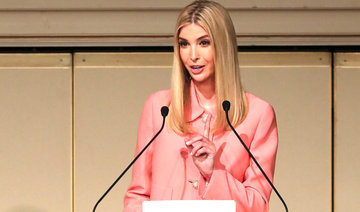
WASHINGTON: Donald Trump’s daughter and adviser Ivanka and the former UN Ambassador Nikki Haley are among possible US candidates to replace outgoing World Bank President Jim Yong Kim, The Financial Times reported Friday.
Kim abruptly announced Monday he was cutting short his tenure as the bank’s president more than three years before his second term was due to end.
In addition to Trump and Haley, who stepped down as US Ambassador to the United Nations last month, other names being floated include Treasury Undersecretary for International Affairs David Malpass and Mark Green, head of the US Agency for International Development, the newspaper reported.
Ivanka Trump in 2017 was the driving force behind a $1 billion, Saudi-supported World Bank fund to promote entrepreneurship by women.
The Treasury Department told AFP on Friday that it had no comment in potential candidates.
The department has received a “significant number of recommendations,” a spokesperson said.
“We are beginning the internal review process for a US nominee. We look forward to working with the governors to select a new leader.”
Under an unwritten agreement, the United States, which is the bank’s largest shareholder, has always chosen its leader since the institution was founded following World War II.
But the success of a US candidate no longer appears completely assured.
Kim was the first American nominee to face a contested election for the World Bank presidency in 2012 and the bank’s board has said its selection process will be “open, merit-based and transparent,” implying non-US candidates would not be ruled out.
The World Bank Board said Thursday it would start accepting nominations for a new leader early next month and name a replacement for Kim by mid-April.

Ivanka Trump among possible World Bank nominees
- Nikki Haley also in the running according to Financial Times report
Marine insurance companies are considering canceling, repricing policies in the Middle East
RIYADH: Marine insurance companies are considering canceling or repricing policies in the Middle East, according to the Financial Times
This comes after the US and Israeli strikes on targets inside Iran, followed by missile attacks and retaliatory military actions in several countries in the region.
Marine brokers expect insurance premiums for ships to rise by up to 50 percent, given the region’s classification as a “war zone.”
Ship owners are considering rerouting their vessels to avoid the Strait of Hormuz and reduce risks to crews and cargo.
20% of the global oil supply passes through the Strait of Hormuz.
Regarding oil prices, a rise is expected as 20 percent of global oil supply passes through the Strait of Hormuz, amid concerns about continued tensions in the region.
Air traffic in the Middle East was severely disrupted after several countries closed their airspace completely or partially, while regional and international airlines suspended or rescheduled flights.
On the morning of March 1st, the Iranian capital, Tehran, witnessed several large explosions following Israel's announcement of what it described as a “preemptive strike.”
Flights to countries in the region suspended due to attacks
In a video message, US President Donald Trump announced that the US had begun “major combat operations” in Iran, asserting that the goal was to defend the American people by neutralizing what he described as the “imminent threat” from the Iranian regime.
Several regional and international airlines announced the suspension of their flights to some countries in the region due to the attacks.
These military developments come at a time when major shipping companies had already avoided the Red Sea and Suez Canal routes due to security tensions, reverting to the Cape of Good Hope route, which increases shipping costs and puts pressure on global supply chains.
With the closure of airspace in several countries in the region, the risk of disruption to air traffic and trade is increasing, while oil markets are watching closely for any signs of potential supply disruptions from a region that is one of the world's most important energy production hubs.


