KARACHI: Pakistan’s federal government has decided to solicit the support of all opposition parties in order to extend the term of military courts, officials said on Friday.
“We have decided to contact all opposition parties, including the Pakistan Peoples Party (PPP) and Pakistan Muslim League-Nawaz (PML-N) for building a consensus for the passage of a bill, which requires two-thirds majority to be passed,” Information Minister Fawad Chaudhry, who is also the government’s focal person on all issues pertaining to the matter, told Arab News on Friday.
Chaudhry argued that the military courts, which were established to cope with extraordinary situations, have fulfilled their responsibility. “These courts have played a vital role in eliminating terrorism,” he said.
“However, we need two-thirds majority for the passage of the bill. So if opposition parties support the bill, it can be adopted into law,” he added.
Opposition parties said that they were awaiting details of a draft amendment bill which the government intends to present in parliament to extend the term of Pakistan’s military courts.
“We are still waiting for the details of the bill from the government’s side and once we have a draft we will deliberate whether to support or oppose it,” former Prime Minister Shahid Khaqan Abbasi told Arab News.
“The military courts have performed well and if its further need is justified, we may support the extension,” Abbasi said.
Military courts were established in January 2015 by introducing the 21st amendment to the constitution of Pakistan. Since then, they have sentenced more than 300 accused to death.
Their term was subsequently extended for two years with the 23rd constitutional amendment on January 7, 2017.
The bill had, however, received presidential assent on March 31, 2017, which gives the military courts a legal cover until March 31, 2019.
Senator Rehman Malik, former Interior Minister and central leader of the PPP, said: “The parliament will make deliberations over it and will accordingly vote in favor or otherwise.”
“When the law was passed, the country was passing through tough times,” Malik said, adding that the respective political parties will have their own deliberations to assess the present requirements for the country to further curb terrorism.
“Let us wait and see what convincing material is placed by the government before the parliament”.
Malik argues that terrorism hasn’t been completely eliminated yet. “The current incidents in Karachi, attacks on paramilitary and security forces, especially those in Balochistan, indicates that terrorism hasn’t be completely rooted out,” he said, adding that the parliament “will decide this matter in national interest keeping the past performance of the military courts.”
The party’s spokespersons, Maula Bux Chandio and Nafisa Shah, didn’t responded to queries by Arab News for further comments on the matter. However, senior leader Farhatullah Babar said that the party may not support the bill.
“At the last meeting of the central excusive committee of PPP in Naudero on December 26, 2018, the party adopted a unanimous resolution calling upon the parliament not to extend the tenure of military courts any further,” Babar told Arab News.
Moreover, the military courts, he said, were envisaged in the NAP as a short-term measure for two-years only.
“During this period the criminal justice system had to be reformed and anti-terror institutions strengthened,” he argued.
The government and the military, for their parts, reason that the courts have performed well.
“Since the establishment of the courts, 717 cases of accused terrorists were sent to military courts by the government. Of these 717 cases, 546 have been finalized by the military courts,” an ISPR statement shared with Arab News read, adding that out of the 546 finalized cases, 310 terrorists were sentenced to death, while 234 were awarded rigorous imprisonment of varied termd ranging from life imprisonment to a minimum duration of five years.
“Two accused were also acquitted,” the statement said.
Additionally, out of the 310 who were sentenced to death, 56 terrorists have been executed after the completion of legal processes, which included their appeal in superior civil courts and rejection of their mercy petitions both by the army’s top commander and by the president of Pakistan.
Implementation of the death sentences for the remaining 254 terrorists is pending completion of legal process in higher courts.


![]()

Government to seek opposition’s support for extension of military courts’ term
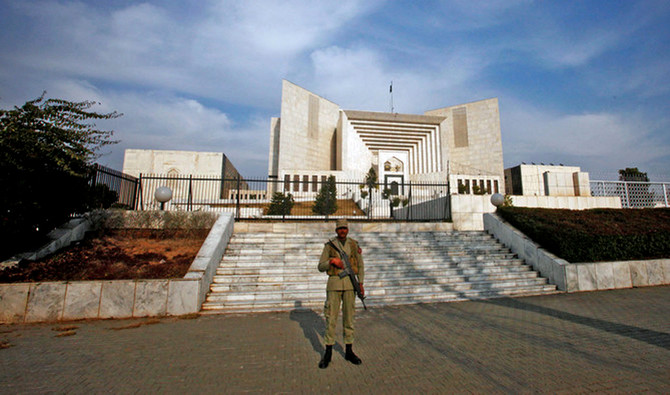
Government to seek opposition’s support for extension of military courts’ term
- Reasons that the body has fulfilled its responsibilities in war against terror
- Needs two-thirds majority to make it into a law
Latest updates


© 2026 SAUDI RESEARCH & PUBLISHING COMPANY, All Rights Reserved And subject to Terms of Use Agreement.