

Chinese consulate assault ordered by RAW, planned in Afghanistan — police chief 

In this file photo, paramilitary soldiers and police officers gather outside, after an attack on the Chinese consulate, where blasts and shots were heard, in Karachi, Pakistan Nov, 23, 2018. (REUTERS)
Updated 11 January 2019
Follow

Chinese consulate assault ordered by RAW, planned in Afghanistan — police chief 

  • Alleges five militants involved in November attack arrested today
  • Attack planned by separatist group’s head of planning and training

KARACHI: An attack by a Pakistani separatist group on the Chinese consulate in Karachi in November last year was planned in Afghanistan on the orders of India’s main spy agency, Research and Analysis Wing (RAW), a senior police official in the port city said on Friday.
Three attackers stormed the Chinese consulate in Karachi on November 23, killing four people. Security forces killed the three attackers who were carrying explosives.
“The terrorists arrested during a joint operation by the Special Security Unit (SSU) and intelligence agencies today morning have divulged that the plan to carry out terrorist attack on the Chinese consulate was prepared in Afghanistan at the behest of RAW,” Additional Inspector General Police Dr. Amir Ahmed Shaikh told Arab News.
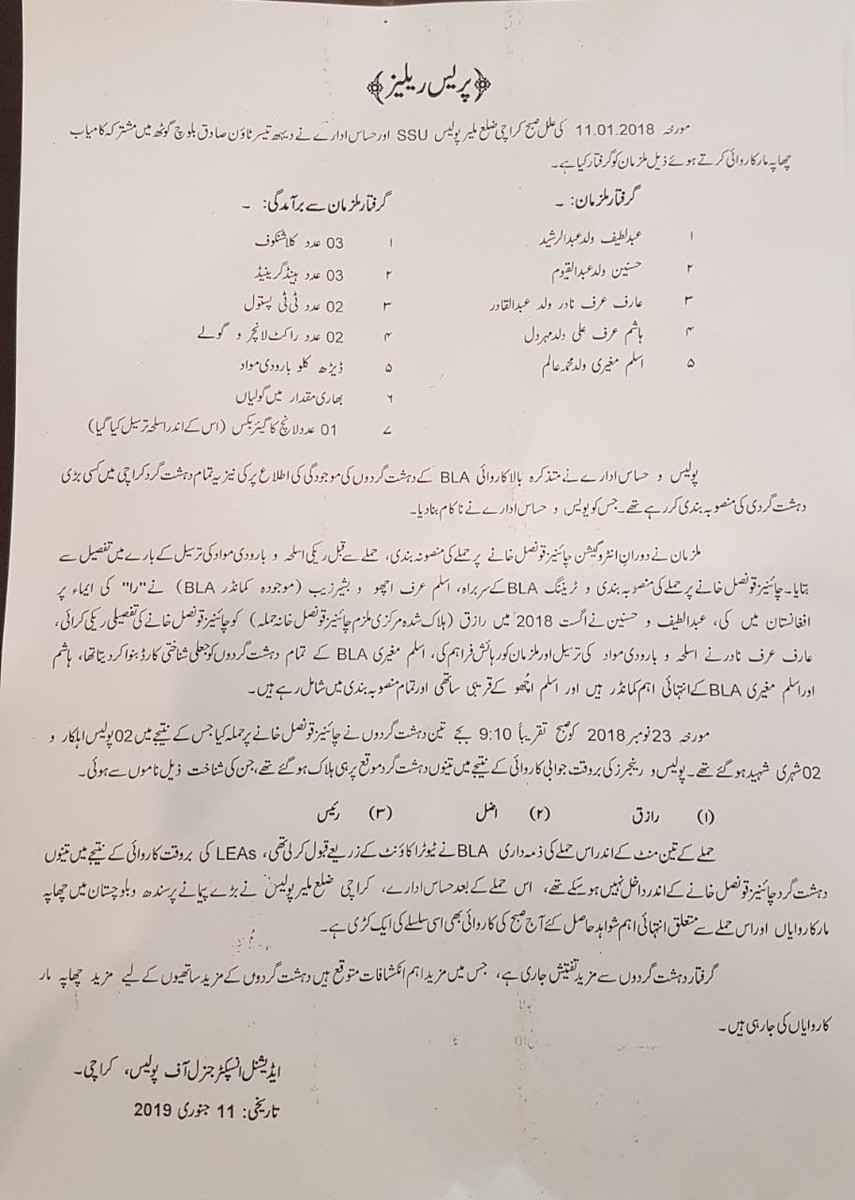


A statement by police in Karachi issued on Friday, January 11, 2019, alleging that the attack on the Chinese consulate in Karachi last November was planned in Afghanistan on the orders of India's main spy agency, Research and Analysis Wing (RAW).

Earlier, while briefing media at his office, Shaikh had said the SSU and intelligence agencies had conducted a joint raid early on Friday in the Sadiq Baloch Goth area on the outskirts of Karachi and arrested five militants associated with the Baloch Liberation Army, who he said were planning a major attack.
“Law enforcement agencies thwarted the attack,” Shaikh told reporters, giving the names of the militants and saying a huge cache of arms and ammunition was recovered from their custody. 
He alleged that during interrogation, the arrested militants had revealed that the attack on the Chinese consulate was planned by BLA’s head of planning and training, Aslam alias Acho and Basheer Zeb, the incumbent commander of the BLA, on the orders of the Indian spy agency. The reconnaissance was conducted in Aigust 2018 by Razzaq, one of the militants killed during the attack, explosives were provided by Arif alias Nadir, while Aslam Mugheri had helped the attackers obtain fake identity cards.
“Mugheri is an important commander of BLA and a close aide of Aslam Acho, who had been involved in the entire planning,” Shaikh said.
The Baloch Liberation Army is a separatist group that opposes projects linked to China’s Belt and Road infrastructure initiative in the resource-rich Baluchistan province. The group confirmed the death of Aslam Baloch and five others in a statement last month. 


Rating firm S&P says it won’t rush Iran war downgrades, sees risks for countries like Pakistan

Updated 12 March 2026
Follow

Rating firm S&P says it won’t rush Iran war downgrades, sees risks for countries like Pakistan

  • Agency says it is monitoring indebted energy importers as higher oil prices strain finances
  • Gulf economies seen better placed to weather shock, though Bahrain flagged as vulnerable

LONDON: S&P Global ‌said it would not make any knee-jerk sovereign rating cuts following the outbreak of war in the ​Middle East, but warned on Thursday that soaring oil and gas prices were putting a number of already cash-strapped countries at risk.

The firm’s top analysts said in a webinar that the conflict, which has involved US and Israeli strikes ‌against Iran and Iranian ‌strikes against Israel, ​US ‌bases ⁠and Gulf ​states, ⁠was now moving from a low- to moderate-risk scenario.

Most Gulf countries had enough fiscal buffers, however, to weather the crisis for a while, with more lowly rated Bahrain the only clear exception.

Qatar’s banking sector could ⁠also struggle if there were significant ‌deposit outflows in ‌reaction to the conflict, although there ​was no evidence ‌of such strains at the moment, they ‌said.

“We don’t want to jump the gun and just say things are bad,” S&P’s head global sovereign analyst, Roberto Sifon-Arevalo, said.

The longer the crisis ‌was prolonged, though, “the more difficult it is going to be,” he ⁠added.

Sifon-Arevalo ⁠said Asia was the second-most exposed region, due to many of its countries being significant Gulf oil and gas importers.

India, Thailand and Indonesia have relatively lower reserves of oil, while the region also had already heavily indebted countries such as Pakistan, Bangladesh and Sri Lanka whose finances would be further hurt by rising energy prices.

“We ​are closely monitoring ​these (countries) to see how the credit stories evolve,” Sifon-Arevalo said.