ISLAMABAD: There are indications Pakistan was pushing the Taliban to enter into direct talks with the Kabul government to resolve a conflict in Afghanistan now dragging into its seventeenth year, the head of Afghanistan’s High Peace Council said on Wednesday in comments that marked a break from long-time accusations Islamabad was not doing enough to advance peace in the neighboring country.
US and Afghan officials have long been pushing Pakistan to lean on Taliban leaders, who they say are based inside Pakistan, to bring them to the table for talks. Pakistani officials deny offering safe havens to the Afghan Taliban and say their influence on the group has waned over the years.
The Taliban have so far refused direct talks with the Kabul government which they see as an illegitimate, foreign-appointed regime, and consider their main adversary to be the US, which invaded the country in 2001 and toppled their rule.
When asked if Pakistan was playing its role to push the Taliban to establish contact with the Kabul government, Umar Daudzai, who holds additional charge as President Ashraf Ghani’s special adviser on reconciliation affairs, told Arab News in an exclusive interview: “They [Pakistan] say that and there are signs that they are doing it.”
Daudzai landed in Islamabad for wide-ranging talks on Tuesday amid an intensification of peace efforts by the US and other regional powers to seek a negotiated settled to the conflict between the Afghan government and the insurgency.
The urgency of the latest round of peace efforts comes partly out of panic generated by reports last month that US President Donald Trump’s planned to withdraw 5,000 of the 14,000 troops from Afghanistan, triggering uncertainty over how the US would carry on training Afghan forces and waging an air campaign against militant groups, in the absence of which a resurgent Taliban would get an opportunity to expand its offensives across Afghanistan.
But Daudzai denied that the withdrawal of US troops would have a serious impact on the security situation.
“I don’t think it has great impact because we have now fully developed the Afghan National Security Forces that is between 350, 000 to 400, 000 [troops],” he said. “If President Trump had made such announcement in 2012, it might have caused some worries but now we have well-trained Afghan National Security Forces. The only thing that is still needed to be developed is our air power.”
The Taliban have strengthened their grip over Afghanistan in the past three years and according to one US government report, the government in Kabul controls just 56 percent of the country’s territory, down from 72 percent in 2015.
US Special Representative for Afghanistan Reconciliation, Zalmay Khalilzad, has recently held three rounds of peace talks with the Taliban. A fourth round of talks with US officials in Qatar this week was called off by the Taliban due to an “agenda disagreement” over the involvement of Afghan officials.
“They don’t talk to us directly; we want to talk to them directly,” Daudzai said.
When asked if his government was in touch with the Taliban, he said: “Indirectly. Informal, indirect yes,” adding that due to changes within the thinking of the Taliban, mostly due to international exposure and the impact of social media, he was hopeful that the prospects for peace were stronger than ever before.
“There are layers [within the Taliban] that are rethinking the whole situation,” Daudzai said. “Still there are people that are fanatics, that want to continue fighting but there is also a positive thinking between them … They are more exposed to the world outside by and through media. Social media has [had a] great impact on Taliban thinking.”
When asked if a meeting this week between US officials and the Taliban in Saudi Arabia would take place, Daudzai said: “Unless they [Taliban] agree to meet with the Afghan government face to face, that kind of meetings may be difficult to be continued.”
But the special envoy was hopeful of a breakthrough in talks this year: “We have declared that 2019 should be the year of peace in Afghanistan. Within 2019, InshAllah (god willing), we will reach to a final peace deal.”
The State Department has announced that Khalilzad would lead an interagency delegation to India, China, Afghanistan, and Pakistan in January to meet senior government officials in each country “to facilitate an intra-Afghan political settlement”.
It said Khalilzad continued to coordinate his efforts with Afghan President Ashraf Ghani, Chief Executive Abdullah Abdullah, and other Afghan stakeholders.
Other than the United States, China, Russia and Iran have also engaged in talks with the insurgency. The Taliban attended landmark peace talks in Moscow last November while Taliban representatives from Afghanistan negotiated with Iranian officials in Tehran in December. Several rounds of meetings have also been held in Beijing.
Daudzai welcomed the “multiplicity” of the peace effort but said all parties needed better coordination to create consensus at the national, regional and international levels. He denied that Kabul was being marginalized in the peace process and said all countries pursuing negotiations were briefing the government every step of the way.
“They are coordinating with us and they are taking our permission,” he said, referring to meetings between the Taliban and representatives from the US, Russia and Iran.
“All initiatives should be done in consultation, in conjunction, with the legitimate state of Afghanistan. So if we have that driving seat, then okay, that’s not a problem,” Daudzai said. “Somebody can sit in the front row and somebody can sit in the back row but they all are on the same bus with one driver. But if that leadership of the Afghan state is not recognized and is not given value, then we may face a serious challenge.”


![]()
![]()

‘Signs’ Pakistan pushing Taliban for direct contact with Kabul — Daudzai
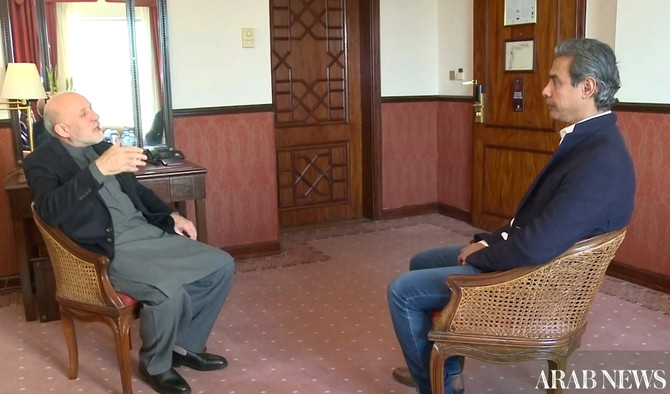
‘Signs’ Pakistan pushing Taliban for direct contact with Kabul — Daudzai
- Says Kabul in “informal, indirect” contact with Taliban
- Denies US troop withdrawal would have “great impact” on security situation


Latest updates


© 2026 SAUDI RESEARCH & PUBLISHING COMPANY, All Rights Reserved And subject to Terms of Use Agreement.