

Film Review: Girls of the Sun — A female Kurdish battalion gives Daesh a drubbing

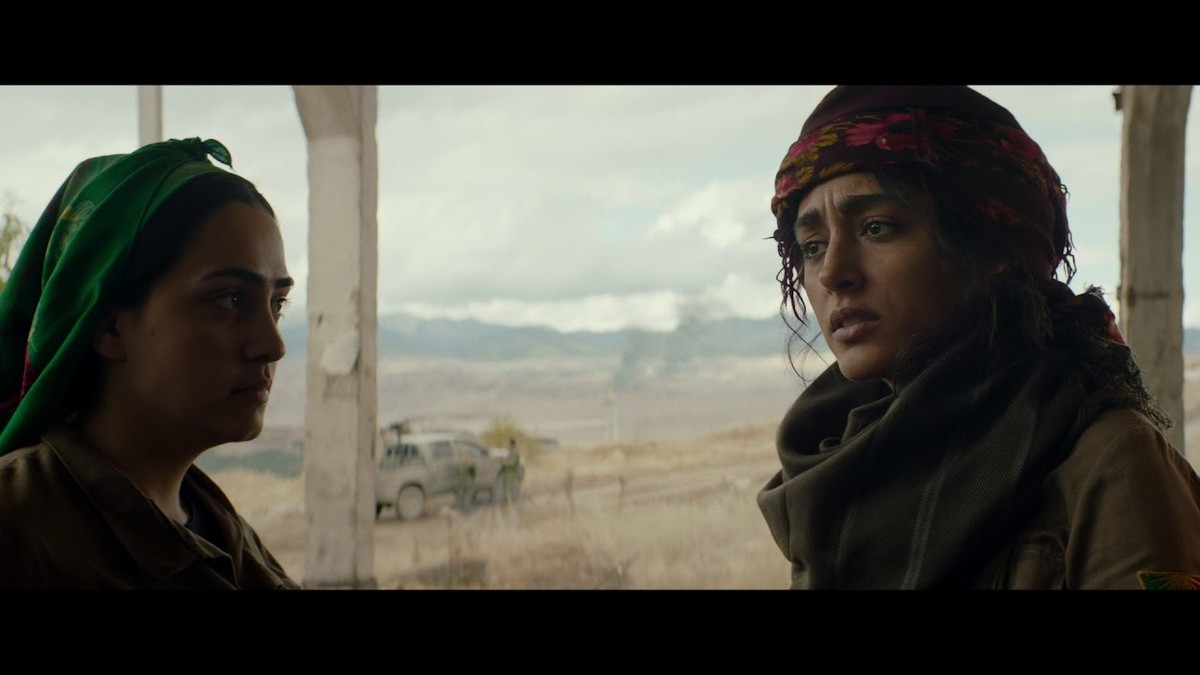
A still from the film 'Girls of the Sun'. (Supplied)
Updated 09 January 2019
Follow

Film Review: Girls of the Sun — A female Kurdish battalion gives Daesh a drubbing

  • 'Girls of the Sun' is a war drama
  • The film is a fictional story based on a true story

CHENNAI: Eva Husson’s war drama “Girls of the Sun” is hitting movie theaters just as the world’s attention is once again focused on northern Iraq, where this fictional story, based on a true story, is set. It also comes as Hollywood, under attack for underrepresentation of women in the industry, is trying to stamp out gender inequality.

With the exiled Iranian actress Golshifteh Farahani in the role of Bahar, commander of a Kurdish unit battling Daesh, “Girls of the Sun” is a paean to the courage and never-say-die attitude of a band of female combatants. From a bored but extremely patient wife in “The Patience Stone” to a Rajasthani woman in “The Song of Scorpions,” Farahani has a brilliant range.

In “Girls of the Sun” Bahar and her comrades take advantage of a male jihadi superstition that death at the hands of a woman will push them straight into hell. A university graduate from Iraq and once a lawyer by profession, Bahar was sold into virtual slavery, her husband murdered and her young son sent away to be trained as a rebel soldier.

Another strong female character is Mathilde (Emmanuelle Bercot), a French war reporter who lost an eye in a conflict zone and has landed in Iraq – a character obviously modelled on American journalist Marie Colvin who died covering the siege of Homs in Syria in early 2012. A film based on Colvin’s life, “A Private War,” has since been made.
French director Husson, the granddaughter of Spanish Republican soldiers, is believed to have written “Girls of the Sun” to explore the theme of resistance against fascist oppression. The message is decidedly feminist, the script is powerful and the action sequences are true to life.

According to one study, women accounted for just 8 percent of directors of the 250 highest-grossing Hollywood films made in 2018. The overall percentage of women in behind-the-scenes movie roles rose to a paltry 20 percent from 18 percent in 2017. “Girls of the Sun,” which competed for the Palme d’Or at the 2018 Cannes Film Festival, marks a step by Hollywood in the right direction.


At Jazan festival, Suad Al-Asiri paints memory, land and leadership

Updated 13 January 2026
Follow

At Jazan festival, Suad Al-Asiri paints memory, land and leadership

  • Local artist channels personal hardship into works that reflect Jazan’s identity, heritage
  • Jazan: A Nation and a Prince, places region at the heart of a composition featuring Prince Mohammed bin Abdulaziz and Prince Nasser bin Mohammed bin Abdullah bin Jalawi

RIYADH: At the Ahad Al-Masarihah pavilion at Jazan Festival 2026, Suad Al-Asiri’s paintings blend memory, place and personal history, offering visual narratives shaped by beauty and hardship. 

A novelist and visual artist, Al-Asiri has long used art as a storytelling tool. After a near-fatal car accident in March 2024, her work took on a new urgency. Bedridden for 11 months, cut off from the public world for more than a year, she describes that period as one of the most painful in her life — yet also transformative. 

“First of all, praise be to God for granting me life, as the accident was extremely severe,” she said. “By God’s grace, I was given a new life. All my thinking after the accident was about becoming an inspiration to others — about enduring pain and obstacles, and still leaving an impact.” 

Her return to public life came in 2025, when she participated in National Day celebrations with the ministry of interior. By the time she arrived at Jazan Festival, she was ready to channel that experience into her art. 

The centerpiece of her display, “Jazan: A Nation and a Prince,” places the region at the heart of a composition featuring Prince Mohammed bin Abdulaziz and Prince Nasser bin Mohammed bin Abdullah bin Jalawi, governor and deputy governor of Jazan respectively. 

Visitors linger over the details: the painting incorporates coffee beans, sesame and khudair — materials drawn from local products.

“I wanted people to recognize these products immediately,” she said. “They are part of Jazan’s daily life, and using them makes the work more tangible, more connected to everyday experience.” 

The painting sparks conversation. Visitors discuss leadership, identity, and the intimate relationship between people and their environment. 

Beyond the central piece, Al-Asiri presents individual portraits of the two princes, expanding the dialogue into a broader exploration of heritage and memory.  

Her journey into art is tied to her life as a storyteller. Early experiments with charcoal and pencil evolved into abstract art, drawn by its expressive freedom. 

From there, she explored realism, surrealism, and eventually modern art, particularly pop art, which has earned her wide recognition in artistic circles. Her novels and media work complement her visual practice, earning her the title “the comprehensive artist” from the governor.

Yet what stands out most in this exhibition is how Al-Asiri’s personal resilience flows through each piece. Her experience of surviving a devastating accident, enduring months of immobility, and returning to the public eye informs every brushstroke. 

Visitors sense not just her artistic skill, but her determination to turn life’s hardships into inspiration for others. 

Walking through the pavilion, one can see it in the way she blends heritage symbols, southern landscapes, and scenes of daily life. 

Each painting becomes both a document and a dialogue — a celebration of Jazan’s culture, a reflection on identity, and a testament to the power of human perseverance. 

At Jazan Festival 2026, Suad Al-Asiri’s art is a quiet, persistent inspiration for anyone who pauses long enough to listen.