Army establishes medical camps in Pakistan’s drought-hit Tharparkar

1 / 4
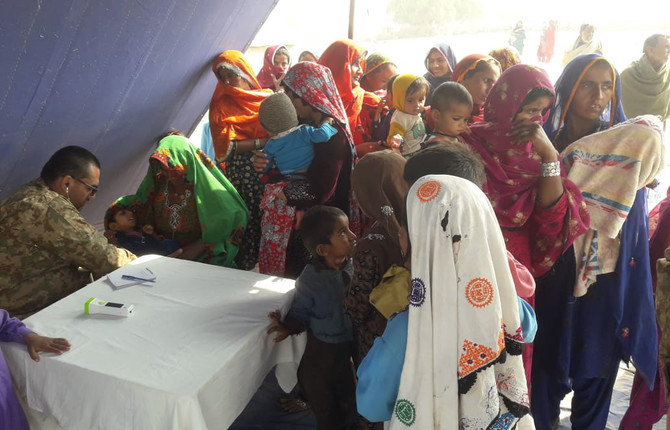
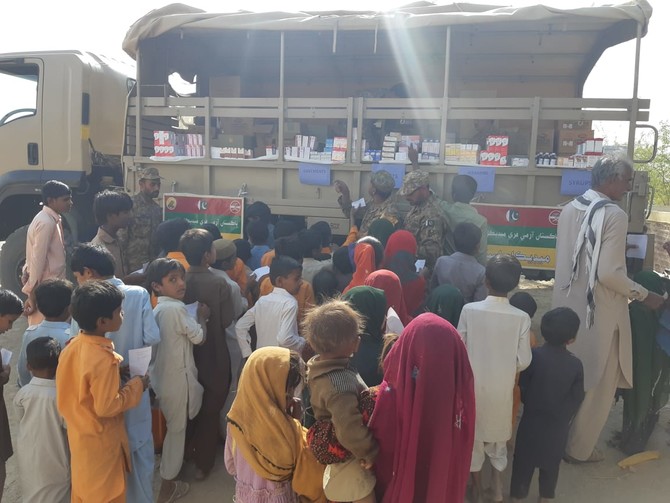
Pakistan Army established a three-day free medical camp to help the drought-hit Tharparkar district. (Photo courtesy: ISPR)
2 / 4
Army doctors and paramedics provided essential medical treatment to over 1700 patients during the medical camp on the first day. (Photo courtesy: ISPR)
3 / 4
Drought in the areas for the last several years has badly affected the livelihood. (Photo courtesy: ISPR)
4 / 4
Team of doctors included physicians, ENT specialists, dental surgeons, and gynecologists. (Photo courtesy: ISPR)
Updated 08 January 2019
Follow

Army establishes medical camps in Pakistan’s drought-hit Tharparkar

  • More than 1,700 patients treated on the first day of the initiative
  • District in southern Sindh has been facing water scarcity issues for the past several years

ISLAMABAD: With an aim to help residents in the drought-hit region of Sindh’s Tharparkar district, the Pakistan Army established a three-day free medical camp which began on Monday, the military’s media wing Inter-Services Public Relations (ISPR) said.
“Army doctors and paramedics provided essential medical treatment to more than 1,700 patients during the medical camp,” the ISPR said on Monday, adding that the “team of doctors included physicians, ENT specialists, dental surgeons and gynecologists.”
Situated in Pakistan’s southern Sindh province, Tharparkar has been facing persistent drought for the past several years which has had an adverse impact on the livelihood of the people.
Thar has a population of 1.6 million, as per the 2017 census.
On December 11, 2018 Pakistan’s Chief Justice Saqib Nisar, accompanied by Chief Minister Sindh Murad Ali Shah and other top officials, visited the drought-stricken areas where he urged authorities to expedite efforts in providing clean drinking water and health facilities to the residents.
Last year in October, the Sindh Government had launched a nutrition program for 50,000 families to cope with the rising number of infant deaths in the district.
“The situation in Tharparkar is an example of how bleak things may become in other parts of the country in case adequate water management measures are not adopted. In order to improve the groundwater levels and recharge our aquifers, we need to build more dams,” Pakistan President Dr. Arif Alvi had said in October while addressing a two-day international symposium on “Creating A Water-Secure Pakistan” in Islamabad.


Pakistan, Indonesia sign MoUs to expand cooperation as Islamabad seeks to ease trade imbalance

Updated 4 sec ago
Follow

Pakistan, Indonesia sign MoUs to expand cooperation as Islamabad seeks to ease trade imbalance

  • Pakistan offers to send doctors and medical experts to support Indonesia’s expanding health needs
  • Indonesian president highlights close foreign policy coordination with Pakistan, including on Gaza

ISLAMABAD: Pakistan and Indonesia signed seven memoranda of understanding on Tuesday to deepen cooperation in trade, education and health, with Prime Minister Shehbaz Sharif saying Islamabad aimed to narrow a $4.5 billion bilateral trade imbalance heavily tilted in Jakarta’s favor.

The agreements were concluded during Indonesian President Prabowo Subianto’s two-day visit to Pakistan, his first trip to the country since taking office and the first by an Indonesian head of state in seven years.

Subianto, who arrived on Monday, held detailed talks with Sharif before the signing ceremony.

“Our discussion has been extremely productive,” Sharif said at a joint media appearance. “More than 90 percent of our current imports from Indonesia are palm oil. We have discussed how to take corrective measures to balance this through Pakistan’s agri-exports, IT-led initiatives and other areas.”

Sharif earlier noted Pakistan’s bilateral trade with Indonesia stood at around $4.5 billion, with the imbalance overwhelmingly in Jakarta’s favor.

Subianto thanked Pakistan for what he called an exceptionally warm welcome, noting his aircraft had been escorted by Pakistan Air Force JF-17 fighter jets.

He said the meeting had produced agreements across several fields, including trade, agriculture, education and science and technology.

The Indonesian president also welcomed Pakistan’s offer to help his country address critical shortages of medical professionals.

“Indonesia has vast needs for doctors, dentists and medical experts, and Pakistan’s support in this regard is strategic and critical,” he said.

Sharif noted Pakistan would be ready to send doctors, dentists and medical professors to assist Indonesia’s plans to expand its medical colleges and universities.

He added that Islamabad would “work closely and diligently” with Jakarta to achieve the targets set during the visit.

Subianto said both countries were also coordinating closely on foreign policy, particularly on developments in Gaza, and reaffirmed Indonesia’s support for a two-state solution.

He invited Sharif to visit Jakarta to deepen cooperation under the new agreements.

Pakistan and Indonesia marked the 75th anniversary of diplomatic ties this year, with both leaders saying the visit would help lift relations to what Sharif called “a much higher level” in trade, development and people-to-people links.