

UAE gives the green signal for $200mn projects in Pakistan

Prime Minister Imran Khan with the Crown Prince of Abu Dhabi and Deputy Supreme Commander of the United Arab Emirates (UAE) Armed Forces, Sheikh Mohammed bin Zayed Al Nahyan, who arrived in Islamabad for an official visit on Sunday. (Photo courtesy: APP)
Updated 06 January 2019
Follow

UAE gives the green signal for $200mn projects in Pakistan

  • Initiative aims to cover five sectors namely education, healthcare, water, infrastructure, and agriculture
  • Will also include construction of the first date factory in the country

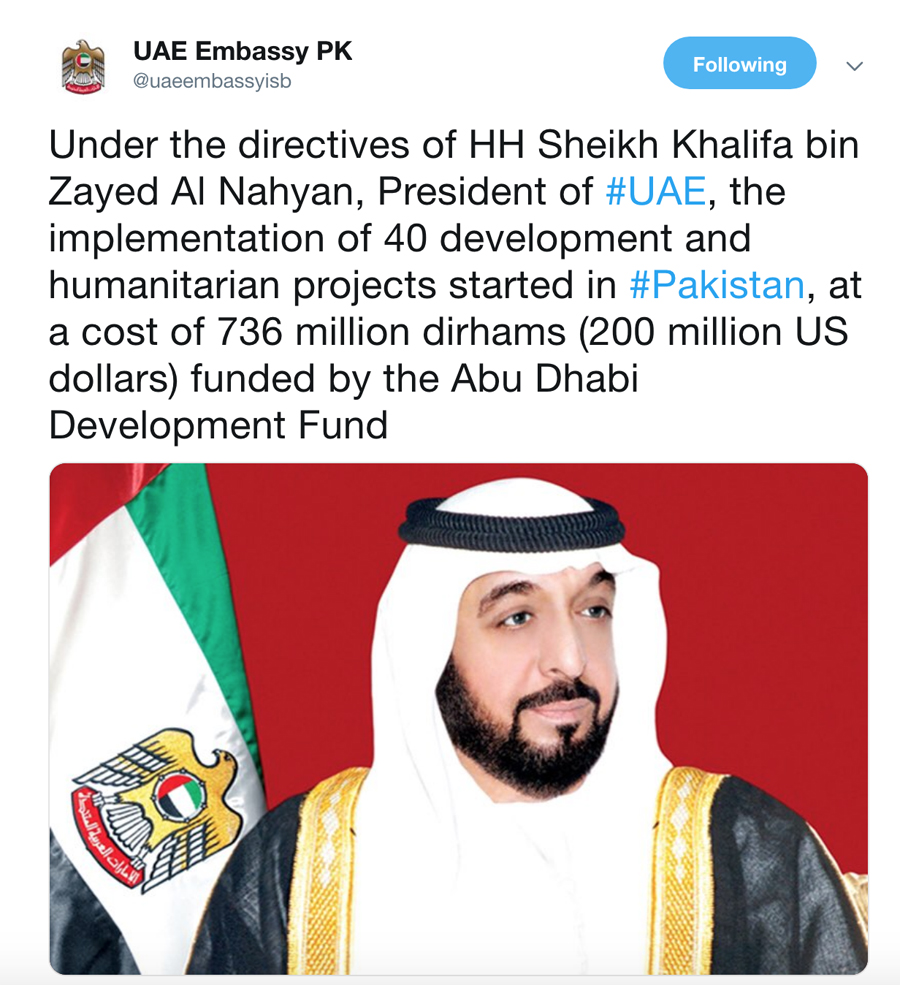
ISLAMABAD: The implementation of 40 development and humanitarian projects as part of a $200 million initiative launched by the UAE and Pakistan has already started in the country, officials said on Sunday.

Titled the UAE-Pakistan Assistance Program (UAE-PAP), the project aims to ensure the development of five main sectors, including infrastructure, education, healthcare, water, and agriculture.

“Under the latest directives issued by Abu Dhabi Crown Prince Sheikh Mohammed bin Zayed Al Nahyan, the implementation of the projects has begun in Pakistan at a cost of $200 million,” the UAE Embassy in Pakistan tweeted on Sunday.

It added that the project, which is “funded by the Abu Dhabi Development Fund” will also provide “food assistance to poor families and displaced people, as well as anti-polio vaccination campaigns”.
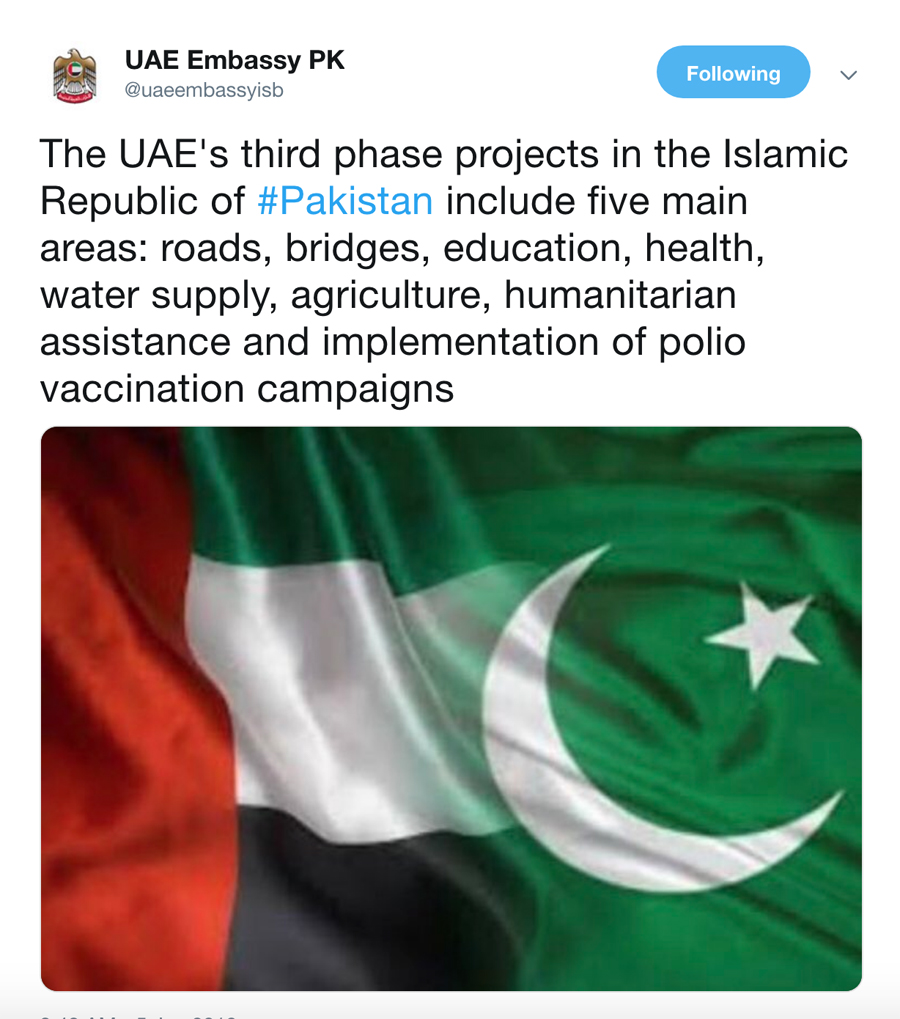
Among the several initiatives to be undertaken by the UAE-PAP will be the construction of the 42-kilometer Khyber-Pakhtunkhwa highway, a 65-kilometer highway in Balochistan, construction of one college and two schools for 1,500 students in Balochistan, and the construction of a cardiac hospital in Quetta.

Additionally, nearly 29 projects are being dedicated to ensuring the steady supply of water to villages and cities that have limited access to clean drinking water. The projects will also include the construction of the first date factory in Pakistan.

The UAE-PAP’s mission is to execute development projects that offer sustainability and continuous benefits to residents in the long run. The program’s first and second phase saw a total of 165 projects being implemented between 2011 and 2017, at a total cost of $420 million.
Alongside developmental projects, more than 371.1 million units of polio vaccines have been provided to more than 57 million children between 2014 and December 2018, as part of an anti-polio drive launched by the UAE-PAP across the country.

The campaign is being implemented in several parts of the country with the support of more than 96,000 workers, including doctors and nurses, and more than 25,000 team members.


Pakistani president arrives in Iraq to deepen trade, energy cooperation

Updated 20 December 2025
Follow

Pakistani president arrives in Iraq to deepen trade, energy cooperation

  • Visit follows recent high-level contacts as Islamabad seeks to expand limited commercial ties with Baghdad
  • Talks are expected to cover investment, manpower and facilitation of Pakistani pilgrims visiting holy sites in Iraq

ISLAMABAD: President Asif Ali Zardari arrived in Iraq on Saturday on an official visit aimed at expanding cooperation in trade, energy and investment, as Pakistan seeks to deepen ties with Baghdad after years of limited engagement.

Pakistan and Iraq established diplomatic relations in 1947 and have traditionally maintained cordial ties, though commercial links remain modest, with officials and business groups identifying scope for cooperation in construction services, pharmaceuticals, manpower and agricultural exports.

“President Asif Ali Zardari arrived in Baghdad on a four-day official visit to Iraq,” his office said in a post on X. “He was received by Culture Minister Dr. Ahmed Fakkak Al-Badrani. During the visit, meetings with senior Iraqi leadership are expected to advance cooperation and further strengthen Pakistan-Iraq relations.”

Zardari’s visit follows a series of recent high-level contacts between the two countries, reflecting efforts to broaden bilateral engagement beyond traditional diplomatic ties and explore collaboration across economic, political and people-to-people domains.

According to Pakistan’s foreign office, the president is expected to hold meetings with Iraq’s senior leadership to discuss cooperation in various areas such as trade and investment, energy, technology, education and manpower.

He is also expected to discuss regional and international issues with Iraqi officials.

Earlier this month, Pakistan’s Interior Minister Mohsin Naqvi met his Iraqi counterpart, Abdul Ameer Al-Shammari, on the sidelines of meetings in Brussels, where both sides agreed to enhance cooperation on security and facilitate travel for Pakistani Shia pilgrims to Najaf and Karbala.

The two officials discussed measures to ensure the smoother movement of these pilgrims and their compliance with visa regulations.